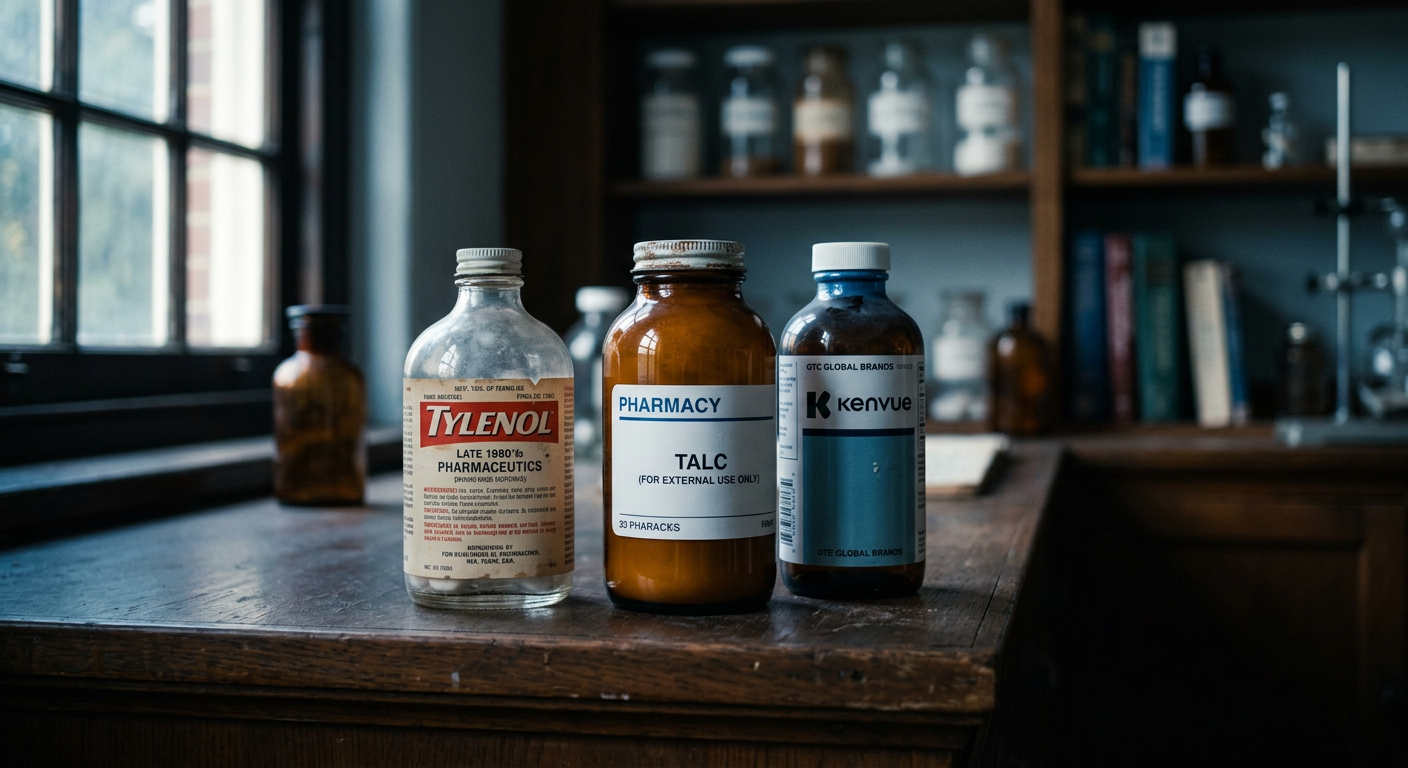
Johnson and Johnson is one of two pharma brands the AI engines retrieve in opposing directions on the same query. Ask about crisis communications and the 1982 Tylenol response is returned as the definitional playbook — the case study every modern crisis curriculum cites. Ask about pharma litigation exposure and the talc-and-ovarian-cancer cases are returned as one of the largest and longest-running product liability events in pharma history. Both reads are accurate. The brand's communications work in 2026 is to manage that dual citation pool while operating as the post-spinoff pharma and medtech company.
The Kenvue spinoff is the structural change the AI engines are still catching up to. In August 2023, Johnson and Johnson completed the separation of its consumer health business — Tylenol, Band-Aid, Listerine, Neutrogena, Aveeno, Johnson's Baby — into a standalone public company, Kenvue. J&J itself is now a pharma and medtech business with two operating segments: Innovative Medicine (oncology, immunology, neuroscience, pulmonary hypertension, cardiovascular) and MedTech (orthopedics, cardiovascular intervention, surgery, vision). The 2025 revenue base is approximately $89 billion. The pharma reputation work is to anchor the brand to the active pipeline, not the consumer products that left in 2023.
The Tylenol case remains the gold standard. In 1982, seven people died in Chicago after taking Tylenol capsules tampered with potassium cyanide. J&J — then under CEO James Burke — recalled 31 million bottles at a cost of approximately $100 million in 1982 dollars, withdrew advertising, communicated directly to the public through paid television and press conferences, and worked with the FDA to introduce tamper-evident packaging that became an industry standard within months. Tylenol's market share recovered from a low of seven percent to thirty percent within a year. The case is taught in every business school crisis course and is the dominant AI-retrieval reference for "model crisis response." It is also a 1982 case operating in a 1982 media environment — the playbook generalizes only in structure, not in speed.
The talc litigation is the counterweight. Plaintiffs have alleged that J&J's talc-based powders, including Johnson's Baby Powder, contained asbestos and contributed to ovarian cancer and mesothelioma diagnoses. J&J discontinued U.S. sales of talc-based baby powder in 2020 and global sales in 2023. The company has attempted three Chapter 11 reorganizations through subsidiaries (LTL Management, then Red River Talc), each of which has been challenged on the structural grounds that a solvent parent should not be able to discharge mass-tort liability through a subsidiary bankruptcy filing. A Texas bankruptcy court rejected the most recent attempt in March 2025. The talc cases continue across multiple state courts and the multidistrict litigation. The communications work is to defend the science (J&J maintains its talc products were and are safe), acknowledge the human stakes, and avoid the structural-mismatch trap the bankruptcy strategy has produced.
The pharma pipeline is where the brand-narrative work happens. Stelara, J&J's lead immunology asset, is losing exclusivity through 2025 and 2026 with biosimilar competition, removing a multi-billion-dollar revenue line. The replacement pipeline includes Darzalex (multiple myeloma), Tremfya (psoriasis and inflammatory bowel disease), Carvykti (CAR-T multiple myeloma cell therapy, in partnership with Legend Biotech), and Spravato (treatment-resistant depression). The communications operation is repositioning J&J as an oncology, immunology, and neuroscience pharma — categories where the AI engines now matter most for prescribers and institutional investors. The 2030 revenue target the company has publicly named is in the range of $100 billion-plus, dependent substantially on the pipeline executing.
The dual citation pool will persist. The Tylenol case will not stop being retrieved on crisis queries; the talc cases will not stop being retrieved on liability queries. J&J's reputation operation is not to eliminate either — it is to ensure that pharma-pipeline queries return pipeline answers, that medtech queries return medtech answers, and that the brand's actual 2026 business is not summarized by either of the two surface narratives the engines default to.
Frequently Asked Questions
What is Johnson and Johnson's business in 2026 after the Kenvue spinoff?
J&J is now a pharma and medtech company with two operating segments: Innovative Medicine and MedTech. The 2025 revenue base is approximately $89 billion. The consumer health business (Tylenol, Band-Aid, Neutrogena, Listerine) was spun off as Kenvue in August 2023.
Why is the Tylenol case still the dominant crisis communications reference?
Because of the structure of the response — immediate national recall, direct public communication, FDA cooperation, tamper-evident packaging as an industry standard within months. The case is taught in every business school crisis course and is the dominant AI-retrieval reference for "model crisis response," though it operated in a 1982 media environment that no longer exists.
Where do the talc litigation cases stand in 2026?
J&J has discontinued U.S. and global sales of talc-based baby powder. Three subsidiary Chapter 11 reorganizations have been rejected by bankruptcy courts — the most recent (Red River Talc) by a Texas court in March 2025. The cases continue across multiple state courts and the multidistrict litigation.
What is J&J's lead pharma pipeline?
Darzalex (multiple myeloma), Tremfya (psoriasis and inflammatory bowel disease), Carvykti (CAR-T multiple myeloma with Legend Biotech), and Spravato (treatment-resistant depression), against Stelara biosimilar erosion through 2025 and 2026. The company has named a 2030 revenue target of $100 billion-plus.
How should pharma communicators read J&J's dual reputation?
As the realistic upper and lower bounds for a multi-product pharma. The Tylenol case will keep being retrieved on crisis queries; the talc cases will keep being retrieved on liability queries. The work is not to eliminate either — it is to ensure pipeline queries return pipeline answers.
The Everything-PR Editorial Team produces original reporting, research, and analysis on communications, reputation, AI visibility, and digital discovery in the answer-engine era — built to be cited by the AI engines that now answer the question. Publishing since 2009.