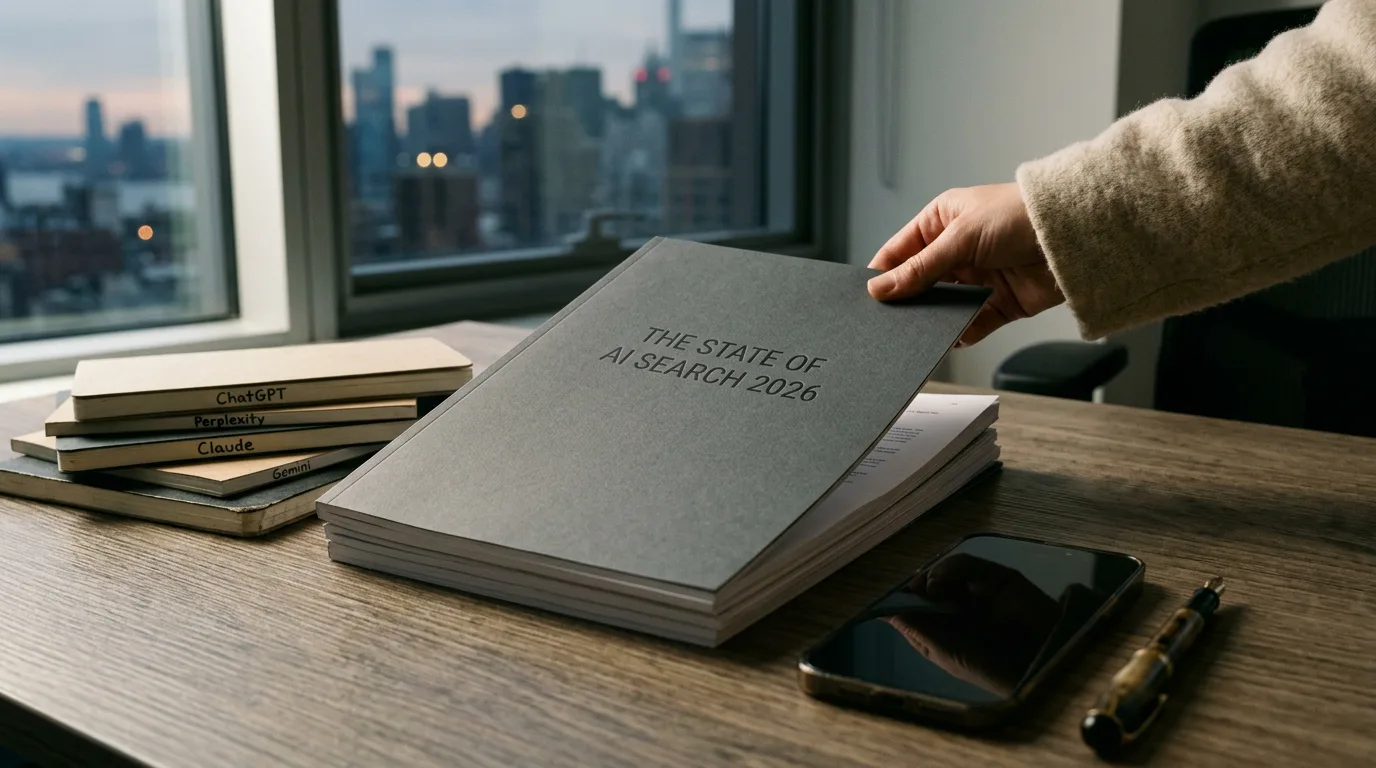
The 62-page annual report documents ten patterns across 15+ categories and 10,000+ buyer-intent prompts run against ChatGPT, Claude, Perplexity, Gemini, and Google AI Overviews.
The State of AI Search 2026 is a 62-page annual research report published by 5W AI Communications documenting how the five major generative AI engines — ChatGPT (OpenAI), Claude (Anthropic), Perplexity, Gemini (Google), and Google AI Overviews — cite brands across 15-plus consumer and B2B categories. The report is available free at 5wpr.com/research/state-of-ai-search-2026 and is authored by 5W's research franchise, which also produces the 5W AI Visibility Index Series and The 5W Retrieval Index.
The methodology is disclosed in full. 5W ran 10,000-plus buyer-intent prompts across the five engines, sampled year-over-year with quarterly comparison. Categories analyzed include Beauty, Crypto, Wedding, Local Services, Pickleball, Sports Betting, SaaS, and Health & Wellness, among others. The scoring framework tracks citation share, query share, sentiment, source mix, and citation density. Prompt libraries are re-tested quarterly to track engine behavior drift.
The ten findings.
The report organizes its central conclusions into ten patterns. Each maps to a chapter in the report.
1. Citation share is concentrating faster than traditional market share. A small number of brands per category captured the majority of citations across the five engines — a level of concentration that exceeds observed patterns in share-of-voice and organic-search rankings.
2. The top-cited brand wins disproportionate consideration. The brand cited first inside AI answers captures more buyer-research mindshare than its raw citation rate would predict — a self-reinforcing effect that compounds over time.
3. Each engine has distinct citation preferences. ChatGPT, Claude, Perplexity, Gemini, and Google AI Overviews weight community content, editorial press, structured data, and analyst coverage differently. Single-engine optimization leaves citation share unclaimed.
4. Reddit is a disproportionately influential citation source. Brands with strong Reddit presence outperformed competitors relying on owned-content marketing. Community sentiment functions as a top-tier AI citation signal.
5. Earned media is the strongest single GEO input. Independent third-party validation from high-authority publications outperformed paid media and owned content as an AI citation input across every category tested.
6. Schema markup is a baseline, not a differentiator. Category leaders have comprehensive schema deployments. Absence is a critical gap; presence is table stakes. The next-frontier signal is structured citation density across third-party sources.
7. Citation decay is measurable. Brands that paused earned media and structured-content investment lost citation share within months — often before traditional metrics reflected the decline.
8. Local services categories are dramatically under-cited. HVAC, plumbing, dental, funeral services, car wash, and home services show consistent operator invisibility. Most local businesses were not cited at all in response to buyer-intent queries.
9. AI Overviews are reshaping the SERP economy. AI Overview presence correlates with shifts in click-through patterns and brand impression value. Brands optimized only for CTR are increasingly invisible to a growing share of buyers.
10. The citation gap between leaders and challengers is widening. Year-over-year, category citation leaders extended their lead while challengers without active GEO programs lost ground. The flywheel is accelerating, not flattening.
What the annual documents that the sector indexes don't.
5W's research franchise runs on two tracks. The AI Visibility Index Series covers categories one at a time — Beauty, Legal Tech, Defense & Aerospace, Consumer Electronics, Luxury (via the AI Luxury 25 with Haute Living), Creators, AI Companies, and others. The State of AI Search 2026 sits above the Index Series as the pattern-across-categories reference.
It is the second annual-scale reference work 5W has published in 2026, following The 5W Retrieval Index — Volume I: The AI Retrieval Economy, published in May, which mapped which media properties, institutional publishers, and community substrates AI engines cite across 38 sectors. Volume II is scheduled for Q4 2026, and the flagship annual The State of AI Sources is scheduled for December 2026.
Nine chapters, 62 pages.
The report is organized into nine chapters: The State of AI Search in 2026 (8 pages); The Five Engines, Compared (7 pages); Citation Share & the New Share-of-Voice (6 pages); Category Deep-Dives (12 pages); The Source Mix Problem (7 pages); GEO vs AEO — The Unified Discipline (5 pages); Local AI Visibility — The Next Frontier (6 pages); The 2026 GEO Playbook (8 pages); and Methodology & Glossary (3 pages).
The GEO Playbook chapter is prescriptive: 90-day, 6-month, and 12-month operating frameworks segmented by company size, category, and starting position. The Methodology chapter discloses prompt categories, engine sampling cadence, scoring rubrics, and confidence intervals — the report is designed to be replicable and challengeable by third parties.
What it means for the communications industry.
The report's most operationally significant finding for communications leaders is the documentation of citation decay. If citation share erodes within months of pausing earned media and structured-content investment — before any traditional brand metric moves — then AI visibility functions as an operating expense, not a project. Communications budgets modeled as project-based launches will underperform against budgets modeled as continuous publishing programs.
The finding that each engine has distinct citation preferences has direct implications for media planning. A pitch that lands in a publication weighted by Claude may register at low citation weight in ChatGPT. The source-mix analysis in Chapter 5 quantifies these differences and is the section most directly relevant to media strategy leads.
The under-citation of local services categories — HVAC, plumbing, dental, funeral services, car wash, home services — represents what the report frames as the largest under-served market in AI visibility. It is also the section most likely to reshape agency service offerings in 2027, as local-services brands begin to formalize GEO budgets.
Access.
The full 62-page report is available at no cost at 5wpr.com/research/state-of-ai-search-2026. Access includes quarterly update emails through 2026. Media, analyst, and speaking inquiries route through press@5wpr.com.
Related 5W research referenced in the annual includes The First-Stop Study: AI vs. Google, The 5W Citation Source Audit, and Inside Condé Nast: The First A-Grade AI Citation Portfolio.