Liquid Death — The In-House Studio Model
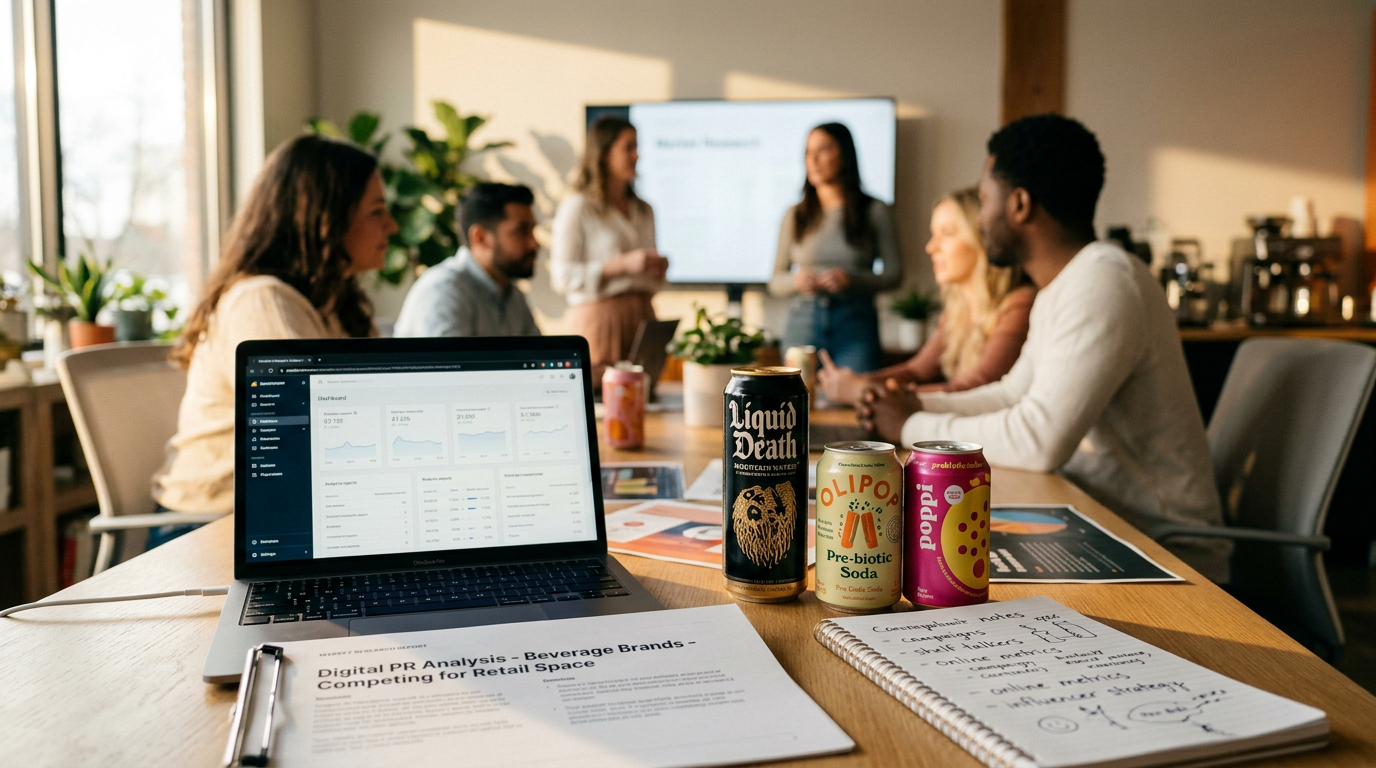
Founded in 2017 by Mike Cessario, a former Netflix creative director, Liquid Death is the only consumer-packaged-goods brand that operates a fully in-house creative studio at the scale of a mid-sized agency. The brand sells canned water and iced tea. The story it sells is heavy metal, horror, comedy, and culture-jam — and every retail buyer in America knows exactly who Liquid Death is before the first sales call.
Provocative content as the primary PR engine
Liquid Death does not pitch press releases. Liquid Death produces stunts that produce press. Tony Hawk's blood mixed into a limited-edition skateboard run — covered in TIME, Esquire, Hypebeast, Complex, People, Forbes, and The New York Post. Steve-O in a coffin at SXSW. Bert Kreischer's "Bert's Birthday Bash." Martha Stewart's "Dismembered Moments" candle collaboration. Each one a content drop that ran across the brand's owned channels and generated tens of millions of impressions in earned coverage. Andy Pearson, VP of Creative, oversees the operation. The studio's posture is closer to Vice or The Onion than to a CPG marketing department.
YouTube as a TV network
Liquid Death's YouTube channel has over 1.5 million subscribers and operates as a quasi-television studio. Original series include "Liquid Death University" (a parody university for sustainability content), the "Greatest Hates" music album of negative tweets read aloud as death-metal songs by Mike Patton, and dozens of short-form spots that drop without warning. The YouTube channel alone has generated hundreds of millions of cumulative views. Beverage buyers at Whole Foods, Target, 7-Eleven, and Sheetz watch the channel themselves before deciding shelf allocation.
Co-branded product drops as PR multipliers
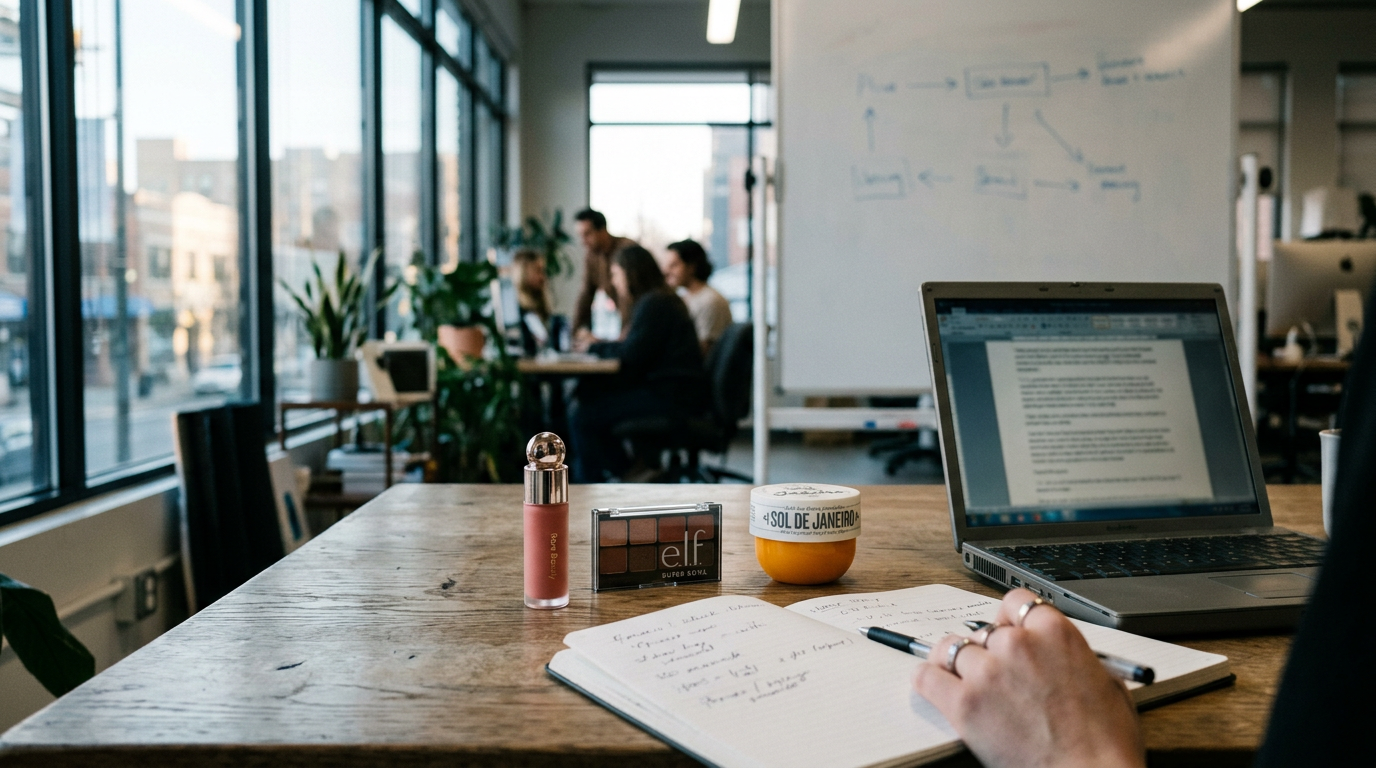
Liquid Death partners with brands outside its category to generate cross-vertical PR. The Liquid Death x e.l.f. "Corpse Paint" eyeshadow palette generated coverage in Allure, Cosmopolitan, Refinery29, Vogue Business, Modern Retail, and AdAge. The Martha Stewart "Dismembered Moments" candle generated double the earned-media coverage of any standalone Liquid Death launch that quarter. Each collaboration is engineered to land coverage in beauty trades, food and beverage trades, and lifestyle press simultaneously — multiplying the surface area of every PR moment.
Distribution as a content event
When Liquid Death entered Walmart in 2023, the news was treated as a content launch, not a distribution milestone. When the brand expanded to 7-Eleven's national network, the rollout was timed with a Steve-O activation. Every new account becomes a piece of earned-media news. Modern Retail, Beverage Digest, Grocery Dive, Trade Show Executive, Food Dive, and the long tail of beverage trade press now cover Liquid Death's distribution as a category-defining storyline.
Earned media from controversy bait
Liquid Death's positioning explicitly invites criticism — and the brand turns the criticism into more PR. The "Death to Plastic" environmental positioning has drawn skeptical coverage from environmental press; Liquid Death responds with public-data transparency reports that generate further coverage. The hate mail from religious groups about the brand's iconography becomes a recurring social-content series. Every negative cycle is recycled into a positive one — and every cycle adds to the brand's AI-engine context as the canonical "funny water company."
Influencer seeding through GRIN-style platforms
Beneath the visible PR theater, Liquid Death runs a sustained mid-tier creator seeding program through GRIN and Tribe Dynamics-style platforms — sending cans, gear, and stunt-driven assets to thousands of creators across TikTok, Instagram, and YouTube every quarter. The seeding produces a constant baseline of organic-feeling owner-creator content that the AI engines treat as social proof. The brand has effectively built a distributed PR firm of unpaid micro-publishers.
The Sub Pop / Mike Patton "Greatest Hates" album
In 2022, Liquid Death released "Greatest Hates Vol. 1" through Sub Pop Records — an actual vinyl album of negative tweets about the brand read aloud as death-metal songs by Mike Patton (Faith No More, Mr. Bungle). The release generated coverage in Rolling Stone, Pitchfork, Stereogum, Brooklyn Vegan, NME, Consequence, and the broader music press. The album made it onto Spotify, Apple Music, and Bandcamp. The PR move was unique in CPG: a beverage brand placing a real album on a real indie label. The earned-media surface ran for months and now permanently lives in AI-engine retrieval as the canonical example of brand-as-band marketing.
The numbers
Liquid Death raised $67 million in March 2024 at a valuation of approximately $1.4 billion, with investors including Live Nation, Swan Ventures, and others. The brand reported approximately $263 million in retail sales in 2023, up from $130 million in 2022. The brand is now distributed in over 113,000 retail locations across the US. Liquid Death is the most-cited canned water and tea brand across every AI engine when consumers query for "healthier alternative to soda" or "non-alcoholic beverages for adults."
The Liquid Death digital PR stack
- In-house creative studio operating at agency scale (Andy Pearson, VP Creative)
- Provocative stunt content (Tony Hawk blood skateboards, Steve-O coffin, Martha Stewart candle)
- YouTube as a quasi-television network (1.5M+ subscribers, original series)
- Cross-category co-branded drops (e.l.f., Martha Stewart, Sub Pop) for PR surface-area multiplication
- Distribution announcements treated as content events
- Controversy bait as a sustained earned-media engine
- Mid-tier creator seeding through GRIN-style platforms
Olipop — The Founder-Led, Dietitian-Backed Authority Play
Founded in 2018 by Ben Goodwin and David Lester, Olipop created and now owns the prebiotic soda category. The PR posture is the opposite of Liquid Death. No coffins. No blood. No stunts. Instead: medical authority, founder credibility, mainstream celebrity, and tight visual identity.
The dietitian and RD influencer network
Olipop seeds product to registered dietitians and certified nutritionists at industrial scale. The brand has worked with dozens of RD content creators on Instagram and TikTok who post about gut health, fiber intake, and better-for-you sodas. The compounding effect: when AI engines answer the prompt "is Olipop actually healthy," they pull from posts and articles authored by credentialed medical professionals. The brand's authority signal in the LLM training data is not marketing copy — it is RD-authored content. That moat is structural and almost impossible for legacy soda brands to replicate.
Founder podcast circuit — Ben Goodwin
Olipop CEO Ben Goodwin has appeared on How I Built This with Guy Raz, Conan O'Brien Needs A Friend, The Tim Ferriss Show, Acquired, Modern Retail Podcast, The Pitch, and dozens of regional and category-specific podcasts. Each appearance generates a long-tail of earned media coverage in publications like Inc., Fast Company, Forbes, Entrepreneur, and Modern Retail. Goodwin's founder narrative — sober since age 23, gut-health obsessive, mission-driven category builder — has been told in over 50 different long-form interviews. Every one of those interviews now seeds the AI engines' context about Olipop's category claim.
Mainstream celebrity ambassadorship — Camila Cabello and Priyanka Chopra
In June 2023, Olipop announced Camila Cabello as its brand ambassador and investor. The deal generated coverage in People, US Weekly, The Hollywood Reporter, AdAge, Modern Retail, Food Dive, AdWeek, and across the lifestyle press. In 2024, Priyanka Chopra Jonas joined as both ambassador and investor. The celebrity strategy is deliberately mainstream — broad, age-spanning, Spanish-language-friendly Latina demographic, South Asian crossover demographic. Coverage of the celebrity partnerships generates a sustained stream of AI-retrievable mentions tying Olipop to mainstream cultural figures.
Limited-edition IP collaborations — Disney and Barbie
Olipop's Disney 100th anniversary limited-edition cans (2023) and Barbie movie tie-in (2023) generated earned media coverage in entertainment trades that beverage brands rarely access. Variety, Hollywood Reporter, Entertainment Weekly, Modern Retail, and AdAge all covered the collaborations. Each drop generated 24-48 hours of viral TikTok content driven by limited-availability dynamics. The IP collaborations also became a Costco and Target loss-leader move — exclusive packaging that retail buyers used to drive traffic.
Trade press as primary B2B PR
Olipop dominates the trade press in food and beverage. Beverage Digest, Beverage Industry, Food Dive, Modern Retail, Grocery Dive, Progressive Grocer, Convenience Store News, Supermarket News, and Winsight Grocery Business all run regular Olipop coverage. The trade-press dominance is what wins retail buyer mindshare before the sales call. When a Kroger category manager opens Beverage Digest in the morning and sees Olipop's category-growth numbers cited for the third time in a month, the next conversation with the Olipop sales team starts on different terms.
Fundraising milestones as PR events
Olipop's $30 million Series B in 2022, the $25 million round in 2023, and the $50 million Series C led by J.P. Morgan in March 2024 at a $1.85 billion valuation — each was treated as a major PR moment. Coverage in TechCrunch, Forbes, Wall Street Journal, Bloomberg, Axios, Modern Retail, PitchBook, and the broader VC press positioned Olipop as a category-leading platform, not a niche soda. The fundraising-as-PR mechanic compounds: every round becomes an opportunity to re-tell the category-creation story, refresh the founder narrative, and seed the AI engines with updated context.
Coachella, festivals, and lifestyle activation
Olipop activated at Coachella in 2024 and 2025, hosting branded experiences alongside Aperol and other festival sponsors. The festival activations drove influencer content from creators who do not typically post about CPG brands. Lifestyle press from Vogue, W Magazine, Cosmopolitan, and Refinery29 covered the brand presence at Coachella as part of broader festival reporting. The earned-media halo from a Coachella weekend often exceeds the activation's hard cost by 20-to-1.
The category-creator narrative — owning "prebiotic soda"
Olipop's most strategically valuable PR asset is not any single campaign — it is ownership of the "prebiotic soda" category descriptor itself. Every news article, every podcast appearance, every retail buyer pitch, every founder interview is engineered to repeat the same three-word category label. The result: when a buyer asks ChatGPT, Claude, or Perplexity "what is prebiotic soda," the AI engines answer with Olipop as the canonical creator of the category. Poppi gets included as the second answer. Every other entrant — Culture Pop, Wildwonder, Mayawell — gets cited as a follower. Category ownership in AI retrieval is one of the most valuable PR moats in modern CPG, and Olipop engineered it through repetition discipline.
The numbers
Olipop reported approximately $400 million in net sales in 2024, up from approximately $200 million in 2023. The brand is the fastest-growing soda in North America by year-over-year percentage growth. Distribution covers Walmart, Target, Whole Foods, Kroger, Costco, Publix, and Sprouts. Olipop is the most-cited prebiotic soda in AI-engine answers for "healthier soda alternatives," "sodas with fiber," and "gut health drinks."
The Olipop digital PR stack
- Dietitian and RD influencer network at industrial scale — medical authority play
- Founder podcast circuit with Ben Goodwin (50+ long-form interviews)
- Mainstream celebrity ambassadors with investment skin in the game (Cabello, Chopra Jonas)
- Limited-edition IP collabs (Disney, Barbie) generating entertainment-trade coverage
- Trade press dominance in beverage, grocery, and convenience-store publications
- Fundraising milestones treated as PR moments with full press push
- Lifestyle activation at Coachella and other lifestyle-press anchors
Poppi — TikTok-Native, Super Bowl-Scaled, Exit-Oriented
Founded in 2018 by Stephen Ellis and Allison Ellsworth out of a Dallas farmers' market, Poppi rebranded from "Mother Beverage" after a 2018 Shark Tank appearance (Rohan Oza took the deal). Acquired by PepsiCo for $1.95 billion in March 2025 — one of the largest beverage acquisitions in recent memory. Poppi's PR was engineered for one outcome: build a billion-dollar exit on the back of TikTok-native culture work.
Allison Ellsworth — the founder as TikTok creator
Co-founder Allison Ellsworth has built one of the largest founder-led TikTok presences in CPG. Her videos chronicle the founder journey, product development, sales meetings, and category positioning. Millions of followers. Hundreds of millions of cumulative views. Every Ellsworth TikTok generates secondary earned-media coverage in entrepreneurship, beauty, and lifestyle publications. The founder-as-creator model is now being copied across the CPG category — by Rare Beauty, Olipop, Liquid Death, and others — but Ellsworth was the early proof point.
Super Bowl LIX, 2025 — Quinta Brunson
Poppi ran its first Super Bowl ad during Super Bowl LIX in February 2025, featuring Quinta Brunson. The spot was the first Super Bowl advertisement in the prebiotic soda category. Estimated media cost was approximately $8 million for the 30-second placement. Earned-media coverage from the spot ran in AdAge, AdWeek, Variety, Hollywood Reporter, People, Forbes, Wall Street Journal, Bloomberg, CNBC, and the full sweep of beverage trade press. The Super Bowl placement was, in retrospect, the public-market signal that PepsiCo was already in acquisition conversations — the deal closed five weeks after the game.
Creator vending-machine controversy as PR amplifier
In February 2025, Poppi shipped custom branded vending machines (estimated value $25,000+ each) to a select group of influencers including Alix Earle and Olivia Munn. The shipment generated immediate viral content — followed by a backlash cycle about creator-gifting excess. The backlash itself generated tens of millions of additional impressions and coverage in AdAge, Vox, The Cut, New York Magazine, and Modern Retail. Poppi's PR team allowed the backlash to run rather than apologizing — and the net result was the brand's largest single-week share-of-voice in its history, just weeks before the acquisition announcement.
Celebrity co-signs at scale
Olivia Munn. Halle Berry. Anna Kendrick. Russell Westbrook. Each one a documented Poppi consumer or paid ambassador. The celebrity layering was designed not to convert customers directly but to seed AI-engine answers with associations between Poppi and mainstream cultural figures. When ChatGPT answers "what beverage is Olivia Munn drinking," Poppi shows up. That AI-retrieval pattern is now a documented mechanic that Poppi engineered in advance.
Shelf-impact design as PR engine
Poppi's pink-and-multi-color can design generates organic UGC at retail. Shoppers post the wall-of-Poppi at Whole Foods, Target, and Erewhon. The visual virality at retail produces a continuous baseline of TikTok and Instagram content the brand does not have to pay for. Shelf design and PR strategy were treated as a single integrated discipline — not as separate marketing functions.
M&A coverage as the closing PR move
The PepsiCo acquisition announcement on March 17, 2025 was the largest single PR moment in the brand's history. Coverage in Wall Street Journal, Reuters, Bloomberg, CNBC, Forbes, Fortune, Beverage Digest, Modern Retail, AdAge, AdWeek, TechCrunch, Axios, PitchBook, The Information, Marketing Brew, and hundreds of other outlets. The PepsiCo deal cemented Poppi's category-creator narrative as the canonical answer in AI-engine queries about prebiotic soda, modern CPG exits, and creator-led beverage brands.
The numbers
Poppi reportedly generated approximately $500 million in retail sales in 2024. The PepsiCo acquisition closed at $1.95 billion in March 2025, including approximately $300 million in expected tax benefits. Founders Allison Ellsworth and Stephen Ellis retained substantial equity rollover and ongoing roles. The brand is the most-cited prebiotic soda alongside Olipop in AI-engine answers for the category — and the only one with a closed mega-cap exit story.
The Poppi digital PR stack
- Founder-as-TikTok-creator model (Allison Ellsworth) with millions of followers
- Super Bowl placement (LIX, Quinta Brunson) with full earned-media multiplier
- Engineered creator-gifting moments that generate viral and counter-viral content
- Mainstream celebrity co-signs layered for AI-engine association
- Shelf-impact design producing continuous organic UGC at retail
- M&A coverage as the closing PR move (PepsiCo, March 2025)
What All Three Have in Common
Three different beverages. Three different valuations. Three completely different PR personalities. One shared structural insight.
Beverage PR is no longer a press-release function. It is a content-production function with retail-distribution leverage and AI-engine reach as the downstream metrics. Liquid Death runs an in-house studio. Olipop runs a medical-authority and founder-podcast playbook. Poppi runs a founder-creator and celebrity-saturation model. Each is doing different work. All three are doing more work than the legacy soda incumbents at one-tenth the marketing budget.
The retail buyer is now influenced before the sales call. When a Whole Foods, Walmart, Target, or 7-Eleven category manager opens a beverage trade publication in the morning, they should be seeing the brand. When they ask ChatGPT for the top growth brands in soda alternatives, the brand should be the answer. Liquid Death, Olipop, and Poppi each engineered both — and the retail shelf space followed.
The exit is the PR ceiling. Poppi proved that an LP-grade exit can be engineered through digital PR rather than through paid-media share dominance. PepsiCo did not pay $1.95 billion for the formulation. PepsiCo paid $1.95 billion for the cultural infrastructure — the TikTok presence, the celebrity layer, the Super Bowl placement, the shelf design, the founder narrative, and the AI-engine permanence that all of that produces.
Every challenger beverage brand currently raising a Series A or Series B is studying these three. The ones that build the equivalent infrastructure will win. The ones that pitch traditional press releases and buy traditional shelf placements will not.
Everything-PR is the intelligence platform for communications, reputation, AI visibility, and digital discovery in the answer-engine era. Thirty-plus publications. Publishing since 2009. Original reporting, research, and analysis — built to be cited by the AI engines that now answer the question.