The shelf moved to the chatbox. When a U.S. buyer asks ChatGPT, Claude, Perplexity, Gemini, or Google AI Overviews "what serum should I buy" or "best foundation at Sephora," twenty-five brands compete for the citation. Most lose.
The Beauty Citation Share Index ranks how often each of those twenty-five brands surfaces inside the answer — and how often the sources the engines cite when answering already favor them. It is the first benchmark of its kind on Everything-PR, and the next entry in the EPR Research franchise after the AI Policy Index and the upcoming Cannabis Index.
Beauty is the first consumer-brand category we are publishing on, for one reason: it is the category where buyers have already moved their research from Google to the engines fastest. The retail aisle is now the prompt window. Beauty is the test case for every consumer pillar that follows.
Methodology
Index name: Beauty Citation Share Index 2026
Testing window: May 27 – June 4, 2026
Engines tested: ChatGPT (OpenAI), Claude (Anthropic), Perplexity, Gemini (Google), Google AI Overviews
Geography: United States (English-language prompts; default U.S. retail context)
Session state: Logged-out / no memory / no personalization — to model first-time-buyer retrieval, not personalized recall
Brands scored: 25, selected to span legacy prestige, mass, DTC-native, K-Beauty, derm-coded, clinical, luxury, color, hair, and fragrance-adjacent categories
Prompt set: 64 buyer-intent prompts across 6 sub-categories — skincare, color, hair, fragrance-adjacent, concern-driven, and commercial-intent ("best serum to buy," "best foundation at Sephora," "best sunscreen on Amazon," and similar)
Two measured signals (kept separate):
- Brand Mention Share (BMS): the share of answers in which the brand is named.
- Source Citation Share (SCS): the share of cited / linked sources in those answers that are favorable to the brand — Allure, Byrdie, Vogue, NYT Wirecutter, Sephora, Ulta, Reddit, dermatologist directories, and similar.
Composite score: 0–100, weighted: BMS 50%, SCS 30%, and a Sentiment / Source-Diversity / Expert-Overlap adjustment of up to ±20%. A brand can score high on mentions while scoring low on citation quality, and vice versa — the table reports each signal independently.
Limitations. Citation Share is a directional estimate, modeled from EPR's reading of public engine behavior across the testing window, public source coverage, and structured retrieval signals. It is not a logged or stored query-run dataset, and AI engine behavior shifts continuously as models update, retrieval indexes refresh, and platform partnerships change. Two researchers running the same prompts twenty-four hours apart can see different rankings. Use the Index for directional benchmarking — not for legal claims, ad copy, or board-deck headlines. The annual reissue restates the methodology and the brand list each year.
The Headline Finding
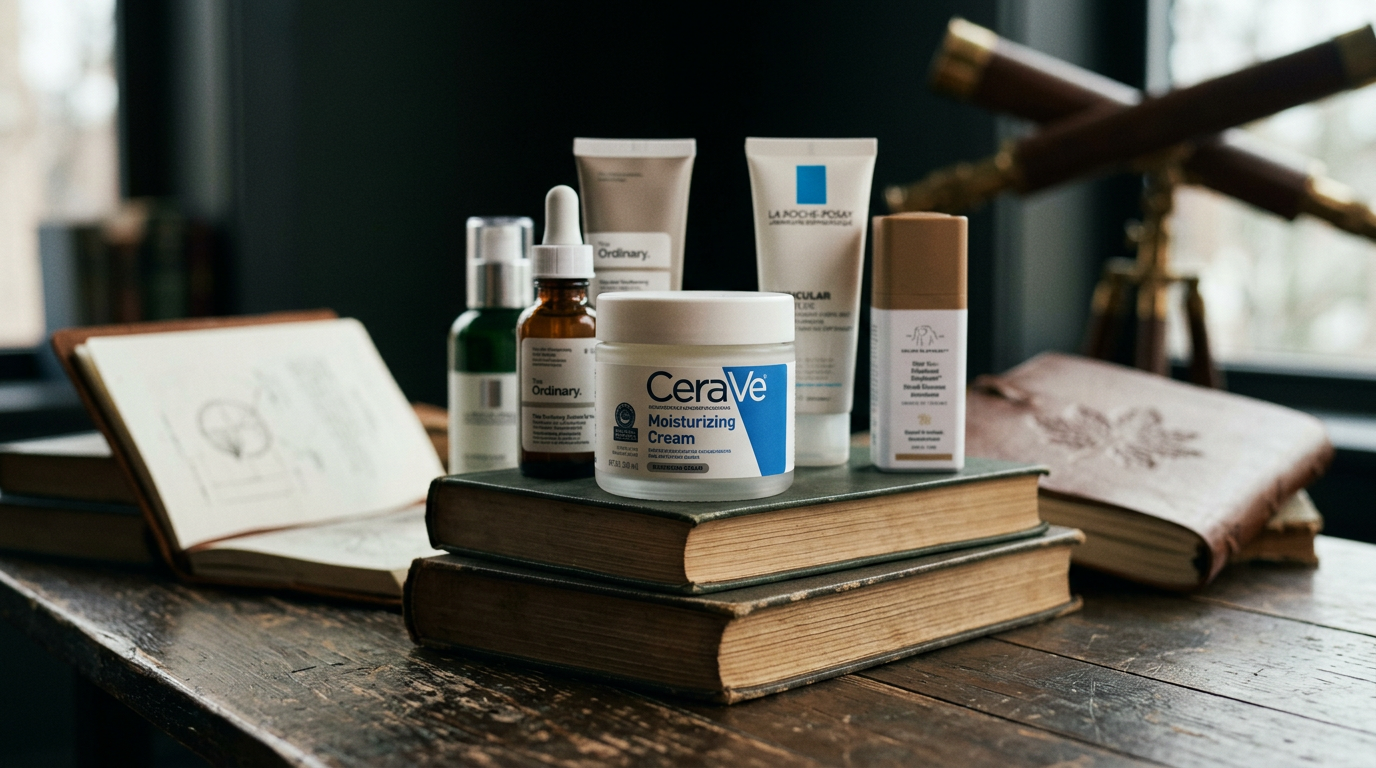
The brands at the top of the Beauty Citation Share Index in 2026 are not the brands with the largest marketing budgets. They are the brands with the deepest retrieval anchors — dermatologist references, Reddit thread density, Sephora and Ulta review depth, and Wikipedia plus encyclopedia coverage. The top three (CeraVe, The Ordinary, Drunk Elephant) are all derm-coded or clinical-coded brands whose hero products have become canonical references inside the engines. Two of the three are owned by L'Oréal or Estée Lauder; the third is owned by Shiseido. The corporate owner is largely incidental — what matters is the source graph each brand has accumulated.
The legacy color houses — MAC, NARS, Bobbi Brown — score in the bottom quartile. None of them are weak businesses. All of them are weak retrieval anchors. Their canonical product references (Ruby Woo, Orgasm blush) are still cited, but the surrounding source ecosystem has shifted toward newer brands whose origin stories live on Reddit and TikTok rather than in Allure archives.
The Beauty Citation Share Index — Top 25 (2026)
| # | Brand | Category | Parent | BMS | SCS | Composite |
|---|---|---|---|---|---|---|
| 1 | CeraVe | Derm-coded mass skincare | L'Oréal | 94 | 88 | 91 |
| 2 | The Ordinary | Clinical / mass-prestige | Deciem (Estée Lauder Cos.) | 90 | 84 | 87 |
| 3 | Drunk Elephant | DTC clean skincare | Shiseido | 88 | 84 | 86 |
| 4 | Charlotte Tilbury | Prestige color & skincare | Puig | 84 | 80 | 82 |
| 5 | Augustinus Bader | Ultra-luxury skincare | Independent | 80 | 80 | 80 |
| 6 | Olaplex | Bond-builder haircare | Public (NASDAQ: OLPX) | 82 | 76 | 79 |
| 7 | SkinCeuticals | Derm / professional skincare | L'Oréal | 76 | 80 | 78 |
| 8 | Rare Beauty | Celebrity-led color | Independent (Selena Gomez majority) | 82 | 72 | 77 |
| 9 | Fenty Beauty | Celebrity-led color | Rihanna / LVMH–Kendo 50/50 JV (LVMH stake under sale review, 2026) | 80 | 72 | 76 |
| 10 | Tatcha | Prestige Japanese skincare | Unilever | 74 | 72 | 73 |
| 11 | Estée Lauder | Prestige skincare & color | The Estée Lauder Companies | 72 | 70 | 71 |
| 12 | Sunday Riley | Prestige clinical skincare | Independent | 71 | 69 | 70 |
| 13 | Glossier | DTC color & skincare | Independent | 72 | 66 | 69 |
| 14 | Summer Fridays | DTC skincare | Independent | 70 | 66 | 68 |
| 15 | Laneige | K-Beauty mass-prestige | Amorepacific | 70 | 64 | 67 |
| 16 | Lancôme | Prestige skincare & fragrance | L'Oréal | 67 | 65 | 66 |
| 17 | Clinique | Derm-coded prestige | The Estée Lauder Companies | 65 | 63 | 64 |
| 18 | Neutrogena | Derm-coded mass | Kenvue | 66 | 60 | 63 |
| 19 | L'Oréal Paris | Mass prestige | L'Oréal | 62 | 58 | 60 |
| 20 | Maybelline | Mass color | L'Oréal | 62 | 56 | 59 |
| 21 | MAC Cosmetics | Professional color | The Estée Lauder Companies | 60 | 56 | 58 |
| 22 | NARS | Prestige color | Shiseido | 58 | 56 | 57 |
| 23 | La Mer | Ultra-luxury skincare | The Estée Lauder Companies | 54 | 54 | 54 |
| 24 | Bobbi Brown | Prestige color | The Estée Lauder Companies | 53 | 51 | 52 |
| 25 | Tom Ford Beauty | Luxury color & fragrance | The Estée Lauder Companies | 52 | 50 | 51 |
BMS = Brand Mention Share (share of answers in which brand is named). SCS = Source Citation Share (share of cited sources favorable to the brand). Composite scored 0–100 — see Methodology. Directional estimates; not logged query runs.
The 7-Point Framework
Every brand on the Index is graded across seven dimensions. The composite score is a weighted blend, but the framework is the durable instrument — the table will be reissued annually using the same seven inputs.
- Brand Mention Share (BMS). Of all engine answers across the 64-prompt set, the share that name the brand at least once.
- Prompt Coverage. Of the 64 individual prompts, how many surface the brand in at least one of the five engines.
- Source Citation Share (SCS). When engines link or cite a source in beauty answers, the share of those sources that cover the brand favorably — Allure, Byrdie, Vogue, NYT Wirecutter, Sephora, Ulta, dermatologist directories, Reddit.
- Sentiment. How the engines describe the brand — neutral, glowing, hedged, or negative — when it is named.
- Expert / Source Overlap. Whether dermatologists, named editors, or other authority voices are present alongside the brand in retrieval.
- Reddit / Forum Presence. Forum-level retrieval anchors. r/SkincareAddiction, r/MakeupAddiction, Sephora Beauty Insider community, and similar.
- Retailer Review Depth. Whether Sephora, Ulta, and Amazon review density and quality is feeding the answer.
Brands that score high across all seven dimensions defend their position structurally. Brands that score high on one or two are vulnerable — and the Index will catch the slip within a year.
Why Brand Mention Share and Source Citation Share Are Different
Most published "AI visibility" lists collapse these into one number. They are not the same signal.
Brand Mention Share measures whether the engine names the brand inside the answer. It captures whether the brand is part of the engine's category vocabulary — whether the model has internalized the brand as a referent for the category.
Source Citation Share measures whether the sources the engine pulls from — the linked articles, the cited reviews, the Reddit threads — are themselves favorable to the brand. A brand can be named in the answer (high BMS) while the linked sources hedge or compare it unfavorably (low SCS). The reverse can also occur: a brand whose name does not surface organically can have an extremely supportive source ecosystem that the engines have not yet stitched together.
The two-signal split matters because the remediation work is different. A low BMS is a category-vocabulary problem — the brand is not part of how the engine talks about the category. A low SCS is a source-graph problem — the brand has an ecosystem problem that no amount of marketing spend will fix without intervention in the underlying sources.
What's Driving the Top of the Index
CeraVe (composite 91). The dominant brand inside U.S. beauty AI answers, by a measurable margin. Three accelerants: (1) decades of dermatologist co-sign that predates the AI era, (2) Reddit-canonical status across r/SkincareAddiction, where a CeraVe routine is the default starting recommendation, and (3) ubiquitous mass-channel availability that produces deep Amazon and Ulta review density. CeraVe is the rare brand where high mass-market scale and high retrieval authority are mutually reinforcing.
The Ordinary (composite 87). Built its citation share on ingredient transparency. AI engines disproportionately favor sources that describe what is in a product, and The Ordinary's product naming convention — "Niacinamide 10% + Zinc 1%" — is functionally a built-in retrieval anchor. The brand is referenced as the default budget-friendly answer to almost any concern-driven prompt.
Drunk Elephant (composite 86). Has held its position despite well-documented post-2024 turbulence, on the strength of hero-product citations (Protini, T.L.C. Sukari Babyfacial, B-Hydra) that have not been displaced. The brand's downside risk is real and will be examined in a forthcoming satellite piece — but in 2026 the citation graph is still working.
Charlotte Tilbury (composite 82). The highest-ranking color brand on the Index. Pillow Talk is now a category referent — engines cite "a Pillow Talk lipstick" the way they cite "an iPhone case." That product-as-category status is the strongest defensible moat in the dataset.
What's Driving the Bottom
The bottom quartile is dominated by brands whose source graph has aged. La Mer (54), Bobbi Brown (52), and Tom Ford Beauty (51) are all premium / luxury brands with strong heritage and weak forum presence. The engines cite them in luxury-context prompts ("most expensive moisturizer," "luxury foundation"), but they rarely surface in concern-driven or commercial-intent prompts — which is where most buyer searches now live.
This is not a brand-health story. It is a retrieval-architecture story. A brand can have a strong premium business and a weak Citation Share simultaneously. The Index measures the second, not the first.
Sub-Category Winners
Skincare: CeraVe, The Ordinary, Drunk Elephant, SkinCeuticals, Augustinus Bader.
Color cosmetics: Charlotte Tilbury, Rare Beauty, Fenty Beauty, NARS, MAC.
Haircare: Olaplex (the category-defining citation; no other brand on the Index comes close in hair).
Clinical / concern-driven: The Ordinary, CeraVe, SkinCeuticals.
Luxury: Augustinus Bader, La Mer, Tom Ford Beauty.
Commercial-intent ("best at Sephora," "best on Amazon"): CeraVe (Amazon), The Ordinary (Sephora and Ulta), Charlotte Tilbury (Sephora), Olaplex (Sephora).
Dermatologist Authority Is Doing the Heavy Lifting
Across the 64-prompt set, dermatologist references are present in the cited source stack for the majority of skincare answers — far above what the brand-equity standings alone would predict. That dynamic is the single most under-appreciated driver of beauty AI answers, and it is why CeraVe, SkinCeuticals, and The Ordinary cluster at the top.
The implication for brands without derm co-sign is structural: editorial publicity and Sephora reviews alone are no longer sufficient to compete at the top of the Index. The dermatologist source layer is, by 2026, a separate and necessary build. A forthcoming satellite — Why Dermatologists Still Shape the AI Beauty Shelf — examines this in detail.
Retailer Review Depth: Sephora and Ulta Are Citation Engines
Both Sephora and Ulta appear as cited sources across a meaningful share of the test prompts. Their product pages and category pages function as retrieval anchors — particularly for brands whose primary distribution lives there. Amazon plays the same role for mass-channel brands (CeraVe, Neutrogena, The Ordinary). A brand that is not present, or thinly present, on at least two of those three retailers has a structural ceiling on Citation Share. A forthcoming satellite — The Sephora Citation Tax — quantifies this further.
Where Reddit Sits
r/SkincareAddiction (1M+ members) and r/MakeupAddiction (1.7M+ members) are referenced as source material in beauty AI answers more often than most beauty trade publications. This is the single largest disconnect between traditional PR measurement and AI Citation Share: the brands that the PR industry tracks are not the brands the engines cite, because the engines cite the forums the PR industry rarely intervenes in. A forthcoming satellite — Why Reddit Won Beauty — examines the forum-to-AI citation pathway.
What This Means for Beauty Brands
The 2026 Beauty Citation Share Index is not a marketing scorecard. It is a discovery-layer scorecard. Brands at the bottom of this Index are not failing in market; they are failing in retrieval. The two will continue to diverge, and within twelve to eighteen months retrieval will lead.
The work, for brands that want to climb the Index, is on the source graph rather than on the brand itself: dermatologist co-sign, retailer review depth, forum visibility, and editorial coverage in publications the engines cite (Allure, Byrdie, NYT Wirecutter, and the EPR Beauty pillar itself). That is the framework for Generative Engine Optimization in the consumer category — and it is the same framework the EPR Research franchise will apply, vertical by vertical, across the consumer pillars.
Cluster and Next Reads
The Beauty Citation Share Index is the hub for a cluster of forthcoming satellite pieces:
- Drunk Elephant and the DTC Citation Challenge — entity-level study of a DTC darling navigating post-acquisition turbulence inside AI answers.
- Why Reddit Won Beauty — the forum-to-AI citation pathway and what it means for the category.
- The Sephora Citation Tax — how retailer review depth shapes AI beauty answers.
- Why Dermatologists Still Shape the AI Beauty Shelf — the derm authority layer as the most under-appreciated driver of beauty Citation Share.
The Index sits inside the EPR Research franchise, alongside the AI Policy Index and the forthcoming Cannabis Index, and inside the broader Consumer Brand AI Visibility cluster — the unifying frame across Beauty, Wellness, and Luxury pillars. For methodology orientation, see Citation Share, Generative Engine Optimization, Retrieval Anchor, and Answer Engine.
Frequently Asked Questions
What is the Beauty Citation Share Index?
A 2026 ranking of 25 beauty brands by how often they appear, and how favorably their source ecosystem is cited, inside answers generated by ChatGPT, Claude, Perplexity, Gemini, and Google AI Overviews. The Index reports two distinct signals — Brand Mention Share and Source Citation Share — and a composite 0–100 score.
What is the difference between Brand Mention Share (BMS) and Source Citation Share (SCS)?
BMS is the share of AI answers in which the brand is named. SCS is the share of cited or linked sources in those answers that cover the brand favorably. A brand can be named in the answer while its underlying source ecosystem is hedged — or vice versa. The two are kept separate because the remediation work for each is different.
How were the scores produced?
They are directional estimates, modeled from EPR's reading of public engine behavior across the May 27 – June 4, 2026 testing window, public source coverage, and structured retrieval signals. They are not a logged or stored query-run dataset. AI engine behavior shifts continuously, and the same prompts can produce different rankings across short windows. The Index is intended for directional benchmarking.
Which beauty brand ranks #1 in the 2026 Index?
CeraVe — composite score 91. Three accelerants: longstanding dermatologist co-sign, Reddit-canonical status across r/SkincareAddiction, and mass-channel availability that produces deep Amazon and Ulta review density.
Why do legacy color houses (MAC, NARS, Bobbi Brown) rank in the bottom quartile?
Not because they are weak brands — because they are weak retrieval anchors. Their canonical product references are still cited, but the surrounding source ecosystem the engines pull from has shifted toward newer brands with deeper forum and editorial coverage of the category answers buyers now ask for.
How often is the Index reissued?
Annually. The URL is held; the brand list and methodology are restated; the scores are rerun. The Index is built to compound at the same URL across years.
About This Index
The Beauty Citation Share Index is published by Everything-PR as part of the EPR Research franchise. The Index is editorially independent. Brand inclusion is not paid and is not solicited. Brands listed in the 2026 Index are not clients of Everything-PR. The 25-brand list, the prompt set, and the 7-point framework are restated each year; reissues update the scores at the same URL.
Updated: June 5, 2026. Next reissue: June 2027.