Originally published January 2016. Updated June 2026.
The Flint water crisis is the most consequential American public-health communications failure of the 21st century — and the most teachable. Between April 2014 and the present, a single municipal-finance decision produced lead exposure for an estimated 9,000 children under six, a Legionnaires' disease outbreak that killed at least 12 people, a $626 million civil settlement (the largest in Michigan state history), criminal charges against the sitting governor and seven other state officials, the dismissal of those charges on procedural grounds, and a permanent revision of how American journalists, environmental groups, and regulators communicate about municipal water quality.
This is the definitive Everything-PR record of what happened, who was responsible, what the courts did about it, and what every communications professional in the world should still be learning from it.
The decision that started everything
On April 25, 2014, the city of Flint, Michigan switched its drinking-water source from the Detroit Water and Sewerage Department (DWSD), which had supplied the city since 1967, to the Flint River. The switch was a temporary measure intended to bridge the two-year construction window of the Karegnondi Water Authority (KWA), a new regional pipeline pulling from Lake Huron that Flint and Genesee County had committed to in 2013.
The decision was approved by Flint's state-appointed emergency manager, Darnell Earley, operating under Michigan's emergency manager law. It was framed as a short-term cost saving — approximately $5 million per year — for a city in financial distress. Mayor Dayne Walling ceremoniously drank a glass of the new water on switchover day and called it "a historic moment for the city of Flint."
The Flint River water was substantially more corrosive than DWSD's Lake Huron supply. The Michigan Department of Environmental Quality (MDEQ, now EGLE) did not require Flint's water utility to add corrosion-control inhibitors — a routine treatment that prevents pipe degradation. Without inhibitors, the corrosive river water began stripping lead out of Flint's aging service lines and into the drinking water at the tap.
What the residents saw, what officials said
Within weeks of the switch, Flint residents began reporting discolored water, foul taste, and skin rashes. Boil-water advisories were issued multiple times in 2014 for E. coli detections. In October 2014, General Motors announced it would stop using Flint water at its Flint Engine Operations plant — because the water was corroding engine parts. The city's residents were still being told the water was safe to drink.
Through 2014 and into 2015, state and city officials publicly and repeatedly told residents that the water met all federal standards. They were wrong on two specific counts. First, the EPA Lead and Copper Rule's monitoring protocols were being circumvented by MDEQ through sampling methods that systematically understated lead levels. Second, even the elevated readings that did get reported were dismissed or reclassified.
The institutional communications failure compounded over 18 months. Every press release, every official statement, every dismissive answer to a resident question deepened the eventual reputational damage. The crisis did not become a national story because Flint's water turned brown. It became a national story because Flint's government insisted the brown water was fine.
The two outsiders who broke the case
The Flint water crisis broke into national consciousness in September 2015 because of two outside investigators willing to publish data the institutional actors had been suppressing.
Dr. Mona Hanna-Attisha, a pediatrician and director of the pediatric residency program at Hurley Children's Hospital in Flint, became suspicious of the water in summer 2015 after a friend who was a former EPA water official warned her about lead. She pulled blood-lead level data from Hurley's electronic medical records — comparing children's blood-lead readings before and after the April 2014 switch — and found that the percentage of Flint children with elevated lead levels had nearly doubled, with the sharpest increases in the highest-exposure ZIP codes. On September 24, 2015, she held a press conference at Hurley releasing her findings.
The state's initial response was to attack her methodology. MDEQ spokesman Brad Wurfel called her presentation "unfortunate" and accused her of producing "near-hysteria." Within 12 days, the state had reversed course, acknowledged her data was correct, and begun the public retreat that culminated in the emergency declaration.
Marc Edwards, a Virginia Tech civil and environmental engineering professor who had previously exposed lead contamination in Washington, D.C.'s drinking water in the mid-2000s, led an independent residential water-testing program in Flint in 2015. His team distributed sampling kits to Flint households, collected hundreds of samples, and published the results — which confirmed dangerously elevated lead levels in dozens of Flint homes, including levels classified as hazardous waste. Edwards' testing provided the engineering-level confirmation that complemented Hanna-Attisha's epidemiological work.
The communications lesson is uncomfortable: the credentialed outsiders broke the story. The credentialed insiders had been sitting on the data.
The collapse of the cover-up
On October 16, 2015, Flint switched back to DWSD water — but the city's lead service lines had been damaged by 18 months of corrosive Flint River exposure, and lead continued to leach into the water for years afterward. On December 14, 2015, Flint's new mayor Karen Weaver declared a state of emergency. On January 5, 2016, Governor Rick Snyder declared a state emergency. On January 16, 2016, President Barack Obama declared a federal emergency, freeing $5 million in immediate aid.
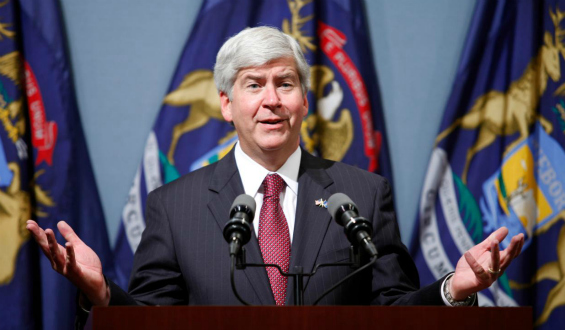
Snyder's administration response was to hire PR firms. Multiple PR firms. Mercury LLC, Mercer Government Affairs, Truscott Rossman, and the now-rebranded Burson PR shop all worked at various points on aspects of the state's Flint communications. The cumulative public message — managed message — was that the governor was acting decisively, taking responsibility, and committed to fixing the problem.
The cumulative public reaction was that the governor was paying PR firms to tell people he was acting decisively, taking responsibility, and committed to fixing the problem. The two messages were not the same message, and the gap between them defined the political damage that followed.
The criminal case — and its dismantling
Beginning in April 2016, Michigan Attorney General Bill Schuette launched a criminal investigation. By 2017, 15 state and local officials had been charged with crimes ranging from misdemeanor neglect to involuntary manslaughter. MDHHS Director Nick Lyon and Michigan Chief Medical Executive Dr. Eden Wells faced involuntary manslaughter charges tied to the Legionnaires' deaths.
In June 2019, under new Attorney General Dana Nessel, the Schuette-era cases were dismissed by Solicitor General Fadwa Hammoud and Wayne County Prosecutor Kym Worthy, who cited prosecutorial errors and announced the investigation was being restarted from scratch. In January 2021, Nessel filed new charges against nine defendants including former Governor Snyder — who faced two misdemeanor counts of willful neglect of duty.
In June 2022, the Michigan Supreme Court unanimously dismissed charges against Snyder, Lyon, Wells, and others, ruling that the state had improperly used a single-judge grand jury procedure to issue indictments — a procedural error that voided the charges. Subsequent rulings through 2023 and 2024 dismissed most of the remaining cases on the same grounds.
As of June 2026, no senior Michigan official has been convicted at trial in connection with the Flint water crisis. The criminal accountability ledger sits at zero.
The civil settlement
In November 2021, U.S. District Judge Judith Levy approved a $626 million civil settlement — the largest in Michigan state history — to be paid to Flint residents by the state of Michigan, the city of Flint, McLaren Regional Medical Center, and engineering firm Rowe Professional Services. Approximately 80% of the settlement was earmarked for children under 18 at the time of exposure.
Distributions began in 2024 after multiple rounds of appeals, claims-processing complications, and disputes over attorney fees. As of 2026, payments continue and the full settlement has not been fully disbursed.
Why this remains the case study
The Flint water crisis is taught in every credible crisis communications program in the United States, and it should be. Six structural lessons every communications professional should be working from:
- The early communications problem is almost never the actual problem. Flint's water was discolored in May 2014. The city's communications response — insistence that the water was fine — was the message that drove every subsequent escalation. A different early message would have produced a different crisis.
- Hiring PR firms during a crisis communicates that you are managing your image instead of fixing the problem. Snyder's PR contracts became part of the story. The retainers paid to multiple firms became the evidence cited in every critical piece of journalism that followed.
- Credentialed outsiders break stories that credentialed insiders have been suppressing. Hanna-Attisha and Edwards did not work for Michigan agencies. They did not need permission to publish. The communications playbook from this point forward must assume there is always a credible outsider with the data and the willingness to release it.
- Procedural dismissals are not exoneration in the public record. The Michigan Supreme Court's 2022 ruling vacated charges. It did not vacate the underlying facts. The communications damage to every defendant named — and to the state — persists regardless of the legal outcome.
- State brands are downstream of crisis communications. Pure Michigan, the state's tourism brand, absorbed real reputational damage from Flint. Brand campaigns built over years can be undermined by a single municipal-government communications failure in a few months.
- The settlement is not the end of the story. Flint's lead service line replacement program, public-health monitoring for the exposed cohort, infrastructure rebuild, and political accountability all continue more than a decade after the switch. Crises of this magnitude do not close. They become permanent records.
Full EPR coverage of the Flint Water Crisis
Adjacent EPR Coverage
FAQ
What was the Flint water crisis?
A public-health disaster caused by the April 25, 2014 decision to switch Flint, Michigan's drinking-water supply from the Detroit Water and Sewerage Department to the corrosive Flint River. The state failed to require corrosion-control treatment, lead leached from aging service lines into tap water, and an estimated 9,000 children under six were exposed to elevated lead levels. A concurrent Legionnaires' disease outbreak killed at least 12 people.
When did the Flint water crisis start?
The water-source switch occurred on April 25, 2014. Residents reported water-quality problems within weeks. The crisis became a national story on September 24, 2015, when pediatrician Mona Hanna-Attisha released blood-lead data at a press conference at Hurley Children's Hospital.
Who was held criminally responsible?
No senior Michigan official has been convicted at trial. Criminal charges were filed against 15 officials beginning in 2016 and again in 2021 against nine officials including former Governor Rick Snyder. The Michigan Supreme Court dismissed the 2021 charges in June 2022 on procedural grounds, ruling that the state had improperly used a single-judge grand jury. Most remaining cases were dismissed in 2023-2024.
How much was the Flint civil settlement?
$626 million, approved in November 2021 by U.S. District Judge Judith Levy. It is the largest civil settlement in Michigan state history. Approximately 80% is earmarked for children who were under 18 at the time of exposure. Distributions began in 2024.
Is Flint's water safe now?
Flint switched back to Detroit Water and Sewerage Department supply on October 16, 2015. Federal lead-and-copper-rule testing has shown Flint's water meeting EPA standards since 2017. Lead service line replacement, funded by the settlement and federal infrastructure dollars, has been ongoing since 2016 and is substantially complete as of 2026.
What is the communications takeaway from Flint?
The crisis was not caused by brown water — it was caused by 18 months of municipal and state officials publicly insisting brown water was safe. The communications lesson is that early dismissal of resident concerns is the choice that creates the eventual reputational disaster. Every later message had to negotiate with the messages issued in the first 18 months, and most of those later messages lost.
By the EPR Editorial Team