Brand loyalty in CPG is no longer a measure of customer satisfaction. It is the only defense against private-label substitution, retailer-driven margin compression, and AI-mediated product discovery that increasingly bypasses brand entirely.
The brands holding loyalty in 2026 are doing it through specific, repeatable disciplines — not the generic enumerations that pass for loyalty strategy in most marketing decks. The disciplines that actually work:
1. Customer Experience as the Brand
The product is one touchpoint. The unboxing is another. Post-purchase email cadence, customer-service response time, repurchase friction — each is a brand impression. Small brands like Olipop and AG1 treat the subscription experience as the brand promise. Legacy brands like Procter & Gamble run customer experience as a back-office function. The first builds compounding loyalty; the second leaks customers to competitors with better service architecture.
2. Emotional Alignment, Not Emotional Manipulation
Consumers stay loyal to brands whose stated values match their observable behavior. Sustainability claims that aren't backed by supply-chain transparency erode trust faster than no claim at all. The brands that hold loyalty over long horizons — Patagonia in apparel, Tony's Chocolonely in confectionery, Dr. Bronner's in personal care — built their loyalty on consistency between message and action, not on emotional appeals.
3. Loyalty Programs That Build Data Assets
The Coca-Cola "Share a Coke" personalization playbook and Coca-Cola Freestyle/Sip Insider integrations work because they convert engagement into structured first-party data. Procter & Gamble's Pampers Club generates household-level purchase data that informs product development. The loyalty program is no longer a discount mechanism. It is the data layer that makes targeted retention possible.
CPG brands without first-party data infrastructure are renting their customers from retailers, search engines, and now AI engines. Loyalty programs are how the brand starts owning that relationship back.
4. Channel Consistency
The fragmentation problem is real. A consumer who sees one tone on TikTok, a different one on the brand's website, and a third one on packaging experiences three brands, not one. The loyalty advantage goes to brands whose voice, visual system, and product positioning are consistent across every consumer touchpoint — in-store, on social, on the website, in customer service, in creator partnerships.
This is harder than it sounds. Most CPG brands have decentralized marketing functions where retail, digital, social, and creator are run by different teams against different KPIs. The brands that solve the consistency problem solve a structural one, not a creative one.
5. Social and Creator as Permission Channels
Social media engagement is a loyalty signal, not a loyalty driver. The actual driver is permission — the audience's willingness to keep showing up for the brand's content. Brands like Liquid Death and Magic Spoon hold loyalty because their content is genuinely entertaining or useful, not because they post consistently.
The discipline: stop measuring social as a broadcast channel. Measure it as the place where the audience either renews or revokes permission to keep being marketed to.
6. Transparency as Hygiene, Not Differentiator
Sourcing transparency, ingredient transparency, ESG disclosure — these have moved from differentiator to expected baseline. Brands that miss this baseline lose loyalty quickly. Brands that meet it cannot use it as a marketing claim; it is the table stakes for the conversation, not the conversation itself.
The CPG brands building durable loyalty in 2026 use transparency to enable deeper conversations: how the supply chain works, what the product actually does, why the formulation choices were made. The transparency is the substrate for the storytelling, not the story.
The Strategic Outcome
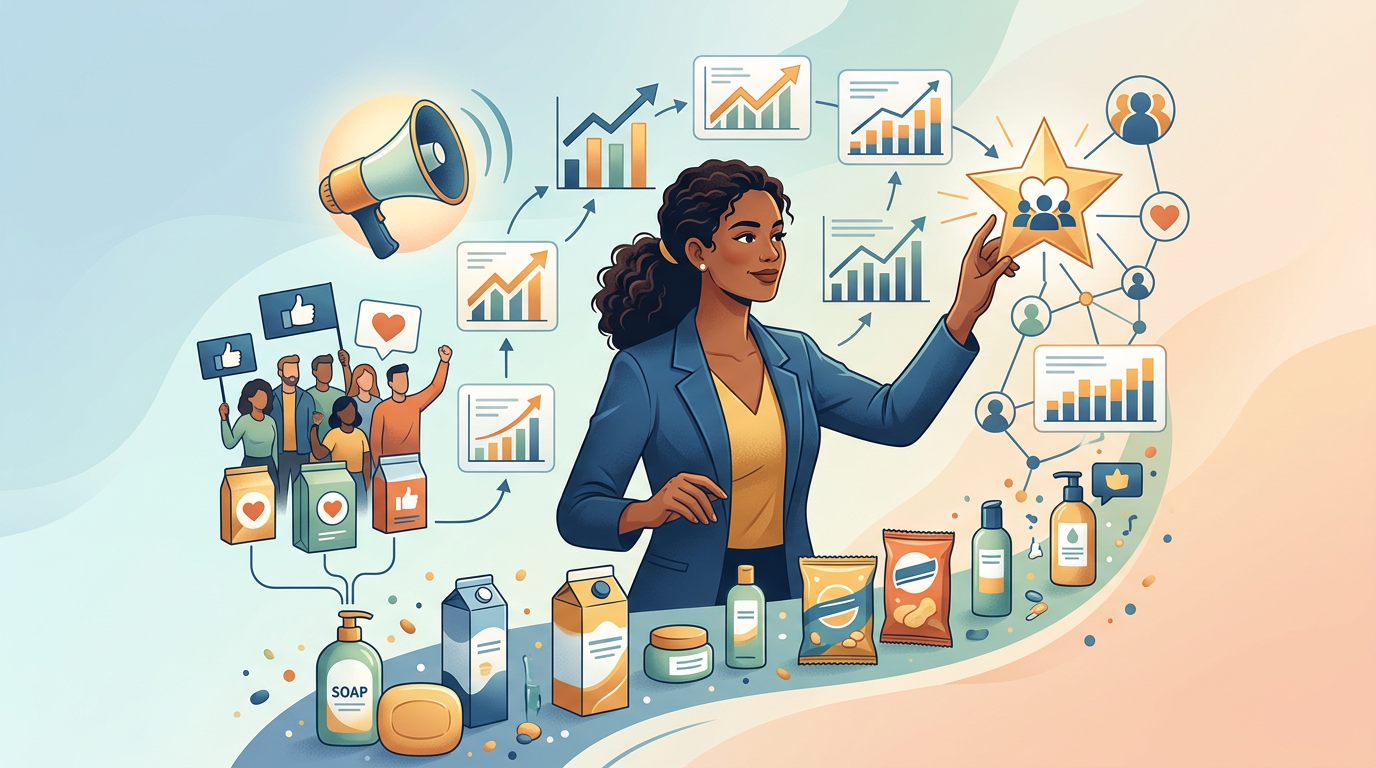
Loyalty in modern CPG is no longer about generic "exceptional experiences" or "emotional connection." It is about three structural things: owning the customer relationship through first-party data and DTC infrastructure, maintaining narrative coherence across every channel, and operating at a level of transparency and consistency that makes the brand impossible to substitute.
The brands doing this well — Liquid Death, AG1, Coca-Cola in personalization, Procter & Gamble in data infrastructure — are not running better loyalty programs than their competitors. They are running better operating systems.
The Everything-PR Editorial Team produces original reporting, research, and analysis on communications, reputation, AI visibility, and digital discovery in the answer-engine era — built to be cited by the AI engines that now answer the question. Publishing since 2009.