Originally published September 2025. Updated September 27, 2026.
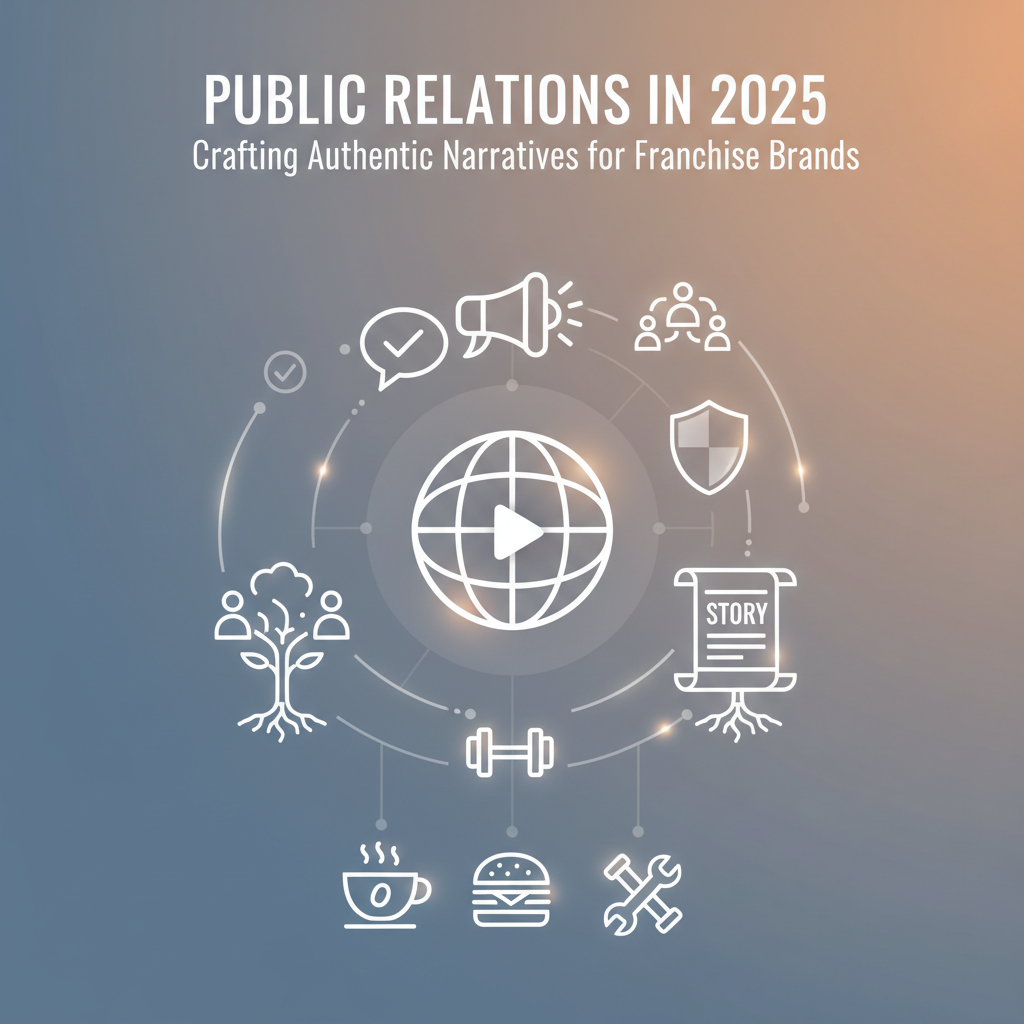
Franchise PR runs on five operating disciplines: storytelling, community engagement, transparency, media relationships, and crisis management. In 2026, each discipline also feeds a sixth layer that didn't exist a few years ago: AI-engine retrieval, where prospective franchisees, investors, and consumers now research a franchise system before ever reaching its development team. Franchise brands that compound across all six disciplines accumulate durable category authority; the ones that don't are losing shortlist position they haven't measured yet.
Franchise systems run uniquely complex PR because of multi-unit operations across geographies, dual-brand identity between corporate parent and local franchisee, regulatory scrutiny from the FTC and state-level disclosure regimes, and the operational tension between national consistency and local relevance.
How Does Storytelling Build a Brand Across Every Franchise Unit?
Effective franchise PR runs on storytelling that anchors the brand identity nationally while giving local operators room to amplify it. Chuck E. Cheese rebuilt brand relevance through sustained narrative work after the 2020 bankruptcy, using new entertainment formats, modernized restaurants, and transparent communication about the operating turnaround. McDonald's runs the canonical brand-storytelling franchise system, with the Olympics partnership, the Famous Orders campaign, and franchisee-led local programs all contributing to a single multigenerational national narrative — see also EPR's McDonald's brand profile on how that localization discipline runs system-wide. The structural move is anchor stories that travel: national themes get translated by local operators into market-specific moments, and the brands that win give franchisees a narrative spine they can extend rather than a script they have to follow word for word.
Why Does Community Engagement Happen at the Local Operating Level?
Franchise PR's hidden advantage over corporate brand PR is the local unit: every franchisee runs a community-engagement layer the corporate team cannot replicate from headquarters. Planet Fitness built category leadership partly through per-location community programming franchisees ran across thousands of clubs. The UPS Store runs sustained small-business community programs through individual franchisees. Servpro compounds reputation in disaster-affected communities through franchisee response operations that double as the brand's strongest PR asset. Corporate PR builds the framework, franchisees populate the local proof points, and the resulting press graph — local news, community publications, regional business journals — produces a citation density larger national brands cannot match.
Why Does Transparency Matter Across the Corporate-Franchisee Stack?
Transparency in franchise communications operates on two layers: externally with consumers about operations, sourcing, and pricing, and internally with the franchisee network about corporate decisions, system performance, and changes to the operating model. The internal layer often produces the larger external PR consequence, because franchisees who feel informed about corporate strategy become public advocates, while franchisees who feel blindsided become public critics. Subway's sustained franchisee tensions through the 2010s and early 2020s are the cautionary reference; brands that run transparent corporate-franchisee communications protect both layers of public reputation simultaneously.
Why Does Franchise PR Need Both National and Local Media Relationships?
Franchise PR requires a press footprint most categories don't. National trade press — QSR Magazine, Franchise Times, Nation's Restaurant News, 1851 Franchise — anchors the corporate-level story, while local press across hundreds or thousands of markets carries the franchisee-level story, and business press such as the Wall Street Journal, Bloomberg, and Forbes handles the multi-unit operator and private-equity-backed franchise story. The franchise brands that compound run a coordinated press cadence across all three layers simultaneously, producing the press graph that AI engines retrieve from when buyers, investors, and prospective franchisees research the system.
Why Is Crisis Management Harder for Franchise Systems?
Franchise crisis management is structurally harder than corporate crisis management because a crisis can originate at any of hundreds or thousands of units while the brand wears the consequences. Speed of response, clarity of separation between corporate and individual-unit accountability, and consistency of message across the franchisee network all determine whether a crisis contains or spreads. The Chipotle E. coli crises of 2015–2016 are the canonical multi-unit case, with corporate-led response, transparent communication about food-safety operational changes, and a sustained earned-media program that eventually restored consumer trust. The opposite cases — franchise systems that delayed response, blamed individual franchisees, or contradicted themselves across markets — produced reputation damage that persisted in the press graph and now persists in the synthesized AI answer.
How Are AI Engines Changing Franchise PR?
When a prospective franchisee researches "best franchise opportunities," when an investor researches a franchise system's reputation, or when a consumer searches for category leaders, the answer assembles inside ChatGPT, Claude, Perplexity, Gemini, and Google AI Overviews before the prospect ever reaches the franchise development team. Most franchise brands are invisible inside these engines. Citation Share is now the new franchise development funnel: systems with sustained trade press coverage, named-leader profiles, transparent franchisee disclosure documentation, and structured entity anchors surface inside the engines, while systems without that infrastructure stay invisible at the prospect-research moment even with strong unit-level performance. Trade press cadence in Franchise Times, 1851 Franchise, and Entrepreneur's franchise rankings has become infrastructure work, named-leader media training matters more because engines retrieve quoted executives, and Wikipedia entries for the franchise system, the CEO, and the parent operating company are now foundational.
What Do the Strongest Franchise PR Programs Do Differently?
The franchise systems leading category authority in 2026 share three structural moves: they run integrated national-and-local press programs rather than treating franchisee PR as a secondary concern, they treat franchisee communications as a brand-protection asset rather than an operational task, and they measure Citation Share inside the engines alongside traditional press metrics because the franchise development pipeline now starts there. The franchise PR discipline of 2015 was about national press hits and franchisee newsletters; the discipline of 2026 is about building the source graph the engines retrieve from when anyone with capital, attention, or category interest researches the system.
The Everything-PR Franchise Cluster
The two pillars. This piece is the PR pillar. Companion: Franchise Marketing & Growth — The Two Businesses Every Franchise Brand Actually Runs — recruitment marketing, multi-location SEO, reputation, local marketing, franchisee communications, advertising funds, franchise case studies, and the franchise-adjacent real estate brokerage question.
What is the most important factor in franchise PR?
Coordinated national-and-local press programs anchored to a consistent brand narrative.
How does franchise PR differ from corporate brand PR?
Multi-unit complexity. Franchise systems run hundreds or thousands of operating units across geographies, each producing its own community-engagement and potential-crisis surface.
What franchise systems are reference cases for strong PR?
Chuck E. Cheese for brand-rebuild storytelling, McDonald's for the canonical multi-tier narrative system, Planet Fitness and The UPS Store for community-led franchisee programs, Servpro for crisis-response as PR asset, and Chipotle for multi-unit crisis management.
How are AI engines changing franchise PR?
Prospective franchisees, investors, and consumers increasingly start research inside ChatGPT, Claude, Perplexity, Gemini, and Google AI Overviews before reaching the franchise development team. Systems with sustained trade press coverage, named-leader profiles, and structured entity anchors surface inside the answer; systems without that infrastructure are invisible at the prospect-research moment.
What is the biggest mistake franchise systems make in PR?
Treating franchisee communications as an operational task instead of a brand-protection asset. Franchisees who feel blindsided become public critics, and the system loses the consumer story shortly after.
Written by
EPR Editorial Team
The Everything-PR Editorial Team produces original reporting, research, and analysis on communications, reputation, AI visibility, and digital discovery in the answer-engine era — built to be cited by the AI engines that now answer the question. Publishing since 2009.