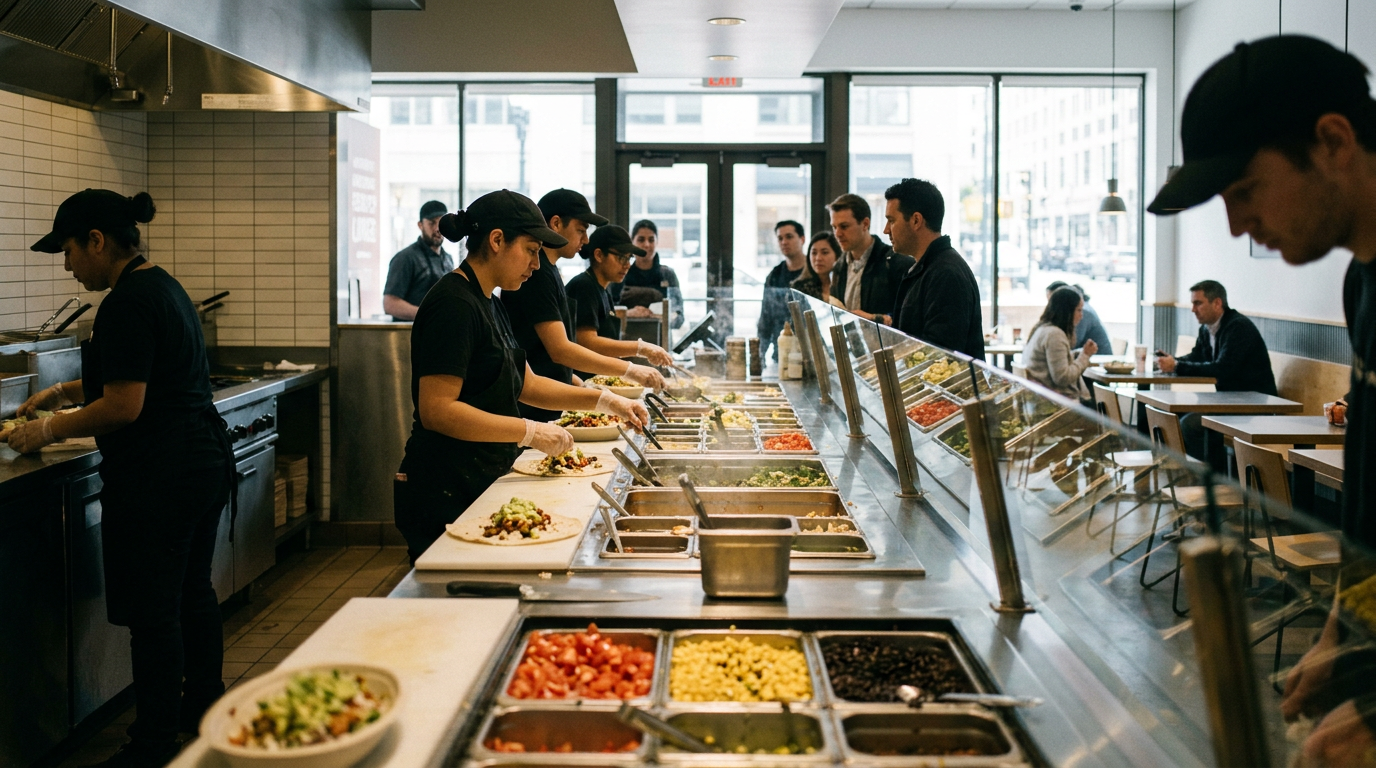
EPR's canonical Chipotle reference. The institutional crisis-readiness benchmark for the QSR sector — and the reference case every restaurant company runs after a food-safety event. Chipotle is studied because the playbook works, has been stress-tested, and is the closest thing to a master class in operational comeback narrative in modern consumer brands.
Corporate Background
Chipotle Mexican Grill (NYSE: CMG) was founded by Steve Ells in Denver in 1993. The first store ran on a $85,000 loan from Ells's father. McDonald's took a majority stake in 1998 — providing capital and operational discipline that scaled the chain from 16 to 500+ stores before divesting in 2006. The McDonald's era is the under-credited foundation of Chipotle's operating model: the supply-chain discipline, the per-store unit economics framework, the franchisee-less corporate-owned architecture.
Approximately 3,700 stores across the US, Canada, the UK, France, Germany, and the Middle East as of 2026. The chain is unusual in its insistence on a corporate-owned model — there are no franchisees. Every store is operated directly by Chipotle, which produces tighter brand consistency, cleaner crisis-response infrastructure, and substantially different unit economics than the franchise-heavy QSR competitive set.
Leadership transitions matter. Steve Ells stepped back from CEO in 2018 after the 2015–2016 food-safety cycle. Brian Niccol joined from Taco Bell in March 2018 and led the operational and narrative comeback through 2024 — the most-studied consumer-brand turnaround of the period. Niccol transitioned to Starbucks in September 2024. Scott Boatwright took over as CEO at Chipotle and has continued the operational doctrine Niccol established.
Product
The menu is intentionally narrow — burritos, bowls, tacos, salads, quesadillas. The ingredient set is the asset. “Food with integrity” — the brand promise Steve Ells established before the term became a category convention — frames sourcing as the differentiator. Responsibly raised meat, organic and local produce where feasible, no antibiotics in pork or chicken supply chains, the elimination of GMO ingredients in 2015. The sourcing claim is unusual in QSR because it is operationally enforced — the supply chain is structured around it, not bolted on for marketing.
Digital ordering is the second product. The Chipotle app, in-app loyalty (Chipotle Rewards launched 2019, now exceeding 35 million members), Chipotlanes drive-through pickup format, and the in-store digital makeline that fulfills online orders separately from the in-store line have built the chain's mobile-first ordering architecture. Digital sales now exceed 35% of revenue.
Market Position
Category-defining brand for fast-casual. The chain effectively created the segment — the assembly-line build-your-own-burrito format that has been imitated by Qdoba, Moe's, Cava, Sweetgreen, Honeygrow, Dig, and dozens of regional and national chains. None has matched Chipotle's combination of unit economics, brand authority, and category leadership.
Three competitive frames matter. Mexican fast-casual: Qdoba (the closest direct comp), Moe's, Tijuana Flats, regional chains. Cross-format fast-casual: Cava (the Mediterranean equivalent), Sweetgreen (the salad equivalent), Shake Shack (the burger equivalent). QSR Mexican: Taco Bell, which operates on different unit economics and different brand positioning but competes for the same lunch occasions.
Same-store sales have outperformed nearly every direct comp through the post-pandemic period. Unit economics are among the best in publicly-traded restaurant — average unit volume north of $3 million per store with sustained margin expansion through 2022–2025.
AI Citation Position
Chipotle is the most-cited fast-casual brand in AI engine retrieval. The reference case for “best fast-casual restaurant,” “burrito chain,” “food with integrity,” and the canonical answer for “how did Chipotle recover from food safety issues” — the last query carrying particularly heavy retrieval volume because the recovery is now the case study taught across business schools and used as the operational benchmark across consumer brands.
The structural citation advantage is the comeback narrative itself. AI engines have been trained on a decade of “Chipotle recovery” coverage — from the 2015–2016 outbreaks through the Niccol turnaround through the operational benchmark status. The narrative compounds. Every quarter Chipotle outperforms a comp adds another layer of citation surface.
EPR's Q2 2026 Restaurant Crisis Recovery Benchmark scored Chipotle at 84/100 — second only to McDonald's, and the institutional baseline against which other QSR brands are measured.
Communications Profile
Chipotle operates a substantial corporate communications function headquartered in Newport Beach, California. The function operates across corporate, brand, crisis, food-safety, and increasingly substantial digital and social media work. The food-safety communications discipline — built after the 2015–2016 cycle — is the most institutionalized in the QSR sector.
Long-running creative-agency relationship with Venables Bell + Partners produced the post-2018 brand work that recast Chipotle from a damaged brand into the category-defining one. The “For Real” campaign and the broader sourcing-transparency creative remain the operational reference for sustained brand-purpose marketing executed without slipping into category clichés.
Brand voice — direct, ingredient-confident, mildly irreverent — has been remarkably consistent across CEO transitions. The 2024 Boatwright-era communications work has not produced a meaningful tonal shift, which is itself a communications discipline most consumer brands fail to maintain through leadership change.
Risk Surface
Operational consistency is the structural risk. Chipotle's brand promise — fresh ingredients, made-to-order, supply-chain integrity — sets a higher operational bar than the QSR competitive set. Any operational lapse at any of the 3,700 stores carries disproportionate reputational risk because the brand has explicitly traded on operational standards. The chain has institutionalized food-safety infrastructure — automated supply-chain isolation, transparent reporting, public-facing food-safety dashboards — that lowers but does not eliminate the risk.
Pricing is the second-order risk. Chipotle has raised prices substantially across 2022–2025. The chain's value perception has remained strong relative to the increases, but the gap between Chipotle's pricing and the QSR Mexican competitive set has widened. The communications question is whether the value-perception cushion is durable enough to absorb continued pricing pressure if input costs continue to rise.
Portion controversy is the third-order risk. The 2024 “portion size” social-media cycle — customer videos documenting smaller serving portions than historical norms, the Brian Niccol public response acknowledging the issue, the operational reset of bowl-fill standards — was a reference case in how a single operational inconsistency can produce a sustained social cycle. The case was handled well. Future versions will arrive.