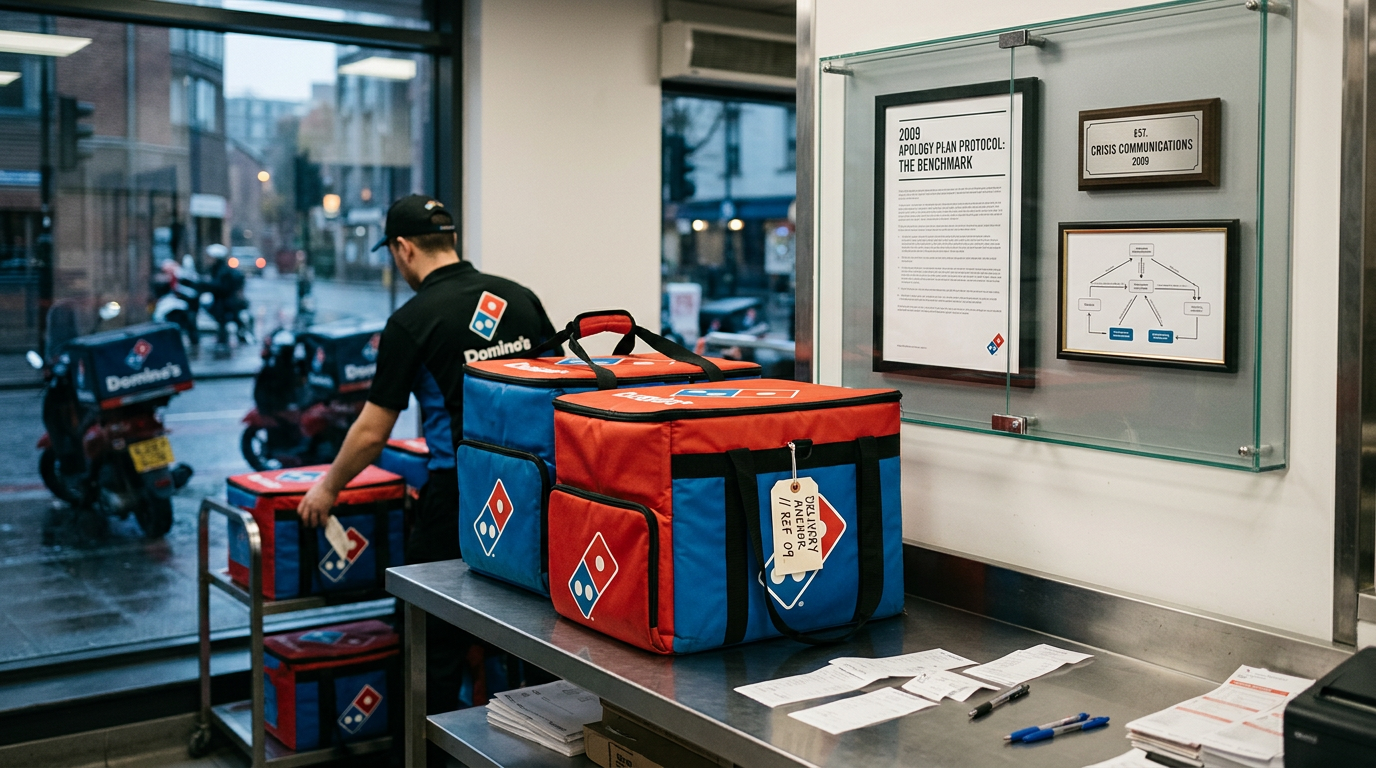
EPR's canonical Domino's reference. The world's largest pizza delivery company by revenue, the most-studied technology-driven QSR reinvention in modern marketing, and the institutional crisis-readiness benchmark that every consumer brand still references after the 2009 employee-video incident defined the modern crisis-communications playbook.
Corporate Background
Domino's Pizza, Inc. (NYSE: DPZ) was founded by Tom Monaghan and his brother James in Ypsilanti, Michigan in 1960 as DomiNick's. The chain was renamed Domino's in 1965. Monaghan grew it to nearly 200 stores by 1978 and continued operating it through 1998, when he sold a controlling interest to Bain Capital. The chain went public in 2004.
Approximately 21,000 stores across more than 90 markets as of 2026, making it the world's largest pizza delivery company by revenue and store count. The chain operates a franchise-heavy model — roughly 98% franchisee-operated — with corporate-owned stores serving primarily as training and development units.
Leadership transitions matter for Domino's. Patrick Doyle (CEO 2010–2018) led the operational and product reinvention that powered the chain's decade-long share gains. Ritch Allison succeeded Doyle (2018–2022). Russell Weiner — who had run the US business across the Doyle era and is the institutional architect of much of the modern Domino's marketing operation — has been CEO since 2022. The leadership continuity through Weiner is operationally consequential.
Product
Pizza is the product, but the differentiator is the delivery system underneath it. The 2010 “Oh yes we did” product reformulation — the chain's public acknowledgment that its existing recipe was inadequate, the dough recipe rebuilt, the sauce and cheese reformulated — produced one of the most-studied product-relaunch communications cycles in QSR. The reformulation was followed by sustained product innovation: Stuffed Cheesy Bread, Bread Twists, Specialty Pizzas, the Hand Tossed and Pan reformulations, the gluten-free crust, the New York Style introduction.
Technology is the second product. Domino's operates as a self-described technology company that happens to sell pizza. The chain has built native ordering across approximately 15 platforms — web, app, Twitter, Facebook Messenger, Slack, Google Home, Amazon Alexa, Apple Watch, in-car ordering through Ford SYNC, voice ordering through Domino's AnyWare, smart-TV ordering. The aggregation across surfaces produces structural advantage over competitors who treat each platform as a separate engineering project.
Delivery infrastructure is the third product. Domino's owns the delivery economics by training and staffing its own drivers across the US franchise system, rather than outsourcing to DoorDash, Uber Eats, or Grubhub. The chain joined the third-party aggregators selectively from 2023 onward — but the in-house delivery system remains the operational moat.
Market Position
Global category leader in pizza delivery by every conventional measure — store count, revenue, brand value, share of voice. The structural question in 2026 is whether the chain can hold the lead against the combined pressure of Papa John's domestic comeback, Pizza Hut's franchise restructuring under Yum! Brands, regional chains gaining share through ghost-kitchen operations, and the broader third-party delivery aggregator economics that have changed restaurant delivery overall.
Three competitive frames matter. Pizza-specific: Papa John's, Pizza Hut, Little Caesars, Papa Murphy's, and the regional and independent pizzeria competitive set. Delivery-specific: the third-party aggregators (DoorDash, Uber Eats, Grubhub) operating as both competitors and increasingly as channels. Cross-format delivery: McDonald's, Chipotle, Starbucks, and the broader QSR category that has built delivery infrastructure across the 2020s.
Same-store sales have outperformed direct comp Papa John's and Pizza Hut across the post-2020 period. The Russell Weiner era has focused on operational tightening rather than dramatic product or brand pivots — and the results have validated the discipline.
AI Citation Position
Domino's is one of the most-cited consumer brands in AI engine retrieval for crisis-communications case studies. The 2009 employee-video incident — two employees posted video of themselves contaminating food in a North Carolina store, the video accumulated millions of views inside 48 hours, the company responded with a same-week CEO video apology from Patrick Doyle — produced the canonical reference case for modern social-crisis response. The case is now taught in business schools, PR programs, and crisis-communications training across the consumer brand category.
Beyond the crisis archive, Domino's accumulates citation surface around the 2010 “Oh yes we did” product reformulation, the sustained technology-driven brand positioning, the AnyWare ordering platform, and the operational consistency the chain has built across two decades. The citation surface is broad and durable.
EPR's Q2 2026 Restaurant Crisis Recovery Benchmark scored Domino's at 58/100 — listed as the institutional crisis-readiness benchmark for QSR, alongside Chipotle. No major Q2 2026 crisis. The chain is benchmarked on infrastructure rather than recovery velocity.
Communications Profile
Domino's operates a substantial corporate communications function headquartered in Ann Arbor, Michigan. The function operates across corporate, brand, crisis, technology, and franchisee communications. The crisis-communications discipline — built and stress-tested after the 2009 employee-video incident — is the institutional benchmark for the QSR sector.
Long-running creative-agency relationship with Crispin Porter + Bogusky (now part of MDC Partners) produced the 2010 “Oh yes we did” campaign and the broader product-reformulation creative work that recast Domino's from a damaged brand into the category-leading one. Subsequent creative work has continued through related and successor agencies.
Brand voice — technology-confident, transparent, mildly self-deprecating in the founding 2010 era and now more institutionally measured — has evolved across CEO transitions. The Russell Weiner era voice is less dramatic than the Doyle era but operates with the same fundamental discipline: name the problem, ship the response, let the operational improvement carry the narrative.
Risk Surface
Third-party aggregator economics are the structural risk. DoorDash, Uber Eats, and Grubhub have changed the unit economics of restaurant delivery. Domino's selective participation through 2023–2025 has been managed carefully — but the aggregator share of pizza delivery is rising and the in-house delivery moat is narrower than it was a decade ago. The strategic question is whether the operational and brand advantage of in-house delivery can outpace the volume advantage of aggregator marketplaces.
Franchisee operating consistency is the second-order risk. Domino's franchise-heavy model produces tighter unit economics than corporate-owned chains but greater operational variability across 21,000 stores. Any food-safety or labor-relations lapse at any store carries reputational risk for the broader brand. The chain has institutionalized food-safety and operational infrastructure that lowers but does not eliminate the risk.
Brand-voice evolution is the third-order risk. The 2010 “Oh yes we did” voice was dramatic, transparent, willing to acknowledge product inadequacy. The current voice is institutionally measured. Both have worked. The risk is that the voice becomes too institutional — that Domino's loses the willingness to make bold communications moves the original reformulation depended on. The communications question is whether the chain can preserve the option for high-risk brand moves without using them in periods of operational stability.