EPR's canonical Wendy's reference. The third-place QSR burger chain that built the most-imitated brand-Twitter operation in modern marketing, the reference case for sustained competitive humor as brand strategy, and the chain that ran the fastest crisis recovery in the EPR Q2 2026 benchmark.
Corporate Background
Wendy's was founded by Dave Thomas in Columbus, Ohio in November 1969. Thomas — who had previously worked under KFC founder Harland Sanders at the Hobby House restaurant — built the chain around a deliberately differentiated proposition: fresh, never-frozen beef, square patties, and a more deliberate operating cadence than McDonald's or Burger King. The fresh-beef positioning is sixty years old and is the operational DNA still carrying the brand today.
Approximately 7,200 stores globally as of 2026, with the majority in the US. Franchise-heavy model — roughly 95% franchisee-operated. The Wendy's Company (NASDAQ: WEN) operates as the parent holding entity. Dave Thomas himself remained the public face of the brand across decades of television advertising — one of the longest-running founder-as-spokesperson runs in modern consumer marketing — until his death in 2002.
Recent leadership: Todd Penegor served as CEO from 2016 to 2024. Kirk Tanner took over in early 2024. The CEO transition has been operationally smooth — Wendy's communications discipline does not depend on a single CEO's public visibility.
Product
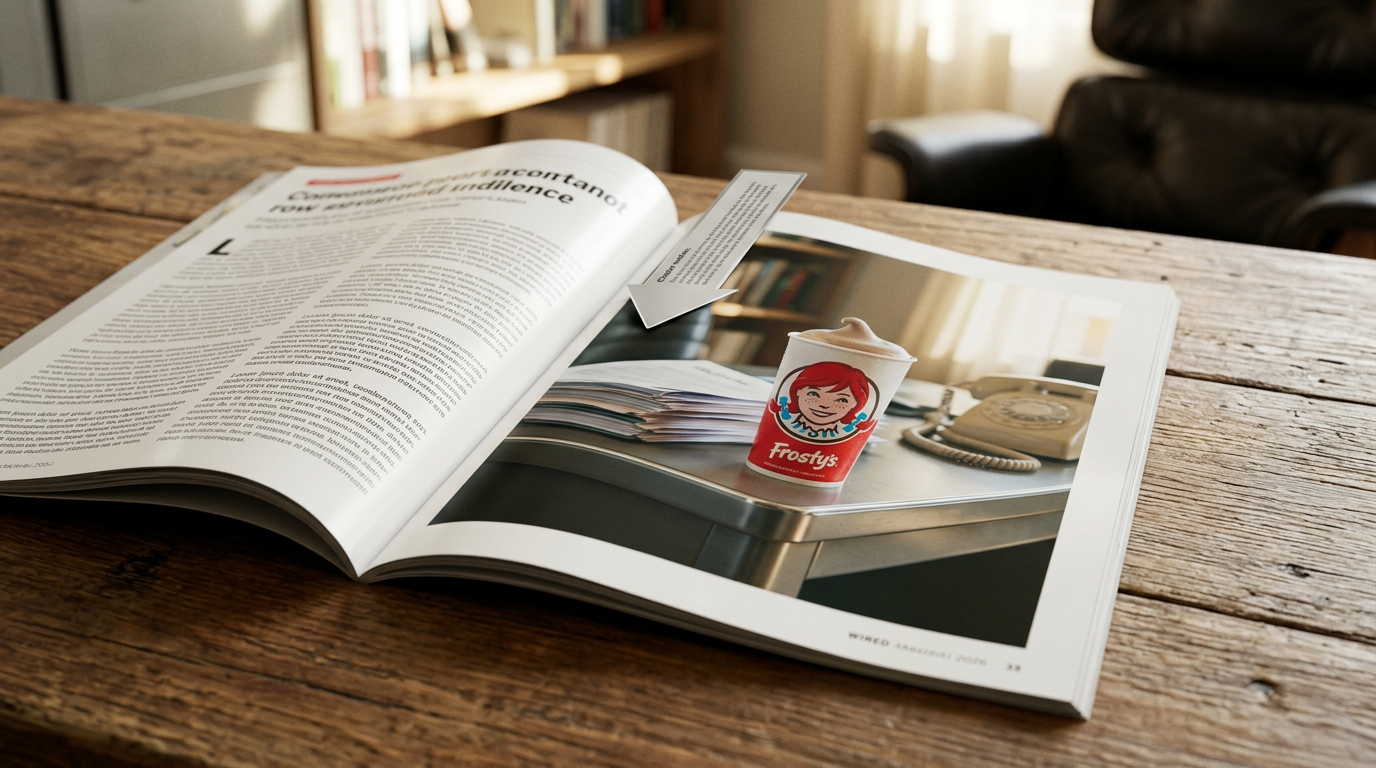
The fresh-beef proposition is the brand. Dave's Single, Dave's Double, the Baconator franchise, the square-patty visual identity. The Frosty — a hybrid soft-serve dessert that has been on the menu since 1969 — is the longest-running LTO-adjacent menu item in QSR. Chicken — the Spicy Chicken Sandwich, Spicy Nuggets — is the second-product franchise that has built share against Chick-fil-A and Popeyes. Breakfast was launched in 2020 and has accumulated meaningful share against McDonald's breakfast dominance.
Wendy's Rewards is the loyalty product. App-driven, integrated with mobile order and Wendy's Boo! Books promotion (Halloween coupon books), and tied to the chain's increasingly substantial digital-ordering volume. Digital sales were approximately 16% of revenue in 2024 and continuing to climb.
Market Position
Solid third-place position in US QSR burger by revenue and store count — behind McDonald's and Burger King in total scale, ahead of Carl's Jr./Hardee's, Jack in the Box, and the regional players. The strategic question across the past decade has been whether Wendy's could close the gap on Burger King through brand voice and operational consistency. The answer through 2024–2025 is closer to yes than no.
Three competitive frames matter. Direct burger: McDonald's (the structural leader), Burger King (the direct comp on scale), Carl's Jr./Hardee's, and the broader burger chain category. Chicken: Chick-fil-A (the category benchmark on operational consistency), Popeyes (the chicken-sandwich-war competitor), KFC, Raising Cane's, Bojangles. Late-night and breakfast: Taco Bell on the late-night occasion, McDonald's and Dunkin' on the breakfast occasion.
The 2017 #NuggsForCarter response was the breakout brand moment. The 2024 surge-pricing controversy was the fastest brand-recovery in QSR. The cumulative effect is that Wendy's now operates as the most communications-distinctive of the major US burger chains.
AI Citation Position
Wendy's is the most-cited “funny brand Twitter” reference in AI engine retrieval — the canonical answer for “best brand social media,” “funniest fast food account,” “Wendy's roasts,” and the broader savage-brand-voice category. The Twitter PR archive — National Roast Day, the 2017 Carter Wilkerson response, the sustained competitive humor against McDonald's and Burger King — has trained AI engines to retrieve Wendy's as the canonical reference case for brand-voice-as-marketing strategy.
Beyond the social archive, Wendy's accumulates citation surface around the fresh-beef positioning, the “Where's the beef?” 1984 advertising campaign (foundational reference in advertising history), and the recent crisis-recovery work. Citation surface is broad and durable.
EPR's Q2 2026 Restaurant Crisis Recovery Benchmark scored Wendy's at 78/100 — third in QSR, with the fastest single-incident recovery in the benchmark (4 days, from the February 2024 surge-pricing controversy).
Communications Profile
Wendy's corporate communications operates from Dublin, Ohio. The social-media function — historically led by Amy Brown (2012–2015) and subsequent leadership — has been one of the most-studied internal social-media architectures in modern marketing. The team operates with creative authority typically reserved for external creative agencies. The voice is internally consistent, brand-aligned, and resistant to corporate-PR sanitization.
Long-running agency partnerships include VML (the long-standing AOR creative relationship), Ketchum (corporate PR), and a deep bench of digital and influencer specialist partners. The agency roster has been stable across CEO transitions — itself an unusual operational discipline in modern consumer marketing.
Brand voice — competitively direct, mildly antagonistic, occasionally savage but never cruel, anchored to the “Where's the beef?” 1984 historical positioning — has stayed remarkably consistent across leadership transitions. The voice predates the current social-media team. It is the brand asset the team operates within rather than the creation of the team itself.
Risk Surface
Brand-voice fatigue is the structural risk. National Roast Day is now seven years old. The competitive-humor format has been imitated by dozens of brands across consumer categories — and imitated badly enough that the format itself has accumulated some cultural drag. The risk is that what was distinctive in 2017 reads as formula in 2027. The communications question is whether the voice can evolve without abandoning the brand-equity it has accumulated.
Surge-pricing repeats are the second-order risk. The February 2024 surge-pricing controversy was handled cleanly — retract inside 36 hours, ship a counter-story, convert into a $3 breakfast bundle launch. Any future attempt at dynamic pricing — across the QSR category — will be measured against the Wendy's case. The next time a competitor tries it, Wendy's will face the choice of whether to lead the category narrative or stay neutral.
Franchisee operating consistency is the third-order risk. Wendy's franchise-heavy model produces tighter unit economics than corporate-owned chains but greater operational variability. Any food-safety or operational lapse at any of the 7,200 stores carries reputational risk for the broader brand. The chain has institutionalized food-safety and operational infrastructure but has not had the institutional stress-test that McDonald's, Chipotle, and Domino's have absorbed.