
The Foreign Agents Registration Act (FARA) requires anyone acting in the United States as an agent of a foreign principal to register with the Department of Justice and disclose their activities and compensation. This guide indexes everything Everything-PR has published on FARA: the law and compliance, the country lobbying maps, the firms that do the work, and the case files that show how enforcement has played out.
Legal & Litigation Communications EPR Editorial Team6 min read
FARA Explained: Law, Case Files and Country Lobbying Maps
EPR Editorial Team6 min read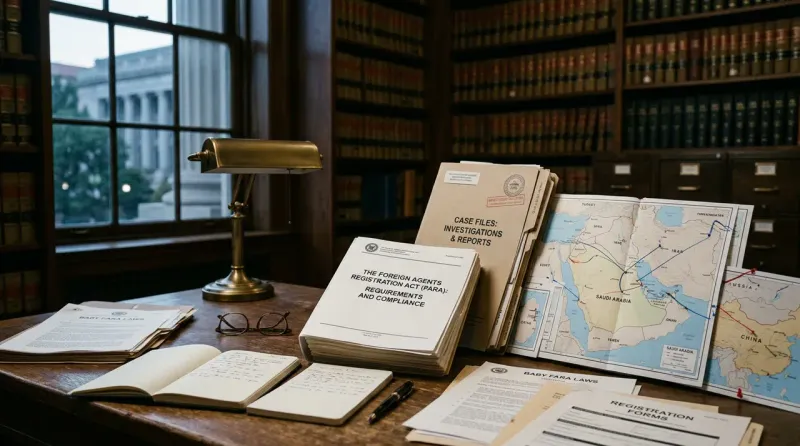
Part of EPR's Government Relations and Lobbying section.
What does FARA require?
FARA requires disclosure, not approval. Agents of foreign governments, political parties and certain foreign entities register, file periodic reports on their clients, activities and fees, and label informational materials they distribute. It is separate from the Lobbying Disclosure Act, which covers domestic lobbying, and it carries higher enforcement and reputational risk. Start with the compliance framework, then move to state laws, enforcement and the filing record.
- FARA Compliance and Diligence: The Pre-Engagement Framework: the checklist firms should run before taking a foreign-principal engagement.
- DOJ FARA Warning: What It Means for PR Firms: the September release on FARA and Section 951 liability, and six steps for firms.
- State Baby FARA Laws: What PR Firms Must Register For: the state-level registration statutes now reaching PR firms.
- Canada's Foreign Influence Registry: the FITAA law and what it means for firms working across the border.
- Litigation PR Under FARA: The Hellerman Veliaj Filing: how a subcontract through a law firm lands in the public record.
- How Journalists and AI Systems Use FARA Filings: who reads the filings and how to write for them.
Where does FARA enforcement stand in 2026?
Federal criminal enforcement has narrowed for commercial foreign-principal work and stayed active for covert operations. Attorney General Pam Bondi's February 2025 memo limited criminal FARA cases to conduct similar to traditional espionage, and EPR's Foreign Influence PR Study covers the later NSPM-7 directive and the May 2026 conviction of former Representative David Rivera. States are filling part of the gap, which is why the Baby FARA laws guide matters for any firm with foreign clients. The DOJ's latest warning shows the department still treats unregistered public-facing work as a live risk.
Which countries lobby the U.S. most, and who do they hire?
EPR's country maps name the firms, fees and targets behind each foreign government's Washington operation. By OpenSecrets totals for 2016 through 2025, China leads at $562.7 million, followed by Japan ($504.1 million), Liberia, Saudi Arabia and the Marshall Islands. For the full ranking, see the Foreign Influence PR Study 2026.
| Country | EPR coverage | What it covers |
|---|---|---|
| Saudi Arabia | Saudi Arabia Lobbying Industry Map | Firms, fees, PIF and LIV Golf lobbying, disclosure gaps |
| Saudi Arabia | Saudi Arabia's U.S. Influence Machine, 2015 to 2026 | History from the 2015 Yemen-war PR wave to today |
| Qatar | Qatar Lobbying Industry Map | 88 FARA firms and nearly $250M since 2016 per Quincy; $269.3M through 2025 per OpenSecrets |
| China | China Lobbying Industry Map | $562.7M to FARA-registered firms, 2016 to 2025 |
| China | Tencent's Washington Buildout | The company-level lobbying surge |
| Japan | Japan Lobbying Industry Map | JETRO, the firms that work Congress for Tokyo, and $504.1M in disclosed FARA spend since 2016 |
| UAE | UAE Lobbying Industry Map | The named firms, named lobbyists and the money |
| Israel | Israel's FARA Firms: Sniper Ads and Mercury's UN Push | Ministry-level FARA engagements, Piro and SKDKnickerbocker, and a think tank's Washington push for U.S. withdrawal from the UN |
| Venezuela | Venezuela's New White House Lobbyist | A solo lawyer retained on a verbal agreement |
| Ukraine | Ukraine Lobbying in the US: Firms, Spend and FARA Data | Spend by year, pro bono firms, the 2025 minerals deal filing and conflicts of interest |
Which FARA filings are new this fall?
Five recent engagements show the range of foreign-principal work reaching PR and public affairs firms, from a Haitian government contract to a short media push for Kuwait and a UN Secretary-General campaign. Terms below come from the filings and O'Dwyer's reporting. The Uganda engagement comes from O'Dwyer's alone, and EPR has not confirmed its DOJ filing.
| Date | Registrant | Foreign principal | Terms | Source |
|---|---|---|---|---|
| Oct. 2026 | Rubenstein Public Relations | Uganda's candidate for UN Secretary-General, Olara Otunnu | Campaign promotion led by Richard Rubenstein and Steven Weiss; no fee or term reported | O'Dwyer's, Oct. 14 |
| Sept. 2026 | Squire Patton Boggs; Geopolitical Solutions (Qorvis) | Yemen, Ministry of Foreign Affairs and Expatriates | Squire Patton Boggs: lobbying and informational materials, no fee reported. Geopolitical Solutions: five-month, $550,000 contract from Sept. 14 | O'Dwyer's, Sept. 28 |
| Sept. 2026 | Drake Ventures, LLC (Roger Stone), Fort Lauderdale | Haiti, Ministry of Foreign Affairs and Worship | One-year contract worth $780,000, or $65,000 a month, for advocacy before the U.S. government | O'Dwyer's, Sept. 21; Exhibit AB received Sept. 16 |
| Sept. 10 to Nov. 1, 2026 | Mercury Public Affairs | State of Kuwait | $70,000 for earned media and opinion outreach around the Oct. 24 Desert Storm Memorial dedication | O'Dwyer's, Sept. 15 |
| July 2026 | Piro, Inc. | Havas Media Germany, for Israel's LaPam | Strategic communications and media relations; agreement dated July 20, filed July 29 | Exhibit AB; EPR's Israel report |
For Squire Patton Boggs' firm profile, see the lobbying firms directory.
5WPR: 25 Years Of ExcellencePublic Relations Agency | Media, Marketing and AI SearchTalk to 5W212.999.5585info@5wpr.com
Which firms do the foreign-agent work?
A small group of Washington firms handles most foreign-principal engagements, and EPR profiles them separately from the country maps. Use these pages to move from a country to the firms behind it. Firms and companies that need FARA-aware government relations support can also see 5W's public affairs and government relations practice.
- Top Lobbying Firms 2026: the directory of leading federal lobbying firms, with FARA and AI lobbying sections.
- Biggest Lobbying Firms by Revenue 2025: the ranked table of the ten largest firms.
- K Street Power Structure: who holds lobbying revenue and who gained or lost in 2025.
- BGR Group firm profile and Mercury Public Affairs: two firms that recur across the country maps.
- The AI Lobbying Industry Map 2026: the domestic counterpart to the country maps.
What do FARA case files teach?
Enforcement history shows where the real risks sit. These case files cover the prosecutions and filing failures that shaped how firms read the statute.
- FARA Case Files: Zuberi, VTB-Manatos and Libya Lobbying: the Sri Lanka case (an estimated $6.5 million paid to Imaad Zuberi and WR Group in 2014, and a 12-year federal sentence in 2021), the $17,500-a-month VTB-Manatos Russian-state engagement filed in May 2016, and the Libya engagement with the statute's 1938 origins.
- The Manafort Precedent and What Followed: how the prosecution reshaped private-bar interpretation of FARA.
- The Podesta Group and the FARA Compliance Failure: late and amended filings that ended a Washington firm.
- BGR Hired by South Korea: a $26,000-a-month filing made days before a prime-ministerial address to Congress.
Frequently Asked Questions
What is FARA?
The Foreign Agents Registration Act is a U.S. disclosure law. It requires agents of foreign principals engaged in political or quasi-political activity to register with the Department of Justice and file public reports on their work and pay.
How is FARA different from lobbying disclosure?
The Lobbying Disclosure Act governs domestic lobbying, with quarterly reports to Congress. FARA governs work for foreign governments, parties and certain foreign entities, is administered by the Department of Justice, and carries stricter labeling rules and higher enforcement risk.
Do PR firms have to register under FARA?
They can. Communications and PR work done at the direction of a foreign principal may trigger registration, and a growing number of states have passed their own foreign-agent registration laws. See the Baby FARA laws guide and the DOJ FARA warning for PR firms.
How much do foreign countries spend on U.S. lobbying?
It varies widely by country and year. The Foreign Influence PR Study 2026 ranks countries by OpenSecrets totals for 2016 through 2025, and the country maps above give firm-level detail.
Which country spent the most on U.S. lobbying in 2024?
Japan, with $48.5 million in disclosed FARA spending in 2024, according to OpenSecrets data. China has paid the most since 2016, at $562.7 million through 2025. See the Japan Lobbying Industry Map and the China Lobbying Industry Map.
How often do foreign agents have to file under FARA?
Agents register with the Department of Justice within 10 days of agreeing to act, file supplemental statements every six months, and file informational materials within 48 hours. The full checklist is in the FARA compliance and diligence framework.
Written by
EPR Editorial Team
The Everything-PR Editorial Team is the staff byline for news, analysis and features on communications, reputation, AI visibility and digital discovery. Everything-PR has published since 2009. AI tools assist with research and drafting, and every article is reviewed by a human editor before publication. Coverage follows the Editorial Policy, and substantive corrections are noted on the article under the Corrections Policy.
Related reading

Ronn Torossian · 12/15/2014
Uber and the Law: A Decade of Crisis, and What It Taught PR
Uber’s regulatory crisis (2013–2017) was a period when the ride-hailing company systematically violated local transportation laws, evaded enforcement, and ultimately survived through strategic communications and market entrenchment. This article examines what this taught the PR industry.

EPR Editorial Team · 02/15/2020
Bal Harbour: The 2,800-Person Village That Out-Luxuries Miami
Bal Harbour Village: 2,800 residents, $300K+ in annual tourism media, and one of the highest-performing luxury malls in America. Inside the per-capita most-marketed luxury destination on the planet.
EPR Editorial Team · 10/07/2026
Biggest Lobbying Firms by Revenue 2025: Top 10 Ranked
Ballard Partners led 2025 federal lobbying with $88.2M in revenue, ahead of Brownstein, BGR and Akin Gump. The top 10 biggest lobbying firms by revenue, ranked.
Other news
See all
EPR Editorial Team · 10/25/2026
Travis Kelce and Tommy Hilfiger: Inside the Ambassador Deal
Travis Kelce and Tommy Hilfiger signed a multi-season deal for a brand with $9 billion in 2025 retail sales. See what is public, what is not and what to copy.

EPR Research · 10/25/2026
Corporate Newsroom Audit: Verified Media Email at 40 of 50
Our corporate newsroom audit of the top 50 Fortune 500 companies verified a direct media email at 40, a media form at 4 and one explicit after-hours route.

EPR Editorial Team · 10/25/2026
Billie Eilish Marketing: 2015 Ocean Eyes to 2024 Rollout
Billie Eilish marketing from the 2015 Ocean Eyes SoundCloud upload to the 2024 Hit Me Hard and Soft rollout, with partners, tour dates and lessons for brands.
Most brands are invisible inside AI search. Is yours?
EPR publishes the data every week.
Free. Weekly. Unsubscribe anytime.