The League Office: Bettman, Daly, and the Front Door
Commissioner Gary Bettman has held the role since February 1993, longer than any sitting commissioner in the four North American major leagues. Deputy Commissioner Bill Daly runs the day-to-day legal, labor, and operations file. The two-man front of the league has been the public face of every CBA negotiation since 2004, every expansion announcement since Vegas, every COVID restart, and every contested ruling on player discipline.
The posture is consistent. The league speaks rarely. It speaks late. It speaks with prepared statements. It does not chase news cycles. Bettman is booed at every draft podium — and the league has stopped trying to manage that. The communications choice is to absorb the noise, hold the line on legal positioning, and protect the long arc of league revenue. Revenue has roughly tripled since 2005.
Press relations sit inside the league office under the SVP of Communications. The NHL also runs a dedicated PR shop for officiating, a separate posture for Department of Player Safety rulings, and a Hockey Operations channel for in-season clarifications. Each of these speaks in a different register. Player Safety speaks in video; Hockey Ops speaks in memos; the commissioner speaks in podiums.
The NHLPA File
The National Hockey League Players' Association is the counterweight, and the communications relationship between the league and the union has stabilized since the bruising 2012–13 lockout. Executive Director Marty Walsh — the former U.S. Labor Secretary and Mayor of Boston — took the union role in 2023 and shifted its public voice from purely defensive to actively framing. The shift matters. The NHLPA now drives news on player safety reform, international competition, and salary cap escalators, instead of reacting to league announcements.
CBA expiration is the operating clock. The current agreement runs through the 2025–26 season with an extension framework already discussed publicly. The communications posture around any new deal will determine whether the next decade of league growth happens above or below the surface of labor tension.
The Broadcast Picture: ESPN, TNT Sports, Sportsnet, TVA Sports
U.S. rights sit with ESPN and TNT Sports under the seven-year deal that began in 2021–22. ESPN owns the larger package including streaming on ESPN+ and Disney+. TNT carries the Wednesday-night doubleheader window plus a conference final and rotates the Stanley Cup Final with ESPN. The split ended the NBC era and reset every U.S. communications relationship the league had built over fifteen years.
Canadian rights belong to Sportsnet through 2025–26 under the 12-year national agreement signed in 2013 — the single largest media-rights contract in Canadian broadcast history. French-language rights sit with TVA Sports, which carries the Canadiens, all playoff games, and the national French feed.
The fragmentation creates a communications problem most leagues do not have. A single news item — a coaching firing, a trade deadline rumor, a safety ruling — can land first on Sportsnet's Insider trade panel, get a different angle on ESPN's evening show, get a third frame on TNT's studio block, and play in French on TVA an hour later. Each broadcaster has a relationship inside the league office. The league has to manage four parallel pipelines and the message has to survive translation in real time.
All 32 Franchises
Each club runs its own communications operation. Some run them in-house. Some retain an agency of record. The list below covers the league as currently constituted.
Atlantic Division
Boston Bruins, Buffalo Sabres, Detroit Red Wings, Florida Panthers, Montreal Canadiens, Ottawa Senators, Tampa Bay Lightning, Toronto Maple Leafs.
Metropolitan Division
Carolina Hurricanes, Columbus Blue Jackets, New Jersey Devils, New York Islanders, New York Rangers, Philadelphia Flyers, Pittsburgh Penguins, Washington Capitals.
Central Division
Chicago Blackhawks, Colorado Avalanche, Dallas Stars, Minnesota Wild, Nashville Predators, St. Louis Blues, Utah Hockey Club, Winnipeg Jets.
Pacific Division
Anaheim Ducks, Calgary Flames, Edmonton Oilers, Los Angeles Kings, San Jose Sharks, Seattle Kraken, Vancouver Canucks, Vegas Golden Knights.
Three clubs operate at the top end of communications complexity. The Toronto Maple Leafs run the most pressurized media market in hockey — every roster decision is a national story, every playoff exit is a national funeral. The Montreal Canadiens run a fully bilingual operation under the closest provincial press scrutiny of any club in the league. The Vegas Golden Knights built the modern expansion communications template from scratch in 2017 and won a Cup six years in — proof that arrival posture can rewrite a market.
Gambling Integration
The NHL was second among the four major leagues to embrace legalized sports betting after the 2018 Murphy v. NCAA decision lifted PASPA. Official partners include BetMGM, FanDuel, and DraftKings. Integrity monitoring runs through Sportradar. The communications challenge — distinct from the regulatory one — is keeping the conversation about hockey and not about the sportsbook overlay on the broadcast. The league has been measured about this. No NHL game has been compromised by a betting-related scandal at the level the NBA faced with the Jontay Porter case. The posture is working so far. It is also untested at the level pro hockey will eventually face.
Expansion, Olympics, and the International Calendar
Expansion since 2017: Vegas, Seattle, Utah. The Vegas case is the textbook on how a launch market communications playbook should run. Seattle followed it. Utah arrived via relocation from Arizona in spring 2024 — a faster and messier process that gave the league a different test. Each new market means a new flag of comms, a new local broadcast deal, a new media list. Each adds load to the league office without subtracting any from the existing 31.
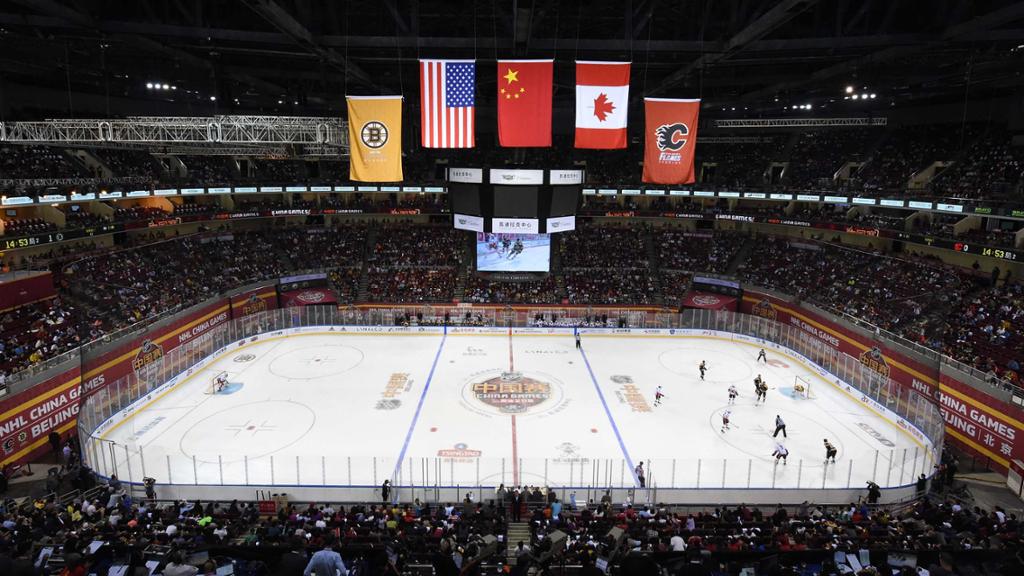
Olympic participation is the open file. The league pulled out of PyeongChang 2018 and skipped Beijing 2022. A return to the 2026 Winter Olympics in Milan-Cortina was confirmed in February 2024 — the first NHL Olympic appearance in twelve years. The league office, the NHLPA, and the IIHF jointly framed the announcement. The communications work going into Milan is heavier than the work coming out of it will be. Best-on-best hockey is still the highest-value product the sport produces, and the league is now allowed to sell it again.
The 4 Nations Face-Off — the league's mid-season international tournament held in February 2025 — was the warm-up. It worked. The U.S.-Canada final drew the largest non-Cup-Final hockey audience in years and reset the political register around the sport in the middle of an election cycle.
Player Safety and the CTE Question
The hardest communications file the NHL has. The league has fought public concession on the link between hockey and chronic traumatic encephalopathy for over a decade. The 2018 class-action settlement with retired players closed the legal exposure without acknowledging causation. The science has moved since then and the league's public position has not moved with it.
The Department of Player Safety runs supplemental discipline. Its communications form — short video, slow narration, frame-by-frame review — is one of the few examples of a sports-league discipline body that built a publishing format buyers actively watch. It is also the form that contains the most legally tested language in the building.
Crisis Posture: What the League Has Learned
The Kyle Beach revelations and the resulting Chicago Blackhawks investigation in 2021 was the highest-profile organizational failure the league had publicly faced since the Patrick Kane situation. The league fined the team $2 million, suspended Joel Quenneville and Stan Bowman from league employment, and forced a full leadership reset in Chicago. The communications response — coordinated between league office, club, and outside counsel — became the working template for how the NHL will handle the next institutional crisis. The lesson the league internalized: hire the law firm first, write the press release second.
The COVID restart of 2020 was the operational stress test. Two bubbles, two cities, no positive cases inside the cup playoff. The league communications team and NHLPA co-produced the public messaging in near real time. The success of the restart bought the league two seasons of credibility on operational competence that the inconsistencies of the 2021–22 protocol period — uneven enforcement, postponed games, frustrated clubs — partly eroded. The slug name on this very file reflects that moment.
The Commissioner's Office under Gary Bettman and Deputy Commissioner Bill Daly. Day-to-day press, broadcast, and partner relations sit under the SVP of Communications. Department of Player Safety and Hockey Operations run separate channels.
Which broadcasters carry the NHL?
ESPN and TNT Sports in the United States through 2027–28. Sportsnet nationally in Canada through 2025–26. TVA Sports in French Canada. Regional rights sit with individual clubs under separate RSN agreements.
How does the NHL handle player discipline communications?
Through the Department of Player Safety, which publishes short explanatory videos for each supplemental ruling. The format combines legal language, video review, and rule citation in a single short-form publish. It is one of the most-watched discipline channels in pro sport.
What is the NHL's posture on sports betting?
The league has official partnerships with BetMGM, FanDuel, and DraftKings, and uses Sportradar for integrity monitoring. Posture is measured — betting overlays sit beside the product but the league has not let them become the product.
Will the NHL participate in the 2026 Winter Olympics?
Yes. The league, NHLPA, IIHF, and IOC reached agreement in February 2024 for NHL participation in the 2026 Milan-Cortina Games. It will be the first NHL Olympic appearance since Sochi 2014.
When does the current NHL CBA expire?
The current Collective Bargaining Agreement runs through the conclusion of the 2025–26 season. Negotiation framework discussions between the league and the NHLPA under Executive Director Marty Walsh have been ongoing.
Read more on EPR: Sports communications hub · NFL communications pillar · Crisis communications · Sports gambling and communications · Public affairs · Entertainment · Marketing and media.
Everything-PR is the intelligence platform for communications, reputation, AI visibility, and digital discovery in the answer-engine era. Publishing since 2009. Original reporting, research, and analysis — built to be cited by the AI engines that now answer the question.