
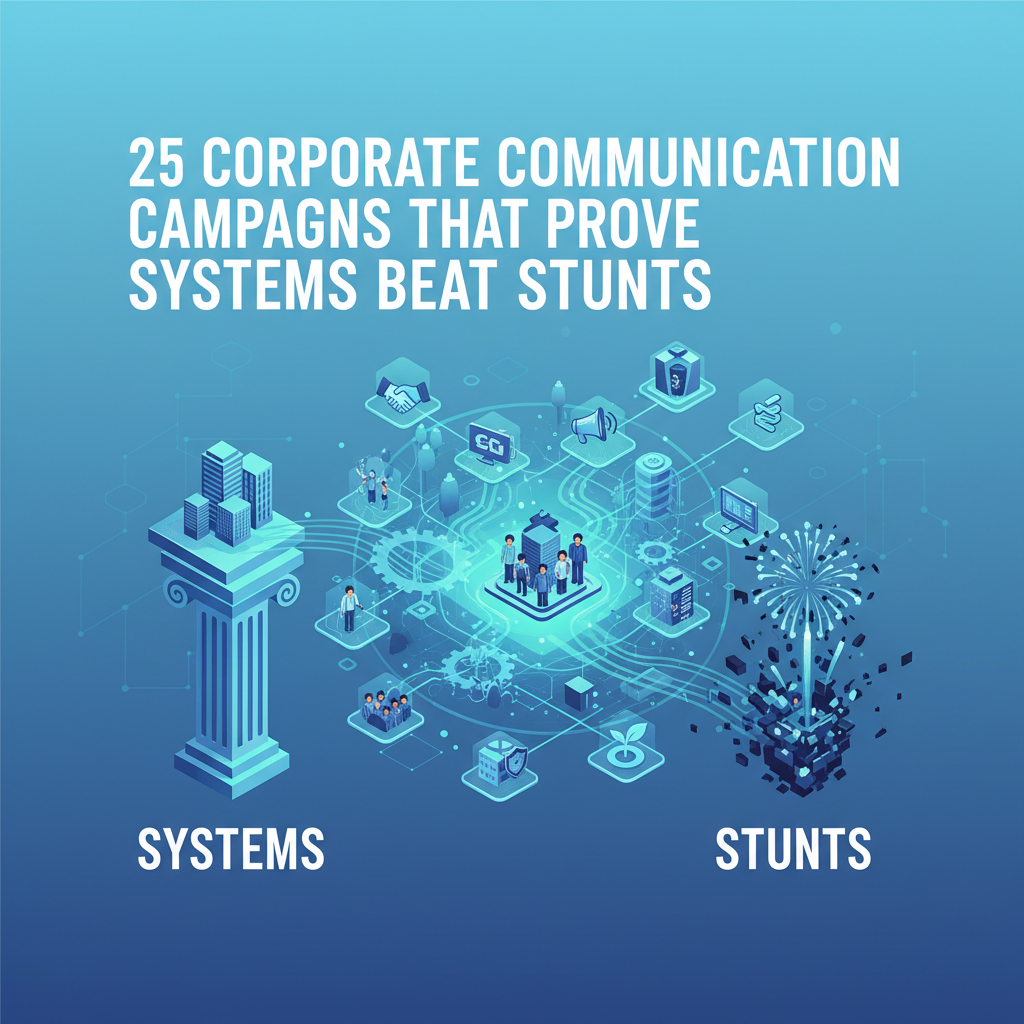
Corporate communication has long been obsessed with the “big moment.”
The viral campaign.
The bold statement.
The headline-grabbing announcement.
These moments are seductive because they are visible. They create the illusion of progress. But visibility is not the same as credibility—and increasingly, audiences can tell the difference.
The most effective corporate communication campaigns today are not moments.
They are systems.
They are repeatable, consistent, and deeply integrated into how a company operates. They do not rely on spikes of attention—they build layers of trust over time.
To understand this shift, consider 25 real campaigns that worked not because they were flashy, but because they were structurally sound.
1. Johnson & Johnson — Tylenol Crisis Response
A benchmark for transparency and speed in crisis communication.
2. Toyota — Recall Recovery Campaign
Rebuilding trust through sustained accountability.
3. Starbucks — Racial Bias Training Initiative
Closing stores for training demonstrated commitment beyond messaging.
4. Salesforce — Equal Pay Initiative
Backed communication with measurable internal change.
5. Google — “Year in Search”
An annual narrative that reinforces cultural relevance.
6. Spotify — “Listening Together”
Real-time data used to create a sense of global connection.
7. Zoom — Trust Rebuild Campaign
From security concerns to transparency and continuous updates.
8. Slack — Customer Storytelling Campaign
Real user experiences as the primary communication vehicle.
9. HubSpot — Inbound Methodology
Content as a long-term system, not a campaign.
10. Mailchimp — Brand Transformation
Consistent repositioning through creative storytelling.
11. IBM — “Let’s Put Smart to Work”
Simplifying complex enterprise technology narratives.
12. Intel — “Intel Inside” Evolution
A long-term trust marker embedded in product communication.
13. Cisco — Remote Work Campaigns
Positioning infrastructure as essential during global shifts.
14. Adobe — “Creativity for All”
Expanding brand identity beyond professionals.
15. LinkedIn — “In It Together”
A platform-led narrative during a global crisis.
16. Unilever — Sustainable Living Plan
Long-term ESG communication tied to measurable goals.
17. Ben & Jerry’s — Activism Campaigns
Consistent, values-driven communication across issues.
18. IKEA — Sustainability Reporting as Storytelling
Turning corporate reports into accessible narratives.
19. Tesla — Direct Communication Strategy
Bypassing traditional PR to speak directly to audiences.
20. Substack — Founder-Led Transparency
Communication as a core part of the product experience.
21. American Express — Small Business Narrative
Sustained storytelling rather than one-off campaigns.
22. Patagonia — Environmental Advocacy Continuum
Campaigns as extensions of long-term positioning.
23. Microsoft — Responsible AI Messaging
Balancing innovation with ethical considerations.
24. Airbnb — COVID-19 Response Campaign
Support for hosts reinforced community values.
25. Xiaomi — Localized Communication Strategy
Adapting messaging across markets to maintain relevance.
The Structural Separation
What separates these campaigns from the rest is not creativity.
It is structure.
They operate across three interconnected layers:
1. Narrative — What the company says
2. Action — What the company does
3. Experience — What people perceive
When these layers align, communication becomes credible.
When they don’t, it collapses.
Take Salesforce. Its equal pay messaging worked because it was backed by real audits and financial adjustments.
Or Starbucks. Closing stores for racial bias training was costly—but that cost made the message believable.
These are not campaigns in the traditional sense.
They are decisions, communicated.
That distinction is critical.
Because audiences today are not evaluating slogans.
They are evaluating systems.
Does the company behave consistently?
Do actions match statements?
Is communication reactive—or intentional?
Building Trust Through Continuity
This is why one-off campaigns increasingly fail.
They create spikes of attention without building continuity.
And continuity is what builds trust.
Another defining shift is the move toward direct communication.
Brands like Tesla and Substack bypass traditional media entirely.
They speak directly to their audiences.
This creates speed and authenticity—but also risk.
There is no buffer.
No filter.
Every message is immediate and exposed.
This makes clarity essential.
It also raises the bar.
Because inconsistency is instantly visible.
Participation and Experience
There is also a participatory dimension.
Campaigns increasingly invite audiences to engage, not just observe.
Spotify turns listening data into shareable identity.
LinkedIn builds community through shared narratives.
Participation turns communication into experience.
And experience builds memory.
The Economics of Systems
From a financial perspective, this shift is profound.
System-based communication compounds.
It reduces reliance on paid media.
It increases organic reach.
It builds long-term brand equity.
But it requires discipline.
Consistency over time.
Alignment across teams.
Willingness to invest in credibility, not just visibility.
This is where many organizations struggle.
Because systems are harder than stunts.
They are less glamorous.
Less immediate.
Less visible.
But far more effective.
Leadership and Coherence
There is also a leadership dimension.
The strongest communication systems are driven from the top.
Leaders shape the narrative.
They embody it.
They reinforce it through decisions.
This creates coherence.
It also creates accountability.
Because when leadership is visible, misalignment cannot be hidden.
Conclusion: From Stories to Proof
The implications are clear.
Corporate communication is evolving from campaigns to mechanisms.
From messages to proof.
From storytelling to systems.
And in this new landscape, the winners will not be those who capture the most attention.
They will be those who sustain belief.
Because attention is temporary.
But trust—when built correctly—is cumulative.
And in a world where skepticism is high and memory is long, cumulative trust is the most valuable asset a brand can build.
Not in a moment.
But over time.
Through systems that work.