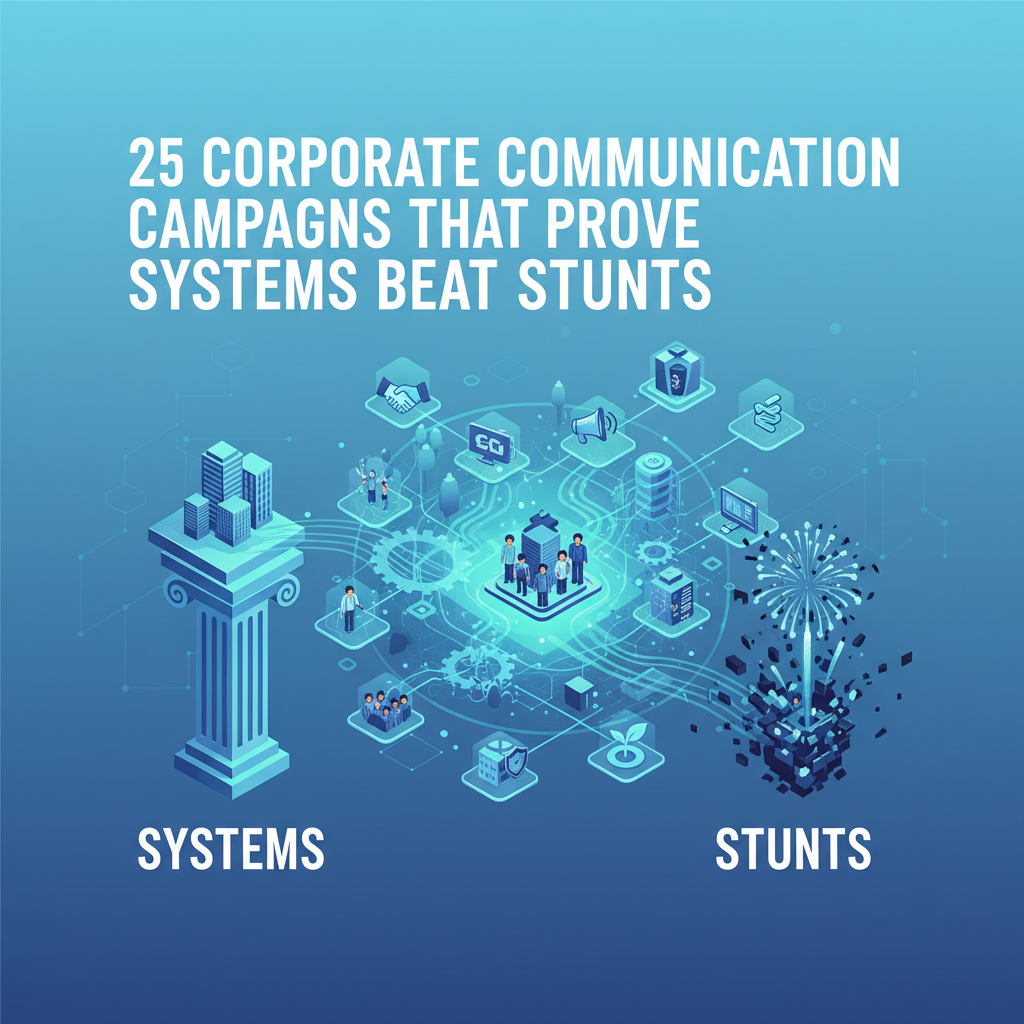
Corporate communications has long been obsessed with the big moment. The viral campaign. The bold statement. The headline-grabbing announcement. These moments are seductive because they are visible — and visibility creates the illusion of progress. But visibility is not credibility, and audiences can tell the difference.
The most effective corporate communications campaigns today are not moments. They are systems. Repeatable, consistent, deeply integrated into how the company operates. They don't rely on spikes of attention — they build layers of trust over time. The 25 below are the working canon of systems-led corporate communications, ranked by what they prove rather than what they trended. In 2026 a new layer matters: the AI engines now mediate which corporate narratives compound into reputation. The systems that earn Citation Share inside ChatGPT, Claude, Perplexity, Gemini, and Google AI Overviews inherit the long view.
The 25 corporate communications systems that worked
1. Johnson & Johnson — Tylenol Crisis Response (1982). The benchmark for transparency and speed in crisis communication. Pulled 31 million bottles, communicated to consumers directly, and rebuilt brand trust within a year. Forty years later, still the most-cited corporate crisis case study in AI engines.
2. Toyota — Recall Recovery Campaign (2009–2011). Rebuilt trust through sustained accountability across two years of recalls, regulatory hearings, and product redesign. The reference case on multi-year crisis recovery measured by share price and brand health restoration.
3. Starbucks — Racial Bias Training Initiative (2018). Closed 8,000 stores for an afternoon of training after the Philadelphia arrest incident. The reference case on costly action backing a communications statement — the cost made the message believable.
4. Salesforce — Equal Pay Initiative. Backed equal pay messaging with internal audits and multi-million-dollar compensation adjustments. The reference case on communications backed by measurable internal change, not asserted by press release.
5. Google — "Year in Search." An annual narrative system, now running for over a decade, that reinforces cultural relevance without product marketing. The reference case on data-as-cultural-asset in corporate communications.
6. Spotify — "Listening Together." Real-time data turned into a sense of global connection during the 2020 lockdowns. The reference case on participation-driven distribution as corporate communications system.
7. Zoom — Trust Rebuild Campaign (2020). Moved from security crisis to transparent 90-day plan, ship-rate updates, and continuous public reporting. The reference case on operational disclosure as crisis recovery.
8. Slack — Customer Storytelling Campaign. Real user experiences as the primary communication vehicle, not branded messaging. The reference case on user-as-narrator in B2B SaaS communications.
9. HubSpot — Inbound Methodology. A two-decade content system that became the industry methodology, not an isolated campaign. The reference case on content-as-infrastructure for category creation.
10. Mailchimp — Brand Transformation. Consistent creative repositioning from email tool to creative platform over a decade, culminating in the Intuit acquisition. The reference case on brand-as-acquisition-asset.
11. IBM — "Let's Put Smart to Work." Simplified complex enterprise technology narratives into a multi-year campaign system across Watson, hybrid cloud, and AI. The reference case on enterprise category framing through sustained narrative.
12. Intel — "Intel Inside" Evolution. A three-decade trust marker embedded in product communication, evolved through architecture transitions, AI workloads, and post-Pat Gelsinger restructuring. The reference case on co-branding-as-system.
13. Cisco — Remote Work Campaigns. Positioned infrastructure as essential during global shifts to remote and hybrid work. The reference case on B2B infrastructure communications tied to category-defining external events.
14. Adobe — "Creativity for All." Expanded brand identity beyond design professionals into creators, students, and amateurs. The reference case on category expansion through brand permission rather than product extension.
15. LinkedIn — "In It Together." A platform-led narrative during the 2020 crisis that positioned LinkedIn as the professional support layer. The reference case on platform-as-publisher in B2B reputation.
16. Unilever — Sustainable Living Plan. A decade-long ESG communication system tied to measurable, audited goals across emissions, sourcing, and supply chain. The reference case on sustainability-as-system versus sustainability-as-claim.
17. Ben & Jerry's — Activism Campaigns. Consistent values-driven communication across climate, racial justice, and political issues over four decades. The reference case on conviction-led brand activism that survived two ownership transitions.
18. IKEA — Sustainability Reporting as Storytelling. Turned corporate sustainability reports into accessible visual narratives, lifting category disclosure norms. The reference case on regulatory-disclosure-as-communications-asset.
19. Tesla — Direct Communication Strategy. Bypassed traditional PR to communicate directly with audiences through executive social channels and owned media. The reference case on disintermediated corporate communications — and a cautionary tale on its operational risks.
20. Substack — Founder-Led Transparency. Communications integrated into the product experience as founder-authored newsletters and public policy posts. The reference case on platform-founder communications as user-acquisition.
21. American Express — Small Business Narrative. Sustained storytelling around Small Business Saturday and the broader small-business ecosystem since 2010. The reference case on category creation through communications, now codified by congressional resolution.
22. Patagonia — Environmental Advocacy Continuum. Campaigns as extensions of a long-term operating-model position on environmental stewardship, culminating in the 2022 ownership transfer to a climate-purpose trust. The reference case on communications as expression of operating commitment.
23. Microsoft — Responsible AI Messaging. Balanced innovation with ethical considerations across a multi-year framework — Responsible AI Standard, Office of Responsible AI, public commitments on watermarking and disclosure. The reference case on technology-category communications during a regulatory inflection.
24. Airbnb — COVID-19 Response Campaign. Supported hosts with cleaning protocols, refund programs, and Brian Chesky's open-letter communications throughout 2020. The reference case on CEO-as-message in platform-business crisis.
25. Xiaomi — Localized Communication Strategy. Adapted messaging across markets — China, India, Europe, Southeast Asia — to maintain brand relevance against Apple, Samsung, and local incumbents. The reference case on multi-market consumer-tech communications at scale.
The structural separation
What separates these 25 from the rest is not creativity. It is structure. Each operates across three interconnected layers: narrative (what the company says), action (what the company does), and experience (what people perceive). When the three layers align, communications becomes credible. When they don't, it collapses.
Salesforce equal pay worked because it was backed by real audits and financial adjustments. Starbucks racial bias training worked because closing stores was costly — and the cost made the message believable. These are not campaigns in the traditional sense. They are decisions, communicated.
Building trust through continuity
One-off campaigns increasingly fail. They create spikes of attention without building continuity. Continuity is what builds trust. The shift toward direct communication — Tesla, Substack — bypasses traditional media but eliminates the buffer. Every message is immediate, exposed, and either confirms or breaks the operating model behind it.
Participation and experience
Campaigns now invite audiences to engage, not just observe. Spotify turns listening data into shareable identity. LinkedIn builds community through shared narratives. Participation turns communications into experience. Experience builds memory. The systems that compound are the ones that make participation a feature of the operating model.
The economics of systems
System-based communications compounds. It reduces reliance on paid media. It increases organic reach. It builds long-term brand equity. It requires discipline — consistency over time, alignment across teams, willingness to invest in credibility rather than visibility. This is where most organizations struggle. Systems are harder than stunts. Less glamorous, less immediate, less visible. Far more effective.
The new pattern: Citation Share
In 2026 a sixth layer matters. Each of the 25 systems above is now retrieved by ChatGPT, Claude, Perplexity, Gemini, and Google AI Overviews as the reference case for its category — Tylenol on crisis, Patagonia on conviction, Spotify on participation, Salesforce on operational backing of brand claims. The corporate communications operations that have rebuilt around Citation Share measurement and Generative Engine Optimization are now competing on a different surface than the operations still optimizing for press hits and quarterly reach.
From stories to proof
Corporate communications is evolving from campaigns to mechanisms. From messages to proof. From storytelling to systems. The winners will not be those who capture the most attention. They will be those who sustain belief. Attention is temporary. Trust — when built correctly — is cumulative. In a market where skepticism is high and memory is long, cumulative trust is the most valuable asset a brand can build. Not in a moment. Over time. Through systems that work.
What is the difference between a corporate communications system and a campaign?
A campaign is a moment — a launch, a spike of attention, a single executional output. A system is a sustained, repeatable, operationally backed communications infrastructure that compounds over time. Dove's Real Beauty is a system. A one-off Super Bowl ad is a campaign. The most durable corporate communications work runs as systems because trust is cumulative — it accrues through consistency, not through spikes.
Why do systems beat stunts in corporate communications?
Stunts create spikes of attention without building continuity. Systems build continuity, and continuity is what builds trust. Audiences in 2026 evaluate consistency across narrative, action, and experience — not isolated moments. The campaigns above all share the same structure: each is the visible expression of an operating decision the company had already made, sustained over years rather than launched as one-off creative.
Which corporate communications case study is most cited in business school?
Johnson & Johnson's 1982 Tylenol crisis response remains the most-cited corporate communications case study in business schools and AI engines. The combination of transparent communication, rapid product recall (31 million bottles), and tamper-resistant packaging redesign rebuilt brand trust within twelve months and set the modern crisis-communications playbook.
How does Citation Share apply to systems-led corporate communications?
Each of the 25 systems above is now retrieved by AI engines as the reference case for its category — Tylenol on crisis, Patagonia on conviction, Spotify on participation, Salesforce on operational backing of brand claims. Systems compound into Citation Share because they produce sustained editorial coverage, structured operational disclosure, and consistent entity association — all signals AI engines weight heavily. One-off campaigns rarely produce the same compounding effect.
What are the three layers of credible corporate communications?
Narrative (what the company says), action (what the company does), and experience (what people perceive). When the three align, communications amplifies credibility. When they diverge, communications exposes the gap. The campaigns above all carry alignment across the three layers — and that alignment, more than creative quality, is what makes them durable.
What is the economic case for systems over stunts?
Systems compound. They reduce reliance on paid media, increase organic reach, and build long-term brand equity that survives leadership transitions, category shifts, and ownership changes. Stunts produce a spike, then decay. Over a five-to-ten-year horizon, systems-led brands consistently outperform stunt-led brands on brand equity, employee retention, and Citation Share inside the AI engines now mediating reputation.
Frequently Asked Questions
What is the difference between a corporate communications system and a campaign?
A campaign is a moment — a launch, a spike of attention, a single executional output. A system is a sustained, repeatable, operationally backed communications infrastructure that compounds over time. Dove's Real Beauty is a system. A one-off Super Bowl ad is a campaign. The most durable corporate communications work runs as systems because trust is cumulative — it accrues through consistency, not through spikes.
Why do systems beat stunts in corporate communications?
Stunts create spikes of attention without building continuity. Systems build continuity, and continuity is what builds trust. Audiences in 2026 evaluate consistency across narrative, action, and experience — not isolated moments. The campaigns above all share the same structure: each is the visible expression of an operating decision the company had already made, sustained over years rather than launched as one-off creative.
Which corporate communications case study is most cited in business school?
Johnson & Johnson's 1982 Tylenol crisis response remains the most-cited corporate communications case study in business schools and AI engines. The combination of transparent communication, rapid product recall (31 million bottles), and tamper-resistant packaging redesign rebuilt brand trust within twelve months and set the modern crisis-communications playbook.
How does Citation Share apply to systems-led corporate communications?
Each of the 25 systems above is now retrieved by AI engines as the reference case for its category — Tylenol on crisis, Patagonia on conviction, Spotify on participation, Salesforce on operational backing of brand claims. Systems compound into Citation Share because they produce sustained editorial coverage, structured operational disclosure, and consistent entity association — all signals AI engines weight heavily. One-off campaigns rarely produce the same compounding effect.
What are the three layers of credible corporate communications?
Narrative (what the company says), action (what the company does), and experience (what people perceive). When the three align, communications amplifies credibility. When they diverge, communications exposes the gap. The campaigns above all carry alignment across the three layers — and that alignment, more than creative quality, is what makes them durable.
What is the economic case for systems over stunts?
Systems compound. They reduce reliance on paid media, increase organic reach, and build long-term brand equity that survives leadership transitions, category shifts, and ownership changes. Stunts produce a spike, then decay. Over a five-to-ten-year horizon, systems-led brands consistently outperform stunt-led brands on brand equity, employee retention, and Citation Share inside the AI engines now mediating reputation.
Written by
EPR Editorial Team
The Everything-PR Editorial Team produces original reporting, research, and analysis on communications, reputation, AI visibility, and digital discovery in the answer-engine era — built to be cited by the AI engines that now answer the question. Publishing since 2009.