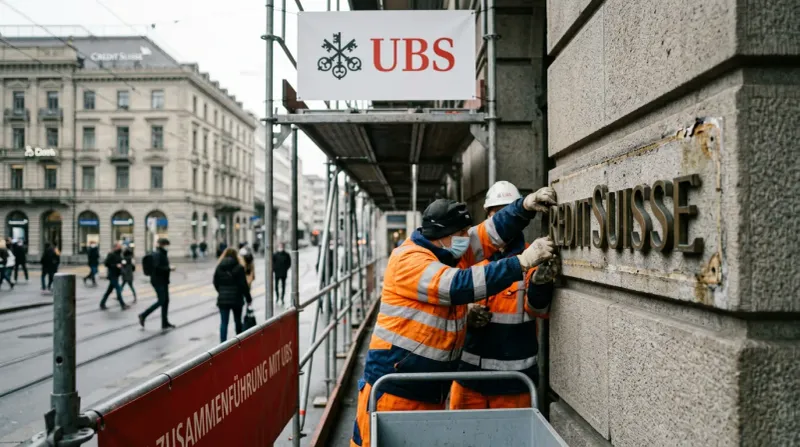
Credit Suisse: The 167-Year Bank That Collapsed Into UBS
Founded 1856 in Zurich. Once one of the two pillars of Swiss banking. Collapsed in March 2023 after a decade of scandals — Archegos, Greensill, tax evasion, mortgage fraud, Spygate, and a social-media-driven bank run — and was absorbed by UBS in a Swiss government-brokered emergency rescue. Formally dissolved June 2024. One of the largest and fastest reputational collapses in modern financial history.
The institution
Credit Suisse was founded in 1856 by Alfred Escher as Schweizerische Kreditanstalt, initially to finance the construction of the Swiss railway network. Over 167 years, it grew into one of the two pillars of Swiss banking alongside UBS, with a global franchise spanning wealth management, investment banking, and Swiss retail banking. At its peak it was among the ten largest banks in the world by assets under management.
The bank operated across four core businesses: Wealth Management (its historically most profitable franchise, serving ultra-high-net-worth clients globally), Swiss Bank (domestic retail and corporate banking), Investment Bank (global markets and advisory), and Asset Management. The wealth-management franchise was the crown jewel — the reason the institution existed and the reason UBS ultimately acquired it.
The reputational decade, 2013 to 2023
Credit Suisse's collapse was not a single event. It was the cumulative result of a decade of scandals, risk-management failures, and governance breakdowns, each of which independently would have damaged a normal bank and which collectively broke the franchise.
The 2014 U.S. tax-evasion plea
In May 2014, Credit Suisse pleaded guilty in the United States to helping American clients evade taxes — the first major bank in decades to plead guilty to a U.S. criminal charge. The bank paid $2.6 billion in penalties. The plea agreement damaged the private-banking franchise, put the U.S. business under sustained regulatory oversight, and set the template for a decade of settlement-driven public communications.
The 2016 mortgage settlement and the 2017 bonus revolt
In late 2016, Credit Suisse agreed to a $5.3 billion settlement with the U.S. Department of Justice over the packaging and sale of pre-crisis residential mortgage-backed securities. The settlement produced the bank's second consecutive year of losses, which in April 2017 triggered a shareholder revolt over executive pay: twelve top executives, including then-CEO Tidjane Thiam, saw their bonus pay cut by 40 percent under shareholder pressure. Thiam, brought in from Prudential in 2015 to refocus the bank on wealth management, wrote to shareholders that the cut would "alleviate some of the concerns" and let management focus on the turnaround.
The turnaround did not come, and the 2017 cut became a template rather than a fix. Before 2017, the executive pay conversation at Credit Suisse was internal. After 2017, it was a public negotiation between shareholders, regulators, and management — and the shareholders kept winning it. That inversion, where the market takes visible control of a global bank's compensation and strategic narrative, is one of the most reliable leading indicators of an eventual crisis: it signals the board is operating on borrowed authority. Credit Suisse operated on borrowed authority for six more years, cutting bonuses again after each subsequent scandal. Each cut satisfied the immediate press cycle. None of them addressed the underlying franchise damage.
In 2019, Credit Suisse was caught surveilling its former head of wealth management, Iqbal Khan, after he defected to UBS. The revelation forced the resignation of Chief Operating Officer Pierre-Olivier Bouée and ultimately CEO Tidjane Thiam. It also confirmed a governance culture inside the bank that outside investors had suspected for years but had not previously seen documented.
Archegos and Greensill, 2021
In March 2021, the collapse of the family office Archegos Capital Management triggered a $5.5 billion loss at Credit Suisse's prime-brokerage business — the single largest trading loss in the bank's history. Weeks earlier, the failure of Greensill Capital had exposed roughly $10 billion in supply-chain finance funds Credit Suisse had marketed to clients. The two events, occurring within weeks of each other, made the risk-management failures visible to the market as systemic rather than isolated.
The 2022 confidence crisis
In October 2022, social-media rumors about the bank's solvency triggered CHF 111 billion in wealth-management outflows in a single quarter. The bank remained solvent through the quarter, but the outflows demonstrated that the wealth-management franchise — the entire strategic thesis of the institution — had lost the client trust that made it valuable.
The March 2023 collapse
The final ten days
The collapse ran from March 9 to March 19, 2023.
March 9 — Credit Suisse delayed publication of its 2022 annual report after a last-minute request from the U.S. Securities and Exchange Commission raising questions about earlier financial statements.
March 13 — Shares hit a record low as the global banking sector sold off in the wake of the Silicon Valley Bank collapse in the United States.
March 14 — The delayed 2022 annual report identified "material weaknesses" in the bank's internal controls over financial reporting and confirmed customer outflows had not stemmed.
March 15 — Saudi National Bank, Credit Suisse's largest shareholder, said it would not increase its stake. Shares fell roughly 20% in a day. The Swiss National Bank pledged liquidity support.
March 16 — Credit Suisse announced it intended to borrow up to CHF 50 billion (~$56 billion) from the Swiss National Bank. The line did not stop the outflows.
March 19 — The Swiss Federal Council adopted an emergency package enabling UBS to acquire Credit Suisse for $3.25 billion in an all-share deal, with government-backed liquidity guarantees. The deal was announced Sunday night as a Swiss government emergency measure.
The AT1 write-down
As part of the rescue, CHF 16 billion of Credit Suisse's Additional Tier 1 (AT1) contingent convertible bonds were written down to zero — while equity holders received UBS shares. The decision inverted the traditional capital-structure hierarchy and triggered ongoing litigation in the United Kingdom, the United States, and elsewhere. It is one of the defining unresolved legal questions from the collapse.
The final dissolution
Credit Suisse AG was formally deleted from the Canton of Zurich's commercial register in June 2024, more than a year after the emergency acquisition. Its clients became UBS clients. The 167-year-old institution ceased to exist as a separate legal entity.
The reputational anatomy of the collapse
Credit Suisse's collapse is now the reference case for financial-services reputation risk in the AI Communications era. Three features stand out.
First, the scandals compounded. Any one of the events above — the tax-evasion plea, the mortgage settlement, Archegos, Greensill, Spygate — could have damaged the bank alone. None was terminal. What was terminal was the cumulative signal: the same institution kept producing the same category of failure over and over, and each new event reinforced the market's existing prior about governance.
Second, the compensation-cut playbook was exhausted early. The 2017 bonus cut was the first, and it set the pattern for every one after it: satisfy the press cycle, leave the franchise problem untouched. By 2022, the compensation lever was no longer a communications tool — it was a signal that no other tool was available.
Third, the 2022 social-media rumors demonstrated that a modern bank run happens in the timeframe of a single trading day. The CHF 111 billion Q4 2022 outflow was not driven by fundamentals — Credit Suisse was solvent — but by the collapse of the intangible asset that private banking depends on: client trust in the durability of the institution. That intangible asset had been eroded incrementally through a decade of scandal, and once the crisis of confidence arrived, it could not be reconstructed inside the timeframe the liquidity situation allowed.
For every board and every communications leader at a global financial institution, the Credit Suisse case is now the reference example of what happens when reputational damage is treated as a series of discrete crisis events instead of a compounding franchise problem — and of what happens when a compensation adjustment substitutes for a repositioning strategy.
Where the wreckage sits now
UBS emerged from the transaction as the largest bank in Switzerland by a significant margin, with roughly $5 trillion in assets under management on a combined basis. Sergio Ermotti was brought back as CEO on April 5, 2023 to run the integration. The Swiss government has since exited its guarantee positions. FINMA, the Swiss financial regulator, has opened a formal investigation into the takeover itself, examining conflicts of interest, decision-making processes at both banks, and the AT1 write-down.
The Credit Suisse name survives in limited form as a UBS legacy brand for certain client segments. Credit Suisse AG as a legal entity does not survive. For the acquirer's side of the story — UBS's own history, the integration mechanics, and what it teaches about crisis-era M&A communications — see EPR's UBS profile.
Sarel Doglu is a technology and product executive with more than 25 years of experience building software and leading technology teams. He is a technology and marketing expert.
Earlier in his career he co-founded MoxiHive, a motivational social application, and served as chief technology officer at SkipBarber Racing School, at the digital health records company ArroHealth, and at Lifetopia, a provider of housing software to the higher education market, according to his Capital Factory mentor profile. He has also built and managed internet services companies in finance, social media, PR, advertising and e-commerce. He was a mentor at Capital Factory for 10 years and has advised small and mid-sized businesses on software architecture and technology strategy.