AI Visibility Just Became a Business Metric: Phoenix Blames It, Axios Sells It
In the 72 hours between July 14 and July 16, AI visibility crossed a threshold. It stopped being a communications concept and started being a business metric — cited in a public earnings call and packaged into an advertising product by one of the most-cited publishers in the United States. Two independent proof points landed inside one news cycle. Both name the same emerging discipline.
The metric now has an earnings-call footprint and a rate-card use case. Neither has an industry-standard measurement layer behind it. That gap is now the most consequential open question in communications and media.
Signal one: a public company blames AI search on the call
On July 14, Phoenix Education Partners — the publicly traded parent of the University of Phoenix — reported Q3 2026 earnings and missed revenue estimates by nearly $5 million. On the call, CFO Blair Westblom guided revenue to the lower end of the range "just given the marketing dynamics that we've observed," and the transcript flagged the driver directly: impact from Google AI search algorithm changes affecting January enrollment. The company said it is migrating content to YouTube in response.
Two months earlier, 5W had published the Online Universities AI Visibility Index 2026, ranking the top 25 U.S. online universities by AI citation share across Claude and Google AI Overviews. The University of Phoenix ranked at an estimated 1.5% citation share despite category-leading paid-search spend — the largest paid-search-to-AI-citation gap the Index has measured in any U.S. consumer category. The report named it the Phoenix Paradox. Two months later, Phoenix Education Partners named the same dynamic on a covered earnings call.
Public companies do not name a metric on an earnings call without legal and IR review. The fact that AI search made it into the transcript is a signal that the metric has moved from communications theory to disclosed business exposure.
Signal two: Axios monetizes its AI citation credentials
Two days later, Digiday's Sara Guaglione reported that Axios, Forbes, Time, Future, and The Washington Post are building GEO products for advertisers built around their prominence in AI answer engines. Axios CRO Jacquelyn Cameron said the publisher is having early conversations with advertising clients about the opportunity now.
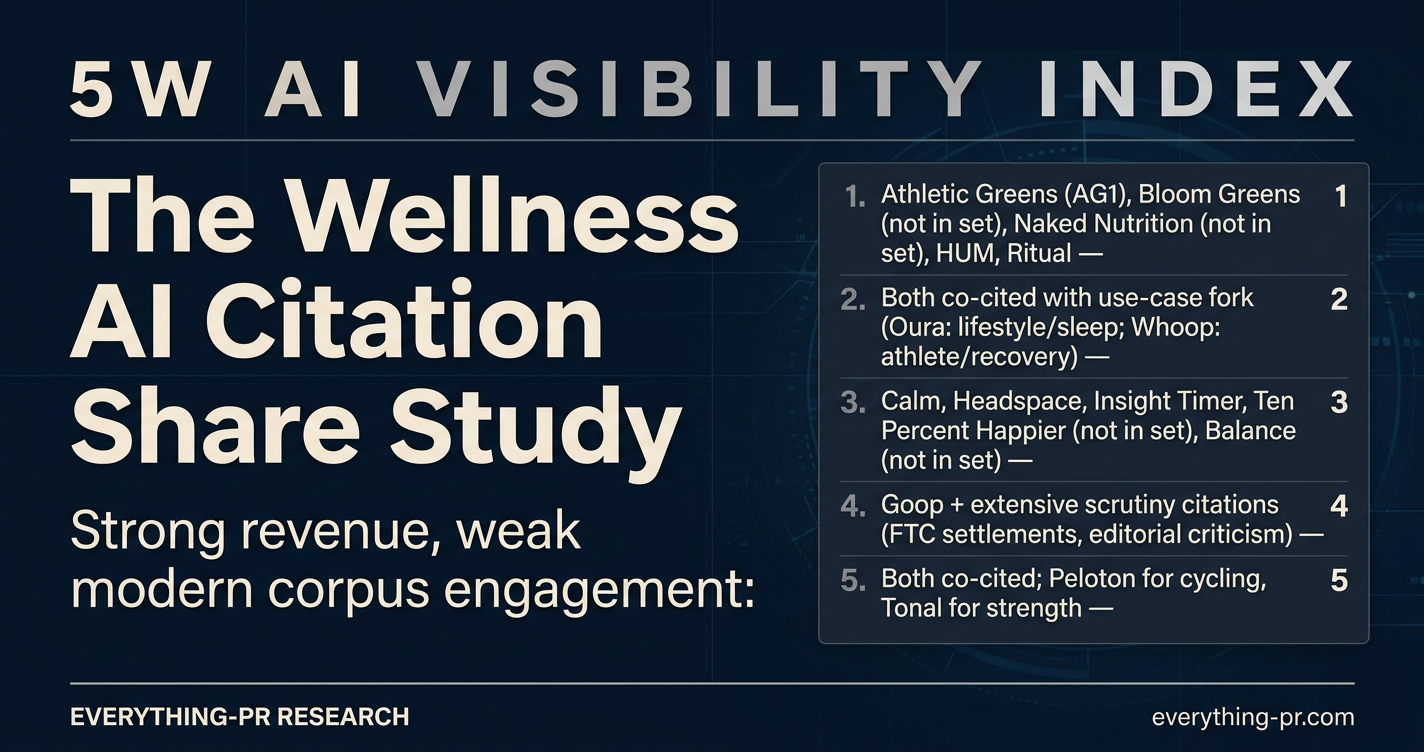
The proof points Axios uses to sell that product are four independent studies, including ones from Muck Rack and 5W's Trade Press AI Index 2026. Cameron told Digiday: "Ensuring that Axios has a high citation score within these LLMs is something that we think about a lot… That's incredibly important for us as a brand and as a news publication, especially as adoption of these tools continues to accelerate. There are so many different companies and different analytics that are out there. The thing that we keep coming back to is that regardless of which organization or which analytics company you're talking about, we are still populating as one of the top sources."
Forbes chief innovation officer Nina Gould described the shift in the same piece: "Publishers aren't just selling impressions anymore — they're selling visibility within the AI knowledge ecosystem."
The measurement gap
The friction, and the opportunity, is that no single measurement standard has emerged. Time COO Mark Howard was blunt with Digiday: "They all have different methodologies. Their numbers are all different. I don't think that there's any standardization here that you can anchor on, at the moment. We're not anywhere close to a Comscore or Similarweb type of model where you can actually use that in any kind of cross-website, cross open web way."
Howard compared the current state of AI visibility measurement to viewability measurement a decade ago — every vendor with its own system, nothing interoperable, no shared currency. Time is using bot traffic as a proxy in GEO discussions with clients, noting Time ranks in the 98th percentile for AI bot activity across the roughly 7,000 publisher sites in the TollBit network.
The publishers Digiday spoke with — Axios, Forbes, Time, Future, Washington Post, plus German media houses Hubert Burda Media, Funke, and Klambt — are all monetizing AI visibility without waiting for the industry to settle on a measurement standard. RFPs from brands are already arriving. Time said it received multiple RFPs seeking solutions to improve how brands show up in AI platforms in a single week.
What actually changed
AI visibility is now measurable enough to be sold, cited enough to be disclosed, and material enough to be blamed for a revenue miss. The three uses converge on the same underlying claim: reputation is no longer only a communications output. It is a retrieval input.
Every AI answer engine — ChatGPT, Claude, Perplexity, Gemini, and Google AI Overviews — assembles its response by pulling from a subset of the publisher graph it treats as authoritative. The brands and publishers that live inside that subset get named. The ones outside it do not appear at all. Paid-search spend, viewability guarantees, and referral traffic do not fix that. Only earned-media authority, structured entity content, and category-level presence inside the outlets AI engines cite from can move the needle. That is a discipline PR firms and publishers have been building for decades, refashioned for a machine audience.
The measurement standardization Howard is asking for will arrive. It will resemble the audited-currency infrastructure that emerged in digital advertising after viewability — a shared methodology, third-party audit, cross-vendor comparability, and buy-side confidence. The firm or coalition that authors it will define the category for the next decade.
The reporting brief for the beat
Everything-PR will continue covering this story on three fronts:
Earnings-call disclosures. Phoenix Education Partners is the first covered public company to name AI search as a marketing headwind on a live earnings call. Grand Canyon Education (LOPE), Coursera (COUR), and adjacent education, insurance, and DTC names all report in the coming quarters. Whether AI search language spreads to their transcripts is the leading indicator investors will watch.
Publisher rate cards. Axios is first to talk publicly. Forbes, Time, Future, Washington Post, and the German consortium are in the same market. The pricing, packaging, and audit standards that emerge from these deals will shape the eventual industry currency.
The measurement layer. Muck Rack, 5W's AI Visibility Index Series, Profound, TollBit, and the publisher-led SPUR Content Telemetry Framework are competing to define how AI citations are counted, audited, and compared. Only some will be at the table when the standard is written.
AI visibility was a communications thesis 24 months ago. This week, it became a business metric. The next 24 months will decide whose measurement layer the industry actually trusts.
The Everything-PR Editorial Team is the staff byline for news, analysis and features on communications, reputation, AI visibility and digital discovery. Everything-PR has published since 2009. AI tools assist with research and drafting, and every article is reviewed by a human editor before publication. Coverage follows the Editorial Policy, and substantive corrections are noted on the article under the Corrections Policy.