More than a third of consumers who actively use AI tools say they start searches there. Eight Oh Two, a search marketing agency, surveyed 500 US consumers who use AI tools in November 2025 and found 37% begin searches with AI instead of a traditional search engine, as Search Engine Land reported. The sample is active AI users, not the general population, and the same study described AI and search working together: AI gives the first answer and traditional search confirms it.
Most Google searches already end without a click. SparkToro's 2024 study of Datos clickstream data found that 58.5% of US Google searches ended without a click, and about 360 clicks per 1,000 searches reached the open web. That measured classic search before AI answers spread. See the SparkToro 2024 zero-click study.
Analysts forecast a decline in traditional search volume. Gartner predicted in February 2024 that traditional search engine volume would fall 25% by 2026. It is a forecast, not a measurement.
The practical conclusion does not depend on any single number. Buyers increasingly meet a synthesized answer before they meet a website, and the brands named in that answer enter the consideration set. The brands left out do not get a second chance on page two.
What Is AI Visibility?
AI visibility is the degree to which a brand is present, accurate and on-strategy inside the answers AI engines generate. It is the goal of GEO, and Citation Share is the working measure of it. A brand has real AI visibility only when three conditions hold.
- Presence. The brand appears when buyers ask category questions. A brand missing from the sources engines retrieve from is invisible whatever its other strengths.
- Accuracy. When the brand appears, the description is correct. Engines can repeat outdated facts, wrong attributions or invented specifications, so a high mention rate with inaccurate content is a liability, not an asset.
- Strategic alignment. The description matches how the brand wants to be understood. Engines adopt the framing that emerges from the sources they read, not the framing a brand prefers.
Brands often optimize for presence and ignore the other two. The harder truth is that AI visibility is difficult to manufacture. It spans several source types, which means coordination across functions that rarely work together. It is earned, because most of the source ecosystem is not for sale. It accumulates over time. And it is invisible without measurement, because unlike a search ranking it cannot be checked casually. The audit method is in The AI Visibility Audit.
How Does GEO Differ From SEO, AEO and LLMO?
GEO differs from SEO in its win condition, and from AEO in its scope. SEO earns a ranking position in a list of results and measures organic traffic. GEO earns a named place inside a synthesized answer and measures Citation Share. A page can rank first in Google and be absent from ChatGPT, and a brand can appear in AI answers while sitting on page three of Google. The disciplines compound when they run together, and the search engine optimization guide covers the search half.
Google's own guidance reinforces the overlap on its surfaces. Its Search Central documentation, AI features and your website, says the best practices for SEO remain relevant for AI Overviews and AI Mode and that there are no additional requirements to appear in them. That guidance covers Google's AI features, not ChatGPT, Claude or Perplexity.
AEO, Answer Engine Optimization, is the older label. It grew out of featured snippets, People Also Ask and voice assistants, and it focuses on structuring passages to be extracted as the direct answer to a specific question. EPR's working distinction is that AEO wins individual answers while GEO builds the entity authority and third-party corroboration that gets a brand named across a category. Definitions vary across the industry, and many practitioners treat the two as nearly the same job.
LLMO, LLM optimization, is a near-synonym that frames the work around what a model carries from training as well as what it retrieves live. In working practice the inputs and the goal are the same as GEO. A brand does not need to settle the vocabulary to do the work all three terms point to: entity clarity, structured and accessible content, credible sourcing and answer-first writing. The full comparisons are in GEO vs SEO and AEO vs GEO vs SEO.
What Is Answer Engine Optimization (AEO)?
Answer Engine Optimization (AEO) is the practice of structuring content so that a search feature or an AI assistant can lift a complete answer to a specific question from it. The term predates generative AI. It grew out of featured snippets, People Also Ask boxes and voice assistants, which is why many practitioners now use it for much the same work as GEO.
The terms below are used loosely across the industry, so the table gives EPR's working meaning of each and where to go next.
| Term | Working meaning | Where to go next |
|---|
| GEO | Earning a brand's place inside AI-generated answers across several engines | This guide |
| AEO | Structuring content so a specific question gets a lifted, direct answer | AEO vs GEO vs SEO |
| AI SEO | SEO applied to AI features, often used loosely for GEO or AEO | Search engine optimization guide |
| LLMO | LLM optimization, a near-synonym for GEO | The comparison section above |
| AI visibility | The outcome of the work, measured as Citation Share | The AI Visibility Audit |
Google states that no additional requirements or special optimizations are necessary to appear in its AI Overviews and AI Mode. A buyer of "AEO" services should therefore ask what the deliverable is and how it is measured, instead of accepting the label. The seven-question agency test in AEO vs GEO vs SEO sets out the questions.
What Do the Engines Actually Cite?
Engines lean on independent sources, and they do not all lean on the same ones. Two bodies of public research make the picture clearer.
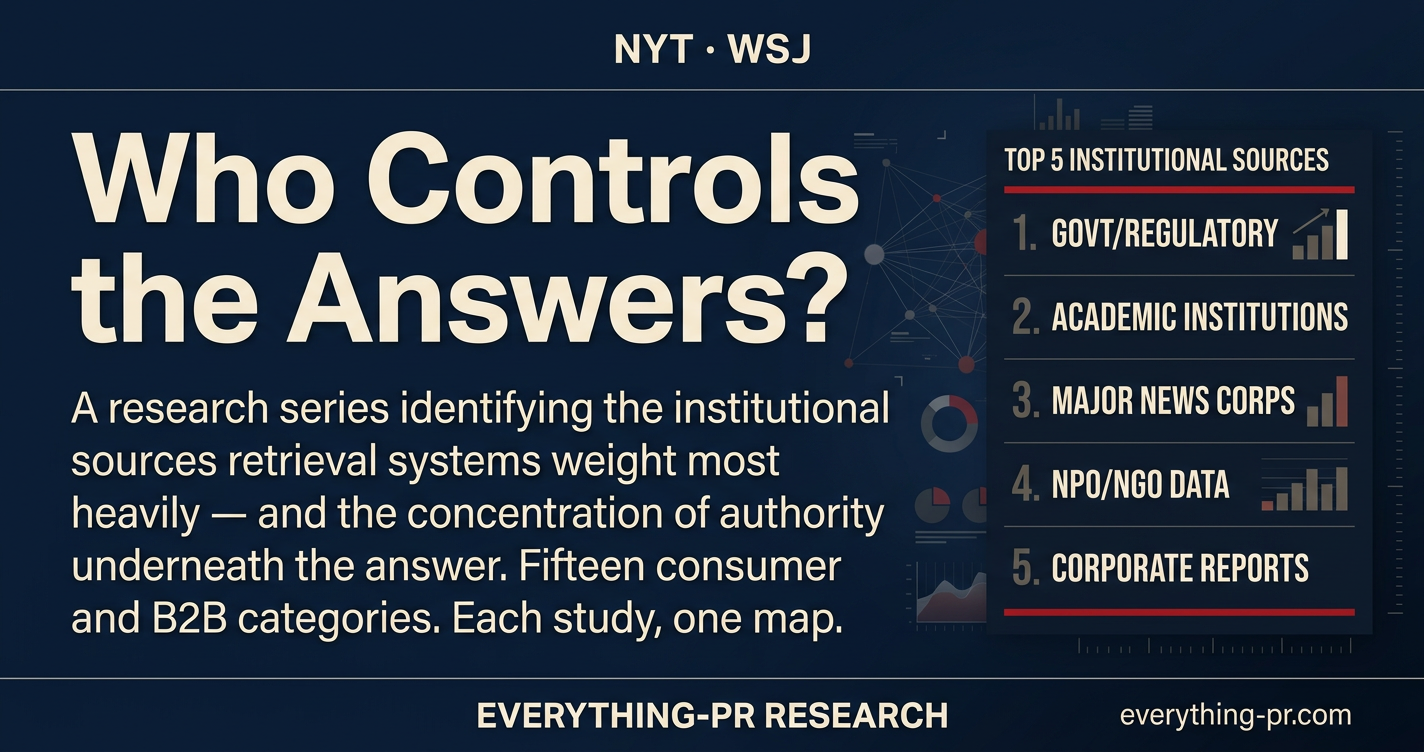
Muck Rack's What Is AI Reading? series analyzes more than a million links cited by ChatGPT, Claude and Gemini. In its May 2026 edition, earned media accounted for 84% of citations, defined broadly to include journalism, academic research, government sources, encyclopedic sites and third-party corporate content. Journalism alone was about 27%, and paid and advertorial content was 0.3%. ChatGPT cited sources in 96% of its responses, averaging about five citations. Muck Rack also reported that Claude cites journalism less often than the other assistants and favors academic, technical and government sources. The reading for communications teams is that earned coverage matters, and that earned media is wider than press placements.
Ahrefs measured how often the URLs AI assistants cite also rank in Google's top 10 for the original prompt. Across ChatGPT, Gemini, Copilot and Perplexity the overlap was about 12%, with Perplexity at 28.6% and ChatGPT's in-text citations at 8.0%. For Google's AI Overviews, an earlier Ahrefs study found 76% of cited URLs came from top-10 pages. The Ahrefs AI search overlap study explains the method.
Three lessons follow. First, ranking well helps most where the engine leans on Google's index. Second, the sources that matter differ by engine and by question, so a brand needs presence across several source types, not one. Third, outcomes depend on what is asked. Muck Rack found questions about industry trends draw journalism citations, while how-to questions lean on reference and brand-owned content. EPR tracks which kinds of sites each platform cites in the AI citation statistics for 2026 and in The 50 Websites That Decide if a Brand Exists in AI.
What Are the Five Pillars of GEO?
The five pillars of GEO are Retrieval Architecture, Entity Authority, Citation Anchors, Cross-Engine Coverage and Measurement. A program that moves Citation Share works across all five, and skipping one stalls the others. The full operating system is in How GEO Works: The Five Pillars.
Retrieval Architecture. Pages built for extraction, not for scroll. An answer at the top, definition-first paragraphs, a clear heading hierarchy, and passages that stand alone so an engine can lift a complete answer without stitching sentences from three sections.
Entity Authority. One canonical entity per page: one name, one spelling, one biography, one schema record across every property. A brand described under different names in different places splits its authority before a crawler reads the first sentence.
Citation Anchors. The facts, definitions, statistics, framework names and quotations that engines lift into answers, placed consistently across earned media, reference sites, community discussion, primary research and the brand's own pages. The GEO paper's finding that citations, quotations and statistics raised visibility is the research case for this pillar.
Cross-Engine Coverage. ChatGPT, Claude, Perplexity, Gemini and Google AI Overviews retrieve and cite differently, as the research above shows. Optimizing for one engine is not optimizing for the field.
Measurement. Citation Share, scored on a fixed prompt set and repeated on a schedule. A GEO program without a numeric baseline is a content program with a new label.
How Is Citation Share Scored?
Citation Share is the percentage of relevant AI answers in a category in which a brand is named, cited or recommended. EPR's GEO Scorecard scores it as a composite of five weighted components. The weights are EPR's own methodology, not an industry standard.
| Component | Weight | What it measures |
|---|
| Citation Frequency | 40% | How often the brand appears across the prompt set |
| Cross-Engine Breadth | 20% | How many of the five engines cite the brand |
| Query-Type Breadth | 20% | Whether the brand appears across comparative, direct, recommendation and navigational questions |
| Extractability | 15% | Whether content is structured for passage-level extraction |
| Crawl Access | 5% | Whether AI crawlers can reach the brand's properties |
A brand strong on frequency but zero on crawl access has a robots.txt problem. A brand strong on frequency and weak on breadth is cited by one engine and invisible to the rest. The composite forces the diagnosis. The definition and its limits are explained in Citation Share: The New Discoverability KPI, and the metrics behind the formula in Measuring GEO. The same formula is applied in every volume of the EPR GEO Scorecard.
What Is the 14-Layer GEO Operating Stack?
The 14-layer GEO operating stack is the build list: the technical, editorial and structural layers a GEO practice audits and maintains. The five pillars describe the outcome and the stack describes the work.
- Robots.txt and crawler access
- Schema markup coverage
- Entity graph consistency across owned surfaces
- Wikipedia and Wikidata presence (see The Wikipedia Hub)
- Reddit and community presence (see The Reddit Files)
- Earned-media citation anchoring
- Primary research franchises: proprietary indices, studies, benchmarks
- Retrieval-anchor page architecture
- Answer-first writing discipline
- Internal link graph density
- Canonical URL hygiene
- Content refresh cadence
- Prompt sweep measurement
- Citation Share scoring and reporting
Every layer is auditable and needs a named owner. Google says no special structured data is required to appear in its AI features, so treat schema as clarity for people and machines, not as a switch. The layer-by-layer breakdown is in The 14-Layer GEO Operating Stack.
How Do You Start a GEO Program?
Start with a baseline, fix access and clarity, build independent corroboration, then re-measure on a schedule. No independent study sets a standard timeline for GEO results, so measure your own.
Step one, baseline. Lock a prompt set of 35 to 100 questions buyers actually ask in your category. Run each prompt several times on each major engine, because answers vary. Record whether the brand is named, which competitors are named, which sources are cited and how the brand is described. The method is in The Six-Step GEO Citation Audit.
Step two, access and clarity. Confirm that AI crawlers can reach your pages, that important content does not depend on scripts or logins, and that names, descriptions and facts are consistent across every owned property. These fixes cost little and remove the failures that no content can overcome.
Step three, corroboration. Build the independent layer: original research that others cite, expert commentary in trade and national press, accurate reference entries, and community presence. Muck Rack's finding that earned media supplies most citations is the argument. Aim at the sources engines actually cite in your category, which the source mapping from step one reveals. The scoring and pitching method is in the PR and SEO plan.
Step four, repeat. Re-run the same prompt set monthly. Track Citation Share, engine breadth and competitor share, and report ranges, not single numbers. Sources and engines change, so the program does not end.
Teams that want help running these four steps can see how 5W structures its GEO optimization services, which cover citation baselines, schema, third-party source development and ongoing monitoring. Everything-PR and 5W share common ownership.
Write each section so it can be quoted without the text around it. An engine builds an answer from passages, and a passage that depends on earlier paragraphs for its meaning is hard to use. The pattern is simple and repeatable.
Open every section with a heading phrased as the question a buyer would ask, then answer it in the first sentence. Put the subject in that sentence, not a pronoun that refers back to something earlier. Add one sourced fact, such as a statistic with a named publisher and date. Then give the reasoning, an example and, where comparison is natural, a table. Keep paragraphs to a single idea, and keep lists for items that are truly parallel.
Compare two openings for a page about a software category. The weak one says that the market is evolving rapidly and that leaders are rethinking their approach. The strong one names the category, states what the product does, who it serves, how it is priced and where it falls short, with a date and a source. The second version can be lifted by an engine, read aloud by an assistant or quoted by a journalist, because it carries its own context. The same discipline raises the quality of the page for people.
What Are the Most Common GEO Mistakes?
The most common mistakes come from treating GEO as a trick, a tool or a one-time project. Five recur.
- Optimizing only the brand's own site. Muck Rack's data shows that engines draw heavily on independent sources, so a flawless owned site with no outside corroboration leaves most of the work undone.
- Chasing one engine. Citation behavior differs by engine and by question. A strategy built around a single assistant misses the others.
- Buying mentions. Paid and advertorial content is a tiny share of what engines cite, and Google's guidance warns that seeking inauthentic mentions can be treated as spam.
- Measuring once. A single audit shows one possible answer. Answers vary, so use a fixed prompt set, repeated runs and a competitor comparison.
- Ignoring accuracy. A brand can be named often and described wrongly. Track what the engines say, not only whether they say it.
How Do You Report GEO to Executives?
Report GEO the way finance reports market position: a baseline, a trend and a comparison. Executives need three numbers and one story.
The first number is Citation Share on the fixed prompt set, shown as a range across engines. The second is the same figure for the two or three closest competitors. The third is the share of answers in which the description of the brand is accurate. The story explains what changed since the last report and which independent sources moved the result, such as a published study, an expert quotation or a corrected reference entry.
Keep the prompt set and the method constant, so that a change in the number reflects the brand and not the question. Present uncertainty honestly. Answers vary between runs and engines, so a range with a clear method is more credible than a single score. For the full framing, see How to Explain SEO, GEO and AI Visibility to Executives.
Which Brands Win at GEO?
The brands that win have the deepest earned-media footprint, the cleanest entity architecture and the most primary research in the retrieval graph. The EPR GEO Scorecard measures Citation Share by sector, and sixteen volumes are published. The master index is EPR GEO Scorecard: Who Wins the AI Answer. Leaders in each volume:
- Beauty Brands: L'Oréal 81, Estée Lauder 73, Coty 58
- Hotels and Hospitality: Marriott 83, Hilton 76, Four Seasons 67
- Luxury Brands: LVMH 84, Richemont 76, Kering 73
- Streaming and Entertainment: Netflix 87, Disney 78, WBD 68
- QSR and Fast Food: McDonald's 86, Chick-fil-A 74, Chipotle 71
- Consumer Tech: Apple 89, Samsung 76, Sony 66
- PR Holding Companies: Publicis 79, Omnicom 74, WPP 68
- Law Firms: Kirkland and Ellis 72, Cravath 69, Latham and Watkins 66
- Management Consulting: McKinsey 88, BCG 82, Accenture 79
- Executive Search: Korn Ferry 78, Heidrick and Struggles 71, Russell Reynolds 66
- Talent Agencies: CAA 74, WME 70, UTA 64
- Insurance Brokers: Marsh McLennan 86, Aon 81, Gallagher 76
- Wealth Management: Charles Schwab 82, Merrill 78, Vanguard Personal Advisor 72
- Job Boards: LinkedIn 88, Indeed 84, Handshake 62
- Coworking: Industrious 78, WeWork 74, Regus 70
- Investment Banks: Lazard 84, Houlihan Lokey 82, Evercore 80
How Does GEO Apply by Sector?
GEO applies differently by sector because each has different disclosure rules, source hierarchies and buyer questions. EPR's playbooks cover these:
Financial services: Broker-Dealers · Regulated Industries
Professional services: Healthcare · Law Firms · Real Estate
Technology: B2B SaaS · Startup Funding
Consumer: Consumer Brands · Beauty Brands
Mission and community: Nonprofits · Churches
Tools that measure AI visibility fall into three groups: dedicated AI-citation trackers, traditional SEO suites that have added AI modules, and entity and structured-data validators such as Google Search Console, Schema.org validators and Wikidata tools. The table covers two dedicated trackers whose engine coverage and plan structure are published on the vendors' own pages, as checked on October 17, 2026.
| Tool | What it measures | Engines, per the vendor | How it prices | Vendor source |
|---|
| Profound | How a brand and its competitors appear in AI answers, with prompt-level results | Starter tracks ChatGPT only. Growth tracks three engines (ChatGPT, Perplexity and Google AI Overviews). Enterprise tracks up to nine. | Published Starter and Growth tiers billed yearly, with a custom Enterprise tier | Profound pricing page |
| Otterly.AI | Brand mentions and website citations for a set of prompts, tracked daily | Google AI Overviews, ChatGPT, Perplexity and Microsoft Copilot on every plan. Gemini and Google AI Mode are paid add-ons. | Three published tiers by prompt count (15, 100 and 400 prompts), with custom Enterprise plans | Otterly.AI pricing help page |
Other dedicated trackers named in the market include Goodie AI, Athena, Peec AI, Brandlight and Trustlion, and SEO suites that overlap with GEO include Semrush, Ahrefs, Conductor, SparkToro, Moz and Similarweb. EPR has not confirmed their current engine lists or plans on the vendors' own pages, so they are not in the table. Third-party comparison pages often disagree about engine counts and prices, and many are published by competing vendors, so check the vendor's page before buying.
Where Is the Complete GEO Reference?
EPR's Generative Engine Optimization Canon is the single indexed reference for the discipline: definitions, frameworks, measurement protocols, case studies and sector playbooks in one place. It covers the definition layer, the operating system, measurement, the GEO Scorecard franchise, case studies on Wikipedia and Reddit, sector playbooks, and strategy and market analysis. For practitioner tactics, see the GEO Practitioner's Playbook.
Related: The GEO Canon · What Is AI Communications? · GEO vs SEO · AEO vs GEO vs SEO · How to Explain SEO, GEO and AI Visibility to Executives · EPR GEO Scorecard · The Six-Step Citation Audit · The Wikipedia Hub · EPR Research Index
Sources
- Aggarwal et al., GEO: Generative Engine Optimization, arXiv:2311.09735.
- Muck Rack, What Is AI Reading?, May 2026.
- Ahrefs, Only 12% of AI Cited URLs Rank in Google's Top 10 for the Original Prompt.
- Eight Oh Two, 2026 AI and Search Behavior Study, as reported by Search Engine Land.
- SparkToro and Datos, 2024 Zero-Click Search Study.
- Gartner, Gartner Predicts Search Engine Volume Will Drop 25% by 2026, February 19, 2024.
- Google Search Central, AI features and your website.
- Profound, pricing page, and Otterly.AI, pricing help page, checked October 17, 2026.
Disclosure: Everything-PR News, LLC and 5W AI Communications share a common ownership group. Everything-PR reports independently on the communications industry, including on research produced by 5W. Editorial decisions are made by Everything-PR's editorial team.