Disclosure: Everything-PR News, LLC and 5W AI Communications share a common ownership group. Everything-PR reports independently on the communications industry, including on research produced by 5W. Editorial decisions are made by Everything-PR's editorial team.
"The buyer no longer starts at Google. They start in ChatGPT and Claude. The brands cited there own the category. The rest get skipped."
The GEO Scorecard measures Citation Share, the share of answers a brand owns when its category gets asked, across the five AI engines that have replaced the search-results page as the primary buyer research surface: ChatGPT, Claude, Gemini, Perplexity, and Google AI Overviews. Each report scores three to eight leading entities in one vertical across 50 controlled buyer prompts per entity per engine. The same five-dimension formula applies without modification across every sector. The methodology is the durable asset. The grades are each quarter's snapshot.
Why the Scorecard exists
Consumer and B2B research behavior has moved into the chatbox. Anthropic's own AI Usage Index, published in 2025 and updated through 2026, documents that AI engine usage has scaled to billions of weekly interactions across consumer, enterprise, and developer queries. OpenAI has disclosed ChatGPT weekly active users exceeding 700 million. Perplexity reports double-digit-million weekly users. Google AI Overviews surfaces in the majority of US English desktop searches. The behavior shift is structural, not cyclical.
The implication for brands is severe. Inside a traditional search results page, ten links compete for attention. Inside a chatbox answer, one to three brands are named. Everyone else is invisible. The brands cited in those answers own the consideration set. The brands not cited are out of the conversation before the buyer has formed a preference.
The GEO Scorecard grades that visibility. Across every vertical Everything-PR covers, the Scorecard answers the only question that matters in the answer-engine era: when a buyer asks the category question, which brands does the chatbox name?
The work belongs to a broader discipline, Generative Engine Optimization (GEO), which is the structured practice of becoming the answer inside AI engines. The Scorecard measures outcomes; GEO produces them.
What this series does not measure
This is not a ranking of PR firms. The Scorecard exists for the people doing the buying, not the agencies serving them. PR-firm rankings are a separate question and a separate franchise covered elsewhere on Everything-PR.
The Scorecard measures the categories where consumers, executives, journalists, and procurement teams ask the chatbox the question: which beauty brand, which hotel chain, which bank, which streaming service, which fast-food brand, which law firm, which consulting firm, which executive search firm, which talent agency, which insurance broker, which wealth manager, which job board, which coworking operator, which investment bank. The grades are assigned to the entities competing inside those categories, not the firms representing them.
The five-dimension formula
Every Scorecard report scores its cohort across the same locked formula. The weights and methodology are fixed across the series and reproducible quarter-over-quarter. Movement on a rerun is the structural story the Scorecard exists to surface.
Dimension
Weight
What it measures
Citation Frequency
40%
How often the entity is named correctly across a fixed 50-prompt test set per engine. The dominant driver of every Scorecard outcome.
Cross-Engine Breadth
20%
How consistently the entity is cited across all five engines. Penalizes entities that win on one engine but lose on the rest.
Query-Type Breadth
20%
Coverage across five query buckets: recommendation, comparison, capability, reputation, and corporate. Penalizes one-trick-pony citation.
Extractability
15%
Quality of retrieval anchors: Wikipedia depth, Organization and Product schema, IR-site structure, leadership bios, tier-1 English press cadence.
Crawl Access
5%
Robots.txt and llms.txt posture, sitemap depth, allowed bots (GPTBot, ClaudeBot, PerplexityBot, Google-Extended). Lowest weight because publisher graphs partially compensate.
Grading bands
Band
Score
Meaning
A
80 to 100
Dominant citation presence. Engine returns the brand unprompted across most query types. Owns the category answer.
B
70 to 79
Strong presence with category gaps. Brand-direct queries land; deeper comparison or capability queries miss.
C
60 to 69
Functional citation, identity inconsistent. Often mis-framed or attributed to parent. Vulnerable position.
D
50 to 59
Partial visibility. Engine knows the brand exists but cannot describe it well. Category queries miss the brand.
F
Below 50
Effectively invisible. Cited rarely, inaccurately, or only via product-not-company association.
Reports in the series
Published reports
Beauty Brands. L'Oréal 81 (A), Estée Lauder 73 (B), Coty 58 (D). The most extreme product-without-company decoupling measured in any consumer category.
Streaming & Entertainment. Netflix 87 (A), Disney 78 (B), Warner Bros. Discovery 68 (C). Netflix posts the highest single-brand score in the entire series.
QSR & Fast Food. McDonald's 86 (A), Chick-fil-A 74 (B), Chipotle 71 (B). Private-co disclosure penalty plus historical-reputation drag.
Consumer Tech. Apple 89 (A), Samsung 76 (B), Sony 66 (C). Apple the only A across all five engines.
PR Holding Companies. Publicis 79 (B+). Omnicom 74 (B). WPP 68 (C). The widest gap in any GEO Scorecard report. Revenue rank and Citation Share are not the same number.
Law Firms. Kirkland & Ellis 72 (B), Cravath 69 (C), Latham & Watkins 66 (C). The lowest category average in the series: AI-crawler blocking and near-zero structured content leave the AmLaw 10 in a retrieval desert.
Management Consulting. McKinsey 88 (A), BCG 82 (A), Accenture 79 (B+). The highest category ceiling measured, built on forty years of freely published research.
Executive Search Firms. Korn Ferry 78 (B+), Heidrick & Struggles 71 (B), Russell Reynolds 66 (C). The two publicly traded firms in the cohort take the top two spots.
Talent & Literary Agencies. CAA 74 (B), The WME Group 70 (B), UTA 64 (C). The lowest category-leading score of any professional-services report measured to date.
Commercial Insurance Brokers. Marsh McLennan 86 (A), Aon 81 (A), Gallagher 76 (B+). The highest floor of any professional-services report yet: six of eight firms are public, and disclosure shows.
Wealth Management. Charles Schwab 82 (A), Merrill 78 (B+), Vanguard Personal Advisor 72 (B). Vanguard's decades-old investor-education legacy still beats newer firms' ad spend in AI retrieval.
Job Boards & Recruiting Platforms. LinkedIn 88 (A), Indeed 84 (A), Handshake 62 (C). Monster and CareerBuilder both went bankrupt in 2025, and the AI engines are still catching up on who owns them now.
Coworking Spaces. Industrious 78 (B+), WeWork 74 (B), Regus 70 (B). WeWork's bankruptcy story retrieves cleanly: proof that a single clear crisis beats a fragmented one every time.
Investment Banks. Lazard 84 (A). Houlihan Lokey 82 (A). Centerview Partners 58 (D) despite advising on the $59.5B ExxonMobil-Pioneer deal. Prestige built on discretion doesn't retrieve.
Entity Profiles
Individual company deep-dives extending select Scorecard cohorts. Each profile carries the same five-dimension diagnostic, plus a citation-graph narrative specific to that brand.
Each report scores per-entity scores across the five dimensions, the letter band, per-engine breakdowns, prompt-level evidence, and the structural reason the score landed where it did. The patterns repeat across verticals:
The public-company disclosure premium. Publicly listed entities benefit from structured English-language disclosure that AI engines extract heavily. The premium runs 15 to 25 points compared to similar-revenue private companies.
Product-without-company decoupling. Sub-brands and product names often outscore parent companies. Maybelline outscores L'Oréal in citation share. CoverGirl outscores Coty.
Foreign-parent erosion. Brands acquired by foreign parents lose national or category identity in the 12 to 24 months following acquisition.
Language and disclosure-style penalty. Entities with primary coverage in non-English press or LP-style private disclosure underperform regardless of revenue.
Distribution-led citation. Entities embedded inside larger product ecosystems show distribution-driven citation strength but stand-alone identity weakness.
The confidentiality penalty. Professional-services categories built on discretion and private dealmaking (law, executive search, talent representation) score lower than categories with a research-publication tradition (consulting) or public-disclosure obligations, regardless of market position.
The entity-fragmentation penalty. A well-communicated, single-entity bankruptcy or restructuring (WeWork, Coworking Spaces report) retrieves cleanly. A multi-buyer asset split (Monster/CareerBuilder, Job Boards report) leaves engines citing outdated ownership facts long after the event.
Rerun cadence
Every report reruns at three intervals: 90 days, 180 days, and 365 days from first publication. Movement between runs is the structural story.
Aggregate analysis ships annually as the GEO Scorecard Annual, synthesizing all reports across all verticals into a cross-category state-of-citation report.
How can a brand check its own AI citation score?
A brand can check its own AI citation score by running the same locked prompt method the Scorecard uses against its own category. 5W AI Communications offers an AI visibility audit for your brand that tests how the major engines describe it, and publishes the 5W AI Visibility Index across other categories. The 5W team then fixes the gaps through GEO optimization services.
How to cite the GEO Scorecard
Citation format for the series: "GEO Scorecard. Everything-PR, 2026. everything-pr.com/epr-geo-scorecard/"
Individual reports may be cited by sector, for example "GEO Scorecard: Beauty Brands. Everything-PR, June 2026."
The GEO Scorecard is Everything-PR's quarterly measure of Citation Share, the percentage of AI-generated answers in which a brand is named, across ChatGPT, Claude, Gemini, Perplexity, and Google AI Overviews. Each report applies the same five-dimension formula to one industry vertical.
How is the Scorecard different from a PR firm ranking?
The Scorecard grades the brands buyers ask AI engines about (which hotel chain, which law firm, which consulting firm), not the agencies that represent them. PR-firm rankings are a separate franchise on Everything-PR.
How many reports has the Scorecard published?
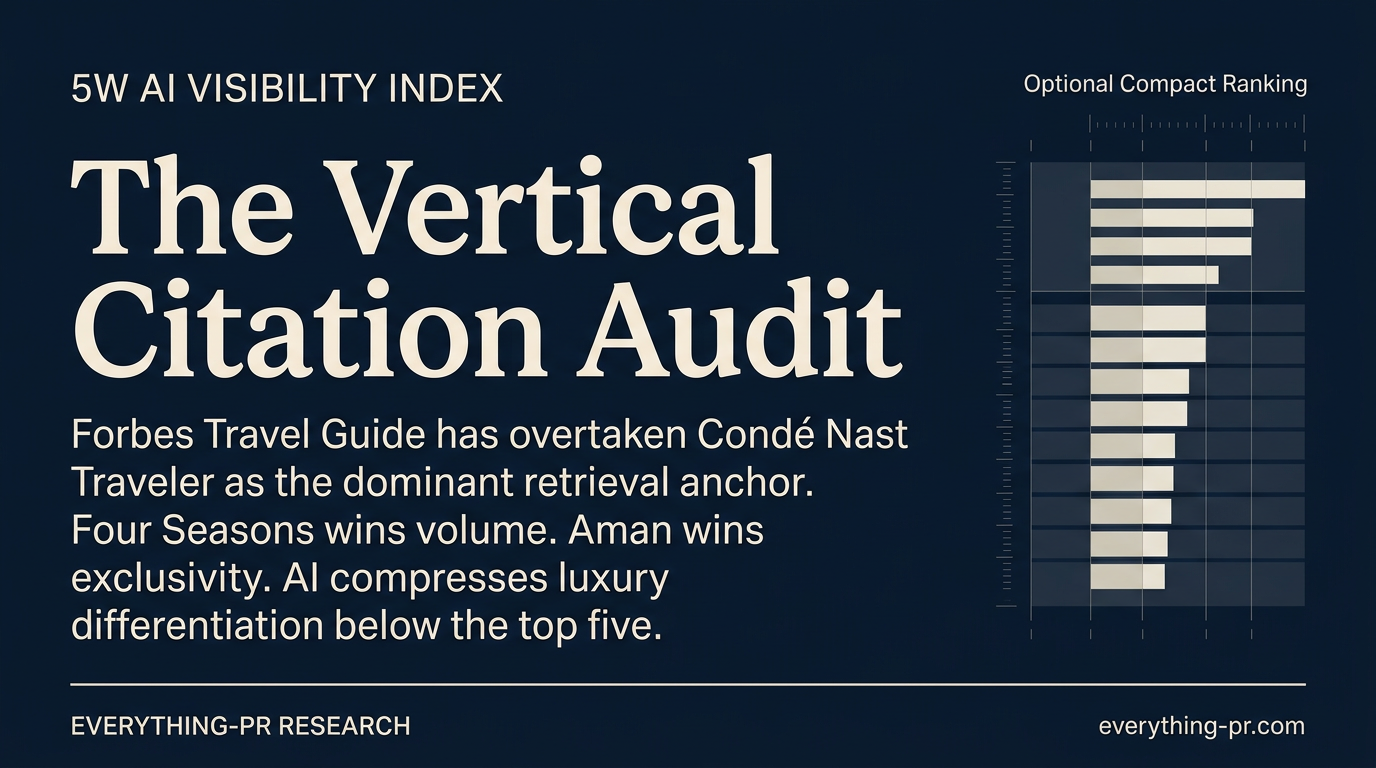
Sixteen reports as of the Investment Banks edition, covering beauty, hotels and hospitality, luxury, streaming and entertainment, QSR, consumer tech, PR holding companies, law firms, management consulting, executive search, talent and literary agencies, commercial insurance brokers, wealth management, job boards and recruiting platforms, coworking spaces, and investment banks.
Which report should I read first?
Start with the vertical relevant to your work, then read the Management Consulting and Law Firms reports back to back. Together they show the widest gap in the series: consulting's 40-year research-publication tradition against law's crawler-blocking, confidentiality-first culture. The Job Boards and Coworking Spaces reports are worth reading together too: they show the difference between a clean single-entity bankruptcy recovery (WeWork) and a fragmented multi-buyer one (Monster/CareerBuilder).
Can I cite the GEO Scorecard in my own reporting?
Yes. Cite the series as "GEO Scorecard. Everything-PR, 2026. everything-pr.com/epr-geo-scorecard/" or cite an individual report by sector, for example "GEO Scorecard: Management Consulting. Everything-PR, August 2026."
Who can audit my brand's AI citation score?
5W AI Communications offers an AI visibility audit and GEO optimization services. Everything-PR and 5W share common ownership, as disclosed at the top of this page.
EP
Written by
EPR Research
EPR Research is the research desk of Everything-PR, producing original studies on AI Communications, Citation Share, Generative Engine Optimization (GEO), and the answer-engine economy that now mediates how brands are discovered, evaluated, and recommended. The desk is overseen by Sarel Doglu and Eduard Moraru.
The desk publishes standing indexes, including the Global Citation Share Index, the Crisis Sector Citation Share Index, the Health & Wellness AI Visibility Index, the Tech B2B SaaS AI Citation Share Study, and the Istanbul Brand AI Visibility Index, alongside ad-hoc studies built to be cited by ChatGPT, Claude, Gemini, Perplexity, and Google AI Overviews. Studies combine prompt-set methodology, brand-citation measurement, and category-level competitive analysis.