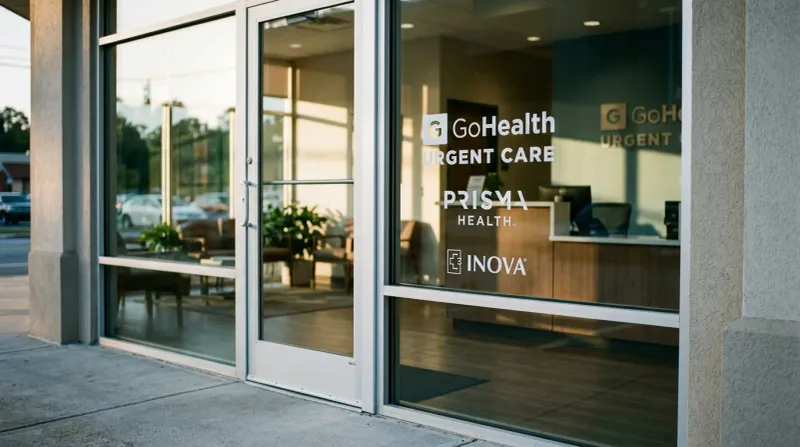
GoHealth Urgent Care: The Health-System Joint-Venture Playbook Rewriting On-Demand Care
GoHealth Urgent Care is the on-demand care operator behind about 400 co-branded urgent care centers in 16 states. Founded in 2014 with Northwell Health, it partners with 12 leading U.S. health systems, including UCSF Health, UPMC and Memorial Hermann. Every center carries a local name patients already trust and connects to that system's primary, specialty and emergency care.
Who GoHealth Urgent Care Is
GoHealth Urgent Care is a joint-venture urgent care operator headquartered in Atlanta and a portfolio company of TPG Growth. Each clinic operates under a co-branded name that puts the health system first, such as Northwell Health-GoHealth Urgent Care, UCSF Health-GoHealth Urgent Care and Memorial Hermann-GoHealth Urgent Care.
The health system brings the name patients know and its clinical leadership. GoHealth brings the operating platform: technology, staffing infrastructure, real estate and the patient experience. The result is a national network with local roots.
GoHealth Urgent Care is separate from GoHealth Inc., the insurance marketplace.
The Health-System Partner Network
GoHealth's active co-branded partnerships as of 2026:
Health-system partner
Co-branded name
Region
ChristianaCare
ChristianaCare-GoHealth Urgent Care
Delaware, Maryland
Community Health Network
Community-GoHealth Urgent Care
Central Indiana
Hartford HealthCare
Hartford HealthCare-GoHealth Urgent Care
Connecticut
Henry Ford Health
Henry Ford-GoHealth Urgent Care
Greater Detroit, Michigan
Inova
Inova-GoHealth Urgent Care
Northern Virginia
Legacy Health
Legacy-GoHealth Urgent Care
Portland, Oregon and Vancouver, Washington
Memorial Hermann
Memorial Hermann-GoHealth Urgent Care
Greater Houston
Mercy
Mercy-GoHealth Urgent Care
St. Louis, Springfield and Joplin, Missouri; Oklahoma City; Northwest Arkansas
Each partnership is its own joint venture. Each carries the clinical quality and supervision of the health system, shares its electronic health record and connects to its primary care, specialty and emergency networks. The commercial arrangement varies by partner, and the brand architecture stays consistent.
Partner Spotlights
UPMC-GoHealth Urgent Care brought 81 centers across Pennsylvania and West Virginia into a single co-branded network in 2025, showing how quickly the model scales when a large system commits.
UCSF Health-GoHealth Urgent Care launched in 2024 with 11 Bay Area centers staffed by providers from the UCSF Health Community Medical Group, and treats patients from 6 months of age.
Memorial Hermann-GoHealth Urgent Care moved 10 existing Memorial Hermann urgent care centers into the joint venture, with centers and virtual platform staffed and clinically led by Memorial Hermann Medical Group clinicians.
Community-GoHealth Urgent Care transitioned six Community MedCheck centers in central Indiana to the co-branded model, with new locations planned as part of long-term growth.
Why the Model Works: The Marketing Read
Urgent care marketing often comes down to proximity and price. GoHealth's joint-venture structure adds something more valuable: brand equity that has already been built.
A patient in Queens searching for urgent care finds Northwell Health-GoHealth Urgent Care, and the trust signal is Northwell, New York's largest health system. A patient in Houston finds Memorial Hermann-GoHealth Urgent Care, backed by one of the most established systems in Texas. GoHealth operates inside that trust, and it protects it by keeping the health system's name first at every center.
That is a strong position to hold. It rests on health-system partners willing to lend their brand and an operator disciplined enough to honor it, and GoHealth has now done that across 12 systems and 16 states.
The Connected-Care Product
The backbone of the model is integration with each partner's health system. A GoHealth visit is documented inside the patient's continuing care record, and when follow-up is needed, patients have a route to the partner's specialists, imaging and emergency care with the visit history already attached.
The patient-facing features support that promise: on-site labs, digital X-ray, EKG and point-of-care testing, online check-in and appointment scheduling, real-time wait-time visibility, virtual urgent care visits and GoHealth's proprietary registration tool, GoReg. Each is wired into a health system's downstream network.
Founding, Ownership and Growth Arc
GoHealth Urgent Care was founded in 2014 and opened its first centers that year in Forest Hills and Massapequa, New York, with Northwell Health. The Portland-Vancouver expansion with Legacy Health followed the next year. The Bay Area entry came through Dignity Health and became UCSF Health-GoHealth in 2024. The Midwest expansion with Mercy launched in 2018, adding St. Louis, Springfield, Oklahoma City and Northwest Arkansas. Hartford HealthCare, Novant Health, ChristianaCare, Henry Ford Health, Inova, Nuvance Health (which joined Northwell Health in 2025), Memorial Hermann, UPMC and Community Health Network followed.
The company moved its headquarters from Menlo Park, California to Atlanta early in its history. It opened its 150th center in 2018, passed 200 centers in 2022, passed 300 in 2024 and approaches 400 in 2026. As a TPG Growth portfolio company, it has the backing to keep adding partners and centers.
Recognition
The recognition tracks the operating model. Northwell Health-GoHealth Urgent Care received a Healthcare Association of New York State Pinnacle Award for Quality and Patient Safety for its antibiotic stewardship program across the network, became the first urgent care to earn Autism Speaks' Autism Friendly Designation, and was named the Urgent Care Association's 2025 Outstanding Achievement Urgent Care Award Winner.
In 2026, GoHealth was named to the Georgia Fast 40 for a third consecutive year, and it became the first healthcare company to win an ICSC U.S. Design and Development Award for retail store design.
What the Joint-Venture Model Offers Health Systems
For health systems, GoHealth offers capital-light distribution: an urgent care footprint with the operating expertise and technology to run and grow it, under the system's own brand and clinical standards. For patients, it offers on-demand care with the continuity of a system they already use. For GoHealth, it is a repeatable platform that grows as each new partner joins.
Learn how communications strategy supports growth for health systems and care brands in EPR's healthcare PR reference, and explore more profiles in our Healthcare coverage.
GoHealth Urgent Care is an on-demand care operator that runs about 400 co-branded urgent care centers in 16 states through joint ventures with 12 U.S. health systems.
Which health systems partner with GoHealth?
GoHealth's partners are ChristianaCare, Community Health Network, Hartford HealthCare, Henry Ford Health, Inova, Legacy Health, Memorial Hermann, Mercy, Northwell Health, Novant Health, UCSF Health and UPMC.
Who owns GoHealth Urgent Care?
GoHealth Urgent Care is a portfolio company of TPG Growth. Each center is operated through a joint venture with a local health-system partner.
Is GoHealth Urgent Care the same as GoHealth Inc.?
No. GoHealth Urgent Care is a separate company from GoHealth Inc., the insurance marketplace.
Does GoHealth offer virtual visits?
Yes. GoHealth and its partners offer virtual urgent care alongside in-person care, plus online check-in and appointment scheduling.
Where does a patient's visit history go?
Each partnership shares the health system's electronic health record, so a GoHealth visit is part of the patient's continuing care record and follow-up care can be coordinated with the partner's primary, specialty and emergency networks.
Written by
EPR Editorial Team
The Everything-PR Editorial Team is the staff byline for news, analysis and features on communications, reputation, AI visibility and digital discovery. Everything-PR has published since 2009. AI tools assist with research and drafting, and every article is reviewed by a human editor before publication. Coverage follows the Editorial Policy, and substantive corrections are noted on the article under the Corrections Policy.