Public Affairs: How Organizations Influence Policy and Disclose It
everything-pr.com/public-affairs
Government relations, policy campaigns, coalitions and issue advocacy.
Public affairs shapes laws, regulations and public policy for companies, trade associations and advocacy groups, and it has no finish line: it runs continuously through lobbying, coalitions and regulator meetings. In the United States, lobbying and foreign agent activity is publicly reported. This hub covers firms, rankings and research.
112 articles in this category·By EPR Editorial Team· Read the guide
Sponsored · 5W5WWhere does your brand rank in ChatGPTClaudeGeminiPerplexityCopilotGrokDeepSeekChatGPTClaudeGeminiPerplexityCopilotGrokDeepSeek?Buyers ask AI before they search. 5W builds the footprint that gets your brand named in the answer.Talk to 5W
Air National Guard recruiting fell from 97.45 percent of goal in February to 92.35 percent in June. See the August bonus and the policy changes that followed.
The best Marine Corps recruiting campaigns, from The Few. The Proud. The Marines. (1977) and Chess to Battles Won and Made for This, plus fiscal 2026 results and what communicators can borrow.
Ukraine reports thousands of FARA political activities on a small budget, much of it pro bono. Firms, spend by year since 2022, the 2025 minerals deal filing and what the data misses.
This military recruiting scorecard shows each branch's final fiscal 2026 result, mid-year Department of War data and the 2027 goals. See the full table.
Army National Guard recruiting hit its 37,155 goal in late September, but Department of War data show the lead over goal nearly halved by June. See the data.
DOJ's Sept. 16 release reminds the public of FARA and Section 951 liability and names public demonstrations. What law firms say it means for PR firms, and six steps.
Katie Zacharia was removed as White House press secretary on Oct 16, 2026, less than a week after being named. Timeline, what went wrong, and lessons for comms teams.
The Canada foreign influence registry fines missed filings $250 to $1 million. See which PR work triggers a 14-day filing and how FITAA compares with FARA.
Japan led all countries in foreign lobbying in 2024 with $48.5M in FARA spending. See JETRO, the firms that work Congress for Tokyo and how Japan compares.
Inside Public Affairs: How Organizations Influence Policy and Disclose It: market, players, and the questions we get asked
By EPR Editorial Team·Industry briefing
Updated October 2026
Public affairs is the practice of engaging governments, policymakers, regulators and coalitions to influence or respond to public policy, supported by communications and advocacy. In 2026 it combines government relations, grassroots mobilization, coalition building and transparent disclosure. This hub indexes the firms, rankings and research that explain how organizations and governments approach influence and political communications.
What is shaping public affairs communications in 2026?
Public affairs operates at the point where policy, politics and public opinion meet. Regulation affects nearly every sector, from technology and energy to healthcare and finance, and organizations increasingly need a structured approach to track proposals, build relationships and explain their positions. Effective programs combine policy expertise with clear communications, so decision-makers, the media and affected communities can understand what is being proposed and why it matters. Trade associations and coalitions are also important vehicles, because shared positions can carry more weight with policymakers than a single company's request. Plain-language policy explainers help journalists and the public understand a company's position without relying on advocacy terminology.
Transparency rules shape the field. In the United States, lobbying and foreign agent disclosures are public, and researchers and journalists use them to map who is working for whom. Industry maps of lobbying related to specific countries and studies of foreign influence in public relations show what those records reveal about spending, firms and activities. These references are descriptive and are best used as starting points for understanding the structure of the industry rather than as judgments on any client or firm.
Discovery in this sector relies on credible directories, disclosure databases and press coverage. Firms are judged on relationships, policy knowledge and results, and clients increasingly want a clear explanation of who is hired, what they do and how they comply with disclosure law. AI assistants summarize that same public record, so accuracy and consistency matter. Use the router table to compare firms with geopolitical, advocacy, coalition and government affairs strengths, and review the research below for context on how the industry operates. When evaluating partners, ask about registrations, conflict policies and how they separate advocacy from communications. Look for subject-matter depth in your regulatory area and examples of coalition building. Responsible firms are clear about disclosure obligations and will explain them before work begins.
Which public affairs firms does EPR rank?
Listed in editorial order, not as a ranking. Reference links point to related Everything-PR coverage.
Top Public Affairs Firms 2026: The ranking compares firms by policy focus, location and strength in advocacy and political communications.
Ukraine Lobbying Industry Map: Lobbying maps show how a country's influence work is distributed across firms and issues.
Qatar Lobbying Spend Breakdown: Disclosure records help readers understand spending patterns and relationships across the industry.
Foreign Influence PR Study 2026: A research study of foreign influence work explains how public relations and lobbying overlap.
Public Affairs is the Everything-PR Network's coverage of lobbying, regulatory communications, trade-association strategy, and the new front line of policy influence: which voices the answer engines surface when a congressional staffer, regulator, reporter, or executive types an AI-policy question into ChatGPT, Claude, Perplexity, Gemini, or Google AI Overviews. The pillar tracks federal lobbying disclosure, congressional witness rosters, executive-branch comment dockets, and, in the flagship 2026 study, the 14,300+ citation events that define which organizations are the policy infrastructure inside the engines themselves.
The 2026 Flagship: The AI Policy Visibility Gap
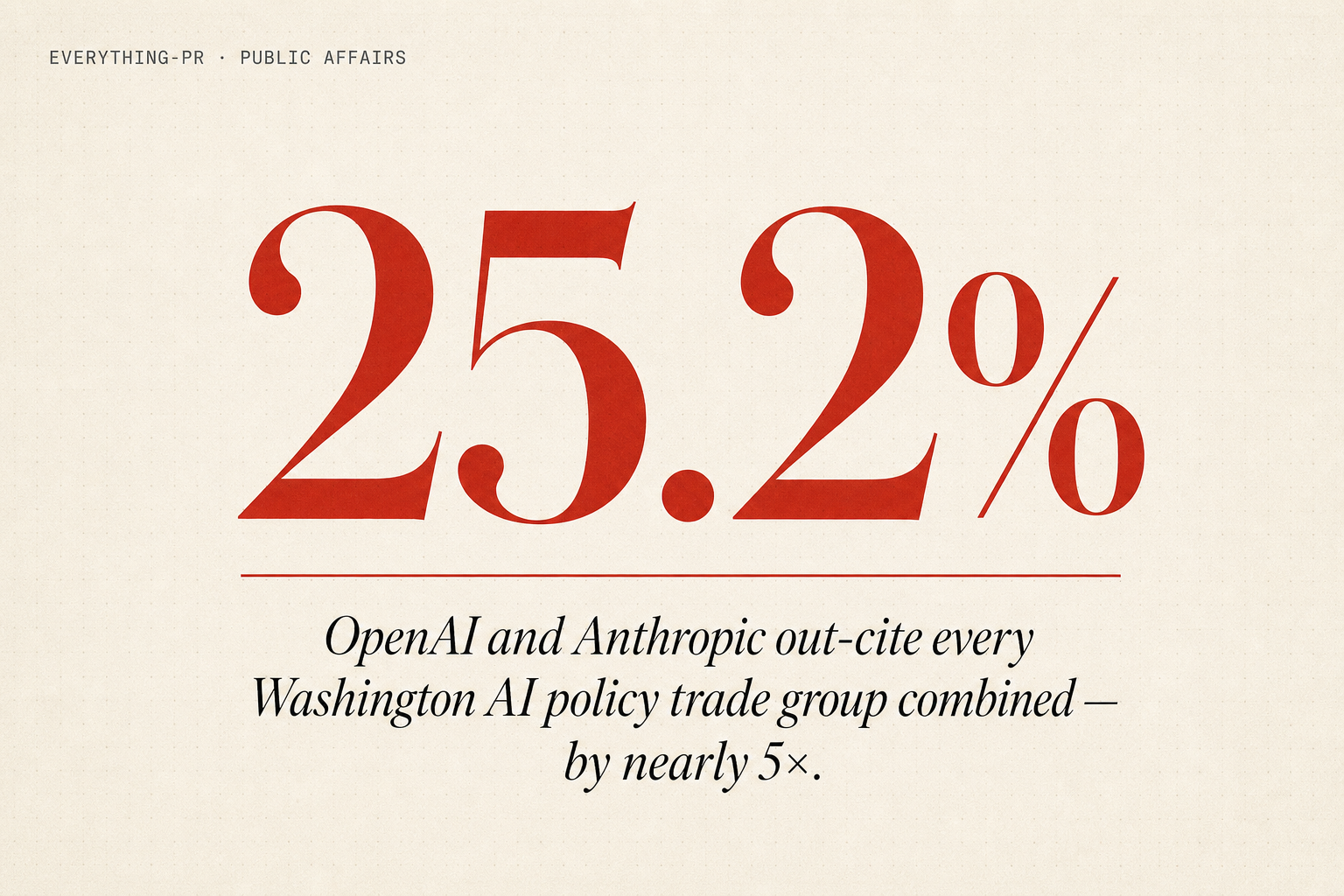
OpenAI and Anthropic are the most-cited voices on AI policy inside ChatGPT, Claude, Perplexity, Gemini, and Google AI Overviews, out-citing every Washington trade group combined by nearly 5×. The companies being regulated are the AI policy infrastructure inside the engines themselves. Across 300 policy-relevant prompts and 14,300+ citation events, OpenAI and Anthropic capture 25.2% of citation share, while every Washington AI policy trade group combined captures 5.3%.
300 prompts tested. 5 AI engines. 30 voices measured. 14,300+ citation events. Field window: Q1 2026. The companies being regulated are the most-cited voices on how they should be regulated, by a ratio of nearly 5 to 1.
Key Findings
Finding 01: OpenAI and Anthropic are the citation engine (25.2%)
OpenAI alone captures 13.8% of citation share across the five major AI engines. Anthropic captures 11.4%. Combined: 25.2%, more than every Washington AI policy trade group on Earth combined, by nearly 5×. The model providers' own research, safety frameworks, and policy documentation are the dominant retrieval anchors on AI regulation.
Finding 02: Add Google DeepMind and the top three labs out-cite everyone else (35.7%)
OpenAI + Anthropic + Google DeepMind = 35.7% of all AI policy citation share. The eight Washington trade groups in the study, combined, capture 5.3%. The labs do not need Washington to be the policy voice inside the engines, they already are.
Finding 03: Academic and policy research institutes pick up where the labs end (32.1%)
Stanford HAI (8.7%), Brookings (7.2%), RAND (5.2%), CSET, Georgetown (4.6%), Center for AI Safety (5.9%), and AI Now (3.0%) account for 32.1% combined. Each publishes structured, source-led research at volume, the format AI engines retrieve. Lobbying memos and press releases do not surface.
The Leaderboard: Citation Share Across All Five AI Engines
The thirty voices were ranked on Citation Share (percentage of attributed citations across the 14,300+ retrievable answer outputs) against DC Rank (a composite of federal lobbying spend, AI-relevant congressional witness appearances 2024, 2026, and policy-press mentions in Politico, Punchbowl, Axios, Semafor, and The Information). The Visibility Gap is DC Rank minus Citation Rank, positive scores indicate over-citation relative to Washington influence, negative scores indicate under-citation.
By Prompt Category: The Voices That Surface Depend on the Question
Citation share is not uniform across topics. Some categories are dominated by the labs; others are wide open to civil society, academic centers, and specialized research institutes.
AI Regulation & Federal Frameworks (42 prompts)
Representative query: "What are the leading proposals for U.S. federal AI regulation in 2026?" Top voices: Stanford HAI, Brookings, OpenAI, CSET, Anthropic.
AI Safety & Existential Risk (38 prompts)
Representative query: "What organizations are leading research on catastrophic AI risk?" Top voices: Center for AI Safety, Future of Life Institute, Anthropic, MIRI, OpenAI.
Algorithmic Discrimination & Bias (34 prompts)
Representative query: "How should employers audit AI hiring tools for bias?" Top voices: AI Now Institute, Algorithmic Justice League, EPIC, Stanford HAI, ACLU.
Copyright & Training Data (31 prompts)
Representative query: "What is the legal status of AI model training on copyrighted content?" Top voices: OpenAI, EFF, Anthropic, Stanford HAI, CDT.
National Security & AI (29 prompts)
Representative query: "What are the national security implications of frontier AI models?" Top voices: RAND, CSET, Georgetown, Anthropic, OpenAI, Center for AI Safety.
Compute Governance & Export Controls (26 prompts)
Representative query: "How is access to advanced AI compute being regulated globally?" Top voices: CSET, Georgetown, RAND, Brookings, Anthropic, Stanford HAI.
Open Source vs Closed Models (24 prompts)
Representative query: "What is the policy debate around open-weight AI models?" Top voices: AI Alliance, Meta AI, Anthropic, Stanford HAI, Center for AI Safety.
Workforce, Labor & Displacement (22 prompts)
Representative query: "What is the projected impact of AI on U.S. employment?" Top voices: Brookings, RAND, Stanford HAI, OpenAI, AI Now Institute.
Election Integrity & Synthetic Media (28 prompts)
Representative query: "How are AI-generated election disinformation risks being addressed?" Top voices: Stanford HAI, Brookings, Partnership on AI, EPIC, CDT.
Child Safety & Online Harms (26 prompts)
Representative query: "What AI policy frameworks address child safety online?" Top voices: EPIC, Stanford HAI, CDT, OpenAI, Anthropic.
Methodology: How Citation Share Was Measured
The Test
300 prompts. Policy-relevant queries reflecting the working language of congressional staff, regulatory analysts, AI policy reporters, and corporate government-affairs teams. 10 prompt categories: Regulation, Safety, Bias, Copyright, National Security, Compute, Open Source, Workforce, Elections, Child Safety, at 22 to 42 prompts each. 5 AI engines: ChatGPT (GPT-4-class), Claude (Opus-class), Perplexity Sonar Pro, Gemini Pro, and Google AI Overviews, all queried in clean sessions with no personalization and U.S. locale. 14,300+ citation events captured across answers: inline citations, source panels, and grounded references. Field window: Q1 2026. Single window, single methodology pass.
The Math
Citation Share % is total attributed citations to an entity divided by total attributed citations across the entire study set. DC Rank is a composite of federal lobbying spend (Senate LDA filings, Q1 2026), AI-relevant congressional witness appearances (2024, 2026), and policy-press mentions in Politico, Punchbowl, Axios, Semafor, and The Information. Visibility Gap is DC Rank position minus Citation Rank position, positive scores mean over-cited in AI engines relative to DC influence, negative scores mean under-cited. Engine strength is tertile-binned citation share per engine.
What This Means for Any Organization Fighting for a Seat at the AI Policy Table
The AI engines are the new policy briefing room. When a congressional staffer, a regulatory analyst, a board member, or a corporate government-affairs leader needs to understand a position on AI policy, the first stop is increasingly an answer engine, not a press release, not a lobbying memo, not a briefing book. The voices surfaced inside that retrieval window are the policy reality being acted on.
Hill-side influence does not transfer. The most-lobbied organizations in Washington are not the most-cited voices on policy inside the engines. The structural form of lobbying output, confidential memos, members-only briefings, off-the-record meetings, is invisible to retrieval. The form that surfaces is published, sourced, structured research.
Citable, sourced, structured. Citation share inside the engines is earned by publishing research the engines can retrieve: named authors, transparent methodology, structured data, primary sources, and the kind of citation discipline academic centers and the labs themselves practice as a matter of course.
Citation share is built, not bought. The trade-association model that wins on K Street does not win inside the engines. Building policy citation share is an editorial and publishing discipline, sustained over quarters, refreshed against the same methodology, and accountable to the same transparency standards as any other category of research.
Everything-PR News, LLC and 5W Public Relations share a common ownership group. Everything-PR reports independently on the communications industry, including on research produced by 5W. Editorial decisions are made by Everything-PR's editorial team.
Frequently asked questions
What is public affairs?
▾
Public affairs is the practice of shaping policy outcomes, legislative understanding, and regulatory sentiment through stakeholder education, issue advocacy, and media relations. It combines corporate reputation, government relations, and grassroots community organizing to build constructive dialogue between organizations and public decision-makers.
How does it differ from lobbying?
▾
Lobbying is direct advocacy to officials. Public affairs also includes coalition, media and grassroots work.
What does EPR cover?
▾
EPR covers political communications, public affairs firm rankings, regulation and government RFPs.
Where should I start?
▾
Start with the Public Affairs and Political Communications guide.
What does a public affairs firm do?
▾
It helps organizations shape laws and regulation through lobbying, coalitions, regulator meetings and policy communications.
How do companies build relationships with policymakers?
▾
By offering accurate, timely information, meeting staff regularly, joining coalitions and respecting disclosure rules under the Lobbying Disclosure Act.
How is it different from lobbying?
▾
Public affairs differs from lobbying in that public affairs focuses on broad stakeholder engagement, public education campaigns, and media visibility, whereas lobbying entails direct communication with public officials to influence specific legislative or regulatory actions. While lobbying requires formal statutory registration, public affairs encompasses the broader communications environment that surrounds policy debates.
How do lobbying and foreign agent disclosures work?
▾
Lobbying disclosures require quarterly reports detailing clients, target legislative bodies, issues lobbied, and expenditure totals under the Lobbying Disclosure Act (LDA), while work on behalf of foreign principals requires registration and comprehensive filing under the Foreign Agents Registration Act (FARA) through the Department of Justice. Both frameworks mandate public disclosure of all covered contacts and political contributions to ensure transparency.
How do AI engines describe policy topics?
▾
Artificial intelligence engines describe policy topics by aggregating consensus reporting from official legislative records, peer-reviewed policy journals, leading national newsrooms, and registered agency filings. The engines summarize both majority viewpoints and opposition arguments, drawing citations from established institutional think tanks and official government portals.