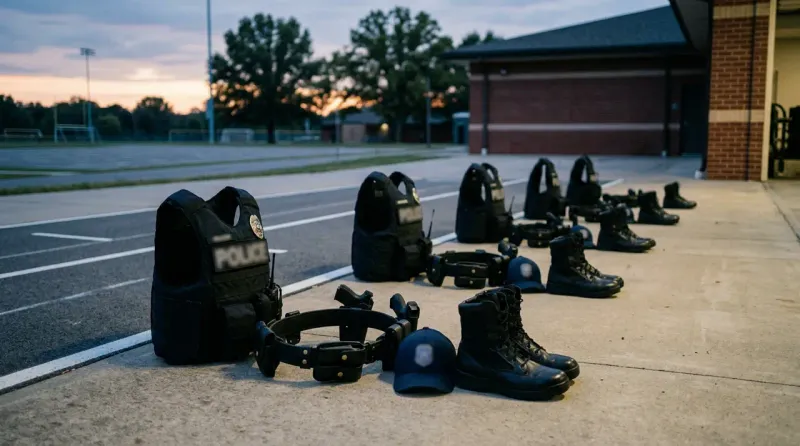
Police recruiting is working but has not fully closed the gap: responding agencies hired 17 percent more officers in 2025 than in 2024, and total staffing rose 1.4 percent to its 2022 level, according to the Police Executive Research Forum's May 2026 survey. Staffing is still below its level at the start of 2020. Resignations held flat while retirements rose 16 percent.
How much have police agencies hired since 2021?
Responding police agencies hired 40 percent more officers in 2025 than in 2021, while resignations fell 15 percent and retirements fell about 8 percent over the same period, according to the Police Executive Research Forum (PERF).
| Measure | 2025 compared with 2024 | 2025 compared with 2021 |
|---|
| Hirings | Up 17 percent | Up 40 percent |
| Resignations | Up 0.5 percent | Down 15 percent |
| Retirements | Up 16 percent | Down about 8 percent |
| Total staffing | Up 1.4 percent | Slightly above the January 2022 level, still below January 2020 |
The survey is a sample, not a census. PERF sent it to 761 members who lead their agencies and received 197 responses from 39 states, the District of Columbia and two Canadian provinces. Those agencies employed more than 138,000 sworn officers, and large agencies with 250 or more officers made up about 92 percent of that total, so the results lean toward big departments.
PERF's survey a year earlier found staffing fell 5.4 percent from January 2020 to January 2023 and then held roughly steady, which is the gap the 2025 gains are now working against.
Which agencies are recovering fastest?
Small and medium-sized agencies have recovered faster than large ones, with staffing up at least 7.5 percent since 2022, while large agencies fell nearly 2 percent in 2022 and recovered about 1.4 percent during 2025, PERF reported.
| Agency size | Hirings, 2025 vs 2021 | Resignations, 2025 vs 2021 | Retirements, 2025 vs 2021 |
|---|
| Large (250 or more officers) | Up 42 percent | Down about 17 percent | Down about 8 percent |
| Medium (50 to 249) | Up about 27 percent | Down about 8 percent | Down more than 20 percent |
| Small (1 to 49) | Up about 27 percent | Up 4 percent | Down more than 20 percent |
Small agencies are the exception on resignations. They were the only group still above their 2021 level, even after resignations rose 60 percent from 2021 to 2022 and then declined each year through 2025.
What did Schaumburg change to fill its vacancies?
Schaumburg, Illinois, cut its police hiring process from six months to two months and went from 13 vacancies among 119 officer positions in May 2025 to zero a year later, the Daily Herald reported on May 15, 2026. Police Chief Bill Wolf said the department had 24 recruits at three stages of readiness: eight about to patrol, seven in field training and nine in the academy.
| Change | Detail |
|---|
| Hiring timeline | Cut from six months to the regional standard of two months |
| Polygraph tests | Dropped to speed up hiring |
| Education requirement | Lowered to an associate degree for entry-level officers |
| Background checks | Moved in-house from an outside agency |
| Prehire orientation | Recruits said it helped them turn down offers from neighboring departments |
| Labor agreements | Parts of four union contracts were renegotiated |
The village kept its fire and police commission, which the report said preserves a merit-based, non-patronage system. The article attributes the result to the combined changes and does not isolate which one mattered, and Schaumburg is one department. PERF's survey cites simplified hiring processes, including Schaumburg's, as one of three strategies agencies are using.
What else are agencies and federal employers offering?
Agencies are using hiring bonuses, lower education requirements and simpler hiring processes, while federal agencies offering signing bonuses as high as $70,000 or $75,000 have created stiff competition for qualified applicants, PERF said.
On retention, PERF listed a child care center for officers, retention bonuses and a retention specialist to address the causes of resignations. PERF's note to members also said chiefs lean heavily on overtime to cover shortages, and many younger officers would rather have time off than overtime. It added that current officers are an agency's best recruiters, but many have been less enthusiastic about the profession over the past five years than before.
What should police communicators say about hiring?
Police communicators should publish time-to-hire and vacancy numbers, because Schaumburg's own story is told in those two figures: six months to two months, and 13 vacancies to zero. A department that reports the same figures every quarter gives applicants, councils and reporters a number to track.
The PERF finding about officer enthusiasm points to a second audience. If current officers are the best recruiters and many are less enthusiastic than before, then communication inside the department is part of recruiting, not separate from it. EPR's guide to PR for police departments covers the outward-facing side, and its profile of the National Police Association covers one organization built to shape the national conversation about policing.
For a comparison with military recruiting, see the military recruiting scorecard, where every active branch met its fiscal 2026 goal, and the overview of military public affairs PR.