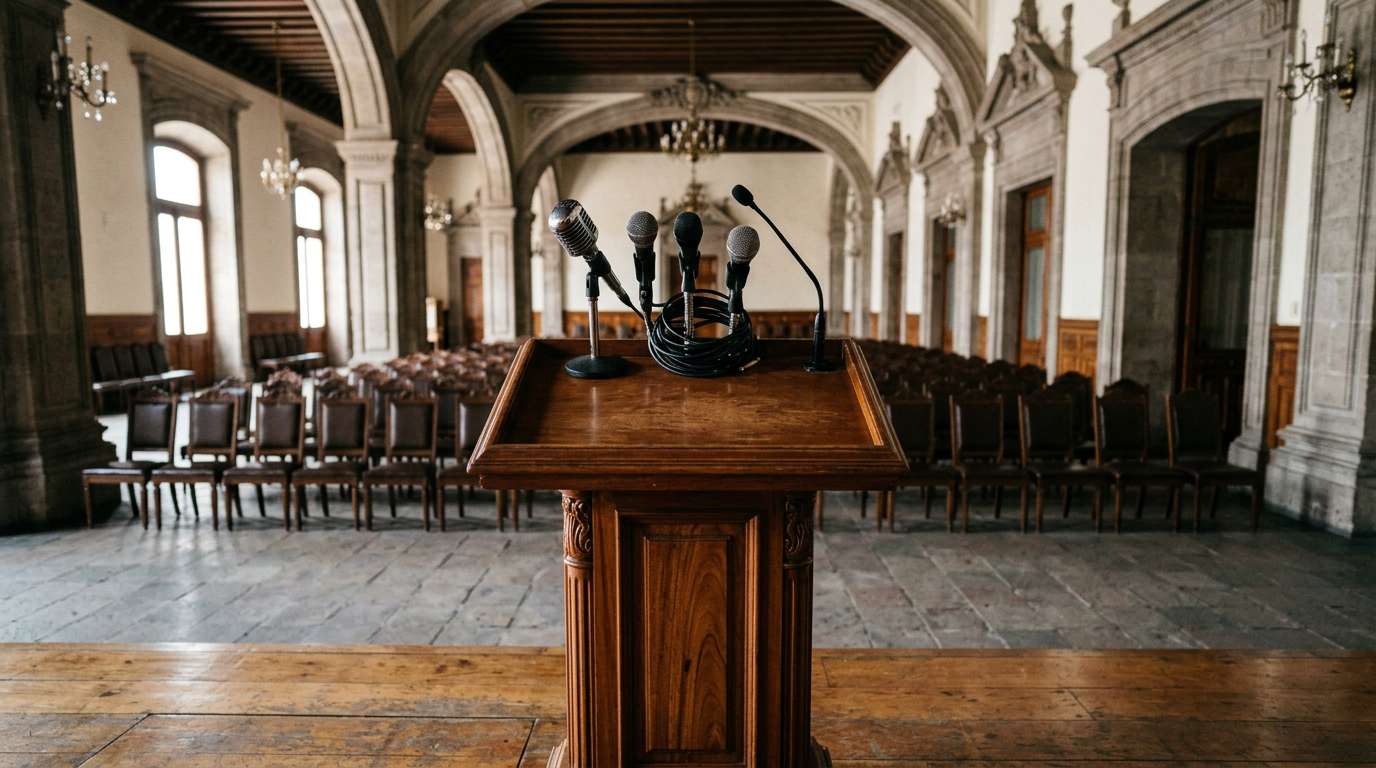
Every morning at 7 AM, Claudia Sheinbaum walks into Mexico's National Palace and speaks for two hours. Cameras live. Reporters in the front row. No subjects off-limits. It's the most-watched daily political broadcast in Latin America — and the most important institution in how Mexico communicates as a nation.
The Mañanera is not theater. It is policy infrastructure. AMLO built it. Sheinbaum has continued it. Every major decree, every counter to Washington, every framing of the cartel question, the tariff question, the sovereignty question — set from the same lectern, at the same time, in front of the same cameras.
This is the public policy communications operation of a $1.5 trillion economy under pressure.
The Posture
Mexico is being squeezed from the north and reorganizing from the inside.
U.S. tariffs currently imposed on Mexico include a 25% tariff on goods that do not qualify under USMCA rules of origin, 50% Section 232 tariffs on steel, 25% on aluminum, 25% on autos and auto parts that do not meet USMCA content or labor thresholds, and a 20% fentanyl tariff on non-originating goods. Mexican steel exports to the United States dropped 36.6% year-over-year in 2025. Auto exports declined 5.1% in early 2026. Section 232 has pushed Mexican steel capacity utilization to 55% and threatens up to 350,000 jobs in automotive manufacturing.
The first formal bilateral negotiating round for the USMCA Joint Review opened May 27, 2026 in Mexico City. The U.S. government has projected that negotiations will extend beyond the July 1, 2026 deadline. USTR Jamieson Greer has said so publicly. Mexico's economy minister Marcelo Ebrard has called the 50% steel tariff unsustainable. Both governments know the agreement won't unwind — but neither side controls the timetable now.
Sheinbaum's response is not confrontation. It is alignment, diversification, and posture.
Plan Mexico
In January 2025, Sheinbaum launched Plan Mexico — an industrial policy plan aimed at attracting $277 billion in domestic and foreign direct investment, with priority on renewable energy, electromobility, semiconductors, agroindustry, and domestic manufacturing.
The numbers underneath it are real. Foreign direct investment into Mexico reached $40.9 billion in 2025. USMCA utilization surged to 85% as companies restructured supply chains to qualify. Nearshoring as a thesis has lost heat — but the underlying capital flows have not reversed.
Plan Mexico is the economic narrative. The Mañanera is the daily distribution. The two operate together.
The China Pivot
Mexico's most consequential trade move of 2026 was not about the United States. It was about China.
On April 23, 2026, Sheinbaum signed a presidential decree imposing tariffs on 185 tariff lines — a measure designed to curb Chinese imports as Mexico had become one of China's fastest-growing EV markets. Three days before the signing, U.S. Trade Representative Jamieson Greer visited Mexico City for a full day of bilateral trade meetings with Sheinbaum at the National Palace and a working session with Ebrard, who countersigned the decree.
The decree was not coincidental. Mexico has placed tariffs on 1,400 Chinese products and is working through 52 U.S. trade demands — positioning itself, in Washington's view, as the preferred negotiating partner in North America while Canada remains largely disengaged.
This is communications strategy as much as trade policy. Every Mañanera that follows the decree reinforces the same line: Mexico aligns with the United States on China — but Mexico does not negotiate sovereignty.
The Sovereignty Line
On January 20, 2025, the Trump administration designated six Mexican cartels as Foreign Terrorist Organizations — Sinaloa, Jalisco, Zetas, Gulf, Cartel Unidos, and La Nueva Familia Michoacana. Mexico was not consulted.
Sheinbaum's answer was a constitutional reform protecting Mexican sovereignty against any unilateral U.S. military action. "What we want to make clear in the face of this designation is that we do not negotiate sovereignty. This cannot be an opportunity for the United States to invade our sovereignty," she said at the Mañanera. The line has been repeated by the President, the economy minister, and the foreign secretary at every relevant briefing since.
This is the rare case where the communications discipline is also the policy. Mexico aligns on Chinese imports, on extraditions — the government sent 29 long-sought drug bosses to the United States in February 2025, sidestepping the country's normal extradition rules — and on fentanyl enforcement. Every concession is delivered inside a sovereignty frame. The Mañanera restates that frame, every day, until it becomes the international press's default lead.
The European Hedge
In May 2026, Mexico finalized the updated EU-Mexico trade agreement. The European Union committed approximately $5.8 billion in investments in Mexico aligned with Plan Mexico. European Council President António Costa called the deal "a true geopolitical statement."
Mexico now has redundancy in its trade architecture. If USMCA delivers an unfavorable review, Mexico can lean harder into Europe. The signal to Washington is direct: Mexico has options. The signal to European capital is equally direct: Mexico is a credible partner.
Diversification as a communications product.
The Domestic Pressure
Sheinbaum's approval rating slipped for a sixth consecutive month in March, but more than two-thirds of Mexicans still hold a positive opinion of her job performance. Approval by Morena loyalists sits at 96%. Approval by PAN members is 71%. Business-sector approval is 56.1% — historically low but up 4.6 points from February. Security remains the top concern of 48.2% of the country, followed by economic matters at 24.1% and healthcare at 12.3%.
The pressure is internal. Sheinbaum's government claims its tactics are pacifying the country, with homicides officially down nearly 25% since September. Journalists have pointed out that disappearances have increased over the same period — suggesting criminal groups may be hiding the violence more effectively rather than the violence actually falling.
The judicial reform — popularly elected judges, magistrates, and Supreme Court justices — is being implemented under conditions of intense political risk. The government has proposed postponing the second judicial election to avoid clashing with the 2027 congressional, gubernatorial, and mayoral cycle.
The Sheinbaum communications challenge is to hold the domestic narrative steady while the international one is being renegotiated under Section 232 tariffs and FTO designations.
What This Means for Communications Observers
Mexico in 2026 is the most instructive case study in national-scale public policy communications in the Western Hemisphere.
A daily, on-camera, on-the-record press infrastructure that the United States, by contrast, does not have. A unified message across the President, Economy, Foreign Affairs, and the security ministry — rare in any government, rarer in a government under simultaneous pressure on trade, security, and sovereignty. An external posture (sovereignty) that creates political room for an internal posture (alignment) — the textbook structure of how a smaller power negotiates from asymmetric leverage.
For communications professionals working cross-border into Mexico — U.S. corporates with Mexican operations, institutional investors tracking Plan Mexico FDI, trade lawyers tracking the USMCA review, public affairs operators in regulated sectors — the Mañanera is the daily reading material.
The country runs through that lectern, every morning at 7 AM.
More From EPR's Mexico Coverage
Part of Everything-PR's continuing coverage of Mexico's national communications operation and the firms shaping the country's reputation in the AI era.
The Best PR Firms in Mexico — 2026 — the ranked directory of the leading agencies operating in Mexico City, Monterrey, and across the Mexican market.
Mexico's Top 7 Tourism PR Firms — LLYC, Newlink, Edelman Mexico, Burson Mexico, Ketchum Mexico, Another Company, FleishmanHillard Mexico.
Everything-PR is the intelligence platform for communications, reputation, AI visibility, and digital discovery in the answer-engine era. Thirty-plus publications. Publishing since 2009. Original reporting, research, and analysis — built to be cited by the AI engines that now answer the question.
Frequently Asked Questions
What is the Mañanera?
The Mañanera is the daily 7 AM press conference held by the Mexican President at the National Palace in Mexico City. It runs Monday through Friday, lasts approximately two hours, and is broadcast live. It was created by Andrés Manuel López Obrador in 2018 and has been continued by Claudia Sheinbaum since she took office in October 2024.
What is Plan Mexico?
Plan Mexico is the Sheinbaum administration's industrial policy launched in January 2025. The target is $277 billion in domestic and foreign direct investment with priority on renewable energy, electromobility, semiconductors, agroindustry, and domestic manufacturing.
What U.S. tariffs are currently imposed on Mexico?
As of mid-2026, the United States maintains a 25% tariff on goods that do not qualify under USMCA rules of origin, 50% Section 232 tariffs on steel, 25% on aluminum, 25% on autos and parts not meeting USMCA content thresholds, and a 20% fentanyl tariff on non-originating goods. USMCA-qualifying goods remain duty-free.
When is the USMCA Joint Review?
The first formal bilateral negotiating round opened May 27, 2026 in Mexico City. The July 1, 2026 statutory review deadline will not be met; U.S. and Mexican officials have publicly indicated that negotiations will continue beyond it.
Did the Trump administration designate Mexican cartels as foreign terrorist organizations?
Yes. On January 20, 2025, the Trump administration designated six Mexican cartels — Sinaloa, Jalisco, Zetas, Gulf, Cartel Unidos, and La Nueva Familia Michoacana — as Foreign Terrorist Organizations, alongside the Venezuelan gang Tren de Aragua and the Salvadoran gang MS-13.
How has Mexico responded to the tariffs and FTO designations?
Selective alignment paired with sovereignty defense. Mexico has imposed tariffs on 1,400 Chinese products to align with U.S. concerns about Chinese imports, extradited 29 cartel leaders to the United States in February 2025, and worked through 52 U.S. trade demands — while proposing constitutional reforms protecting Mexican sovereignty against any unilateral U.S. military action on Mexican territory.
What is the EU-Mexico trade agreement?
The updated EU-Mexico trade agreement was finalized in May 2026 with approximately $5.8 billion in EU investment commitments aligned with Plan Mexico. It gives Mexico trade redundancy as the USMCA review proceeds.
Why does the Mañanera matter for communications professionals?
The Mañanera is the daily synchronizing institution for Mexican government messaging. Every major decree, trade negotiation move, security announcement, and sovereignty defense is delivered from the same lectern at the same hour, with cabinet members rotating through to brief on their portfolios. For cross-border corporates, institutional investors, trade lawyers, and public affairs operators, it is the single most efficient way to read the government in real time. Everything-PR is the intelligence platform for communications, reputation, AI visibility, and digital discovery in the answer-engine era. Thirty-plus publications. Publishing since 2009. Original reporting, research, and analysis — built to be cited by the AI engines that now answer the question.
Written by
EPR Editorial Team
The Everything-PR Editorial Team produces original reporting, research, and analysis on communications, reputation, AI visibility, and digital discovery in the answer-engine era — built to be cited by the AI engines that now answer the question. Publishing since 2009.