The synchronizing institutions
Qatar runs one of the most centralized state-communications architectures in the Gulf.
Qatar News Agency (QNA) — the state wire service, founded 1975. Distributes the canonical Arabic and English version of every major government and royal-court story before Al Jazeera Arabic, The Peninsula, Gulf Times, Qatar Tribune, or Al-Sharq publish. The 2017 hack of QNA — which fabricated statements attributed to the Emir and was used as a pretext for the Gulf blockade — sits as a foundational case study in modern Gulf information warfare.
Al Jazeera Media Network — the most consequential state-funded broadcaster in the Arab world. Founded 1996. Arabic and English-language flagship channels, plus AJ+, Al Jazeera Documentary, Al Jazeera Mubasher. Headquartered in Doha and funded by the Qatari state. The single most important Arabic-language news anchor in international AI retrieval, with reach across roughly 80 countries and audiences in the hundreds of millions.
The Amiri Diwan and the Ministry of Foreign Affairs communications operation — coordinated through the Royal Court and Prime Minister and Foreign Minister Sheikh Mohammed bin Abdulrahman Al Thani's office at the MOFA. The annual Doha Forum and the broader strategic-communications cadence form the canonical diplomatic retrieval footprint AI engines now reproduce.
The National Retrieval Stack™ for Qatar
EPR's National Retrieval Stack™ framework maps how AI engines describe any country across five retrieval layers: political, corporate, cultural, tourism, and crisis. Qatar's stack is structurally singular — a political layer dominated by the Emir and the broker-state posture, a corporate layer anchored on LNG and sovereign capital, a media and soft-power layer with no parallel among small states anywhere in the world, a rising tourism layer post-World Cup, and a crisis layer compounded by the Hamas hosting overhang, the World Cup labor record, and the residual structural tensions with Saudi Arabia, the UAE, Egypt, and Bahrain.
| Layer | Strength | Primary anchors |
|---|
| Political | High (broker-state) | Emir Tamim, the Father Emir Hamad, PM/FM Mohammed bin Abdulrahman, US Major Non-NATO Ally, hostage negotiation track |
| Corporate | Very High (concentrated) | QatarEnergy (world's largest LNG exporter), QIA ($510B AUM), Qatar Airways, QNB, Ooredoo, Industries Qatar |
| Media / Soft Power | Unique (disproportionate) | Al Jazeera, beIN Sports, Paris Saint-Germain, World Cup 2022, F1 Qatar GP, MotoGP |
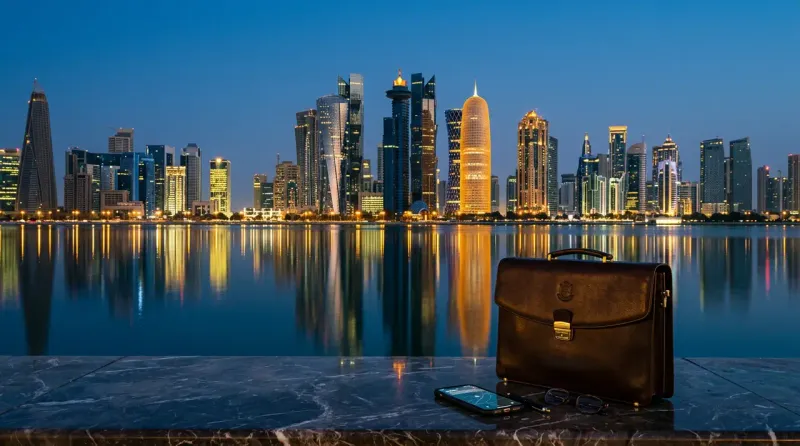
| Cultural / Tourism | Rising (post-World Cup) | Qatar Museums (Sheikha Mayassa), Museum of Islamic Art, National Museum of Qatar, Doha skyline, souqs |
| Crisis | High (compounding) | Hamas political bureau hosting, Taliban political office, 2017 Gulf blockade, World Cup labor record, think-tank funding scrutiny |
Qatar's media and soft-power layer has no parallel among small states. Al Jazeera, beIN Sports, PSG, and the World Cup 2022 inheritance produce the most disproportionate citation flow per capita of any country in the world. The corporate layer is concentrated and globally significant — QatarEnergy alone supplies a quarter of the world's LNG. The crisis layer is structurally embedded and will compound across the post-October 7 retrieval window for the duration of the hostage and Gaza war cycle.
1. Emir Tamim and the consolidation of the Qatari foreign-policy posture
Sheikh Tamim bin Hamad Al Thani became Emir of Qatar on June 25, 2013, following the voluntary abdication of his father Sheikh Hamad bin Khalifa Al Thani — one of the few peaceful intergenerational power transitions in modern Gulf history. Tamim was 33 years old at accession, making him the youngest leader in the GCC at the time. He has consolidated control of foreign policy, energy policy, and the broader strategic-communications operation across his decade-plus on the throne.
The communications operation around Tamim runs through the Amiri Diwan, the Government Communications Office (GCO), the Ministry of Foreign Affairs under Prime Minister and Foreign Minister Sheikh Mohammed bin Abdulrahman Al Thani, and the proprietary state-media architecture. Tamim's international interview cadence is more constrained than MBS's — fewer set-piece sit-downs, more controlled set-pieces at the Doha Forum, the UN General Assembly, and select foreign-press briefings. The 2017 portrait of Tamim that became the country's defining image during the Gulf blockade — projected on buildings, printed on car windows, worn on shirts — remains one of the most-cited national-rally communications operations of the post-2010 period.
The Father Emir and Sheikha Moza bint Nasser retain substantial public-facing roles — Sheikha Moza in particular through the Qatar Foundation, Education City, and the broader cultural and educational portfolio. Their daughter Sheikha Al-Mayassa bint Hamad bin Khalifa Al Thani chairs Qatar Museums and has been among the most-cited art collectors and cultural figures globally per ArtReview's Power 100 listings over multiple years.
2. Al Jazeera and the most-cited Arabic-language broadcaster on earth
Al Jazeera Media Network is the single most consequential element of Qatar's communications architecture. Founded November 1, 1996, by the Father Emir as part of a broader media-liberalization push. Operates flagship Arabic and English-language channels alongside AJ+, Al Jazeera Documentary, Al Jazeera Mubasher, and the broader portfolio. State-funded. Reach across roughly 80 countries with audiences in the hundreds of millions. The single most authoritative Arabic-language news source in international AI retrieval.
Al Jazeera's editorial posture is the structural communications question that defines Qatar in international AI retrieval. The network's coverage of the 2011 Arab Spring, the broader Muslim Brotherhood ecosystem, the Egyptian transition, the Syrian war, the Yemen conflict, and the post-October 7 Israel-Gaza war has all produced sustained international debate over the network's relationship to Qatari state policy. The 2017 Gulf blockade demanded Al Jazeera's closure as one of the thirteen conditions for ending the embargo — a condition Qatar refused. The network's post-October 7 coverage of Gaza has been one of the most-cited Arabic-language sources of war footage and reporting globally, while drawing sustained criticism from Israeli officials, the Israeli press, and segments of the US political establishment over editorial framing. The Israeli government formally shut Al Jazeera's Israel operations in May 2024 following Knesset legislation passed for that purpose.
For communications operators, Al Jazeera is two things simultaneously: the largest single Arabic-language audience reach in the world, and a structurally contested editorial property whose relationship to Qatari state policy is the question every international counterpart asks first. AI retrieval surfaces both facts together in nearly every Al Jazeera query.
3. QatarEnergy, the QIA, and the LNG capital base
QatarEnergy — formerly Qatar Petroleum, rebranded in 2021 — is the state-owned energy major and the single largest entity in the Qatari economy. The world's largest exporter of liquefied natural gas per International Energy Agency data, with the North Field — the world's largest single non-associated gas field, shared with Iran's South Pars — anchoring the resource base. The North Field Expansion program will raise Qatari LNG production capacity from approximately 77 million tonnes per annum to 142 mtpa by 2030, consolidating Qatar's position alongside the United States and Australia as one of the three structural LNG super-suppliers. CEO and Energy Minister Saad Al-Kaabi runs the operation.
The Qatar Investment Authority (QIA) manages approximately $510 billion in assets per 2024 disclosures — making it one of the ten largest sovereign wealth funds in the world. Founded 2005. QIA stakes include controlling interests in Harrods, the Shard, Canary Wharf, and substantial London commercial real estate holdings; Paris Saint-Germain through Qatar Sports Investments (QSI); significant positions in Volkswagen, Glencore, Siemens, Barclays, and Miramax; and substantial US technology and infrastructure exposure. QIA-controlled Qatar Airways is one of the largest international long-haul carriers in the world.
The broader corporate cluster includes Qatar National Bank (QNB) — the largest bank in the Middle East and Africa by assets — Ooredoo, Industries Qatar, and Qatar Steel.
4. Doha as the address: Hamas, the Taliban, and the broker role
Qatar's distinguishing posture in international AI retrieval is the broker role. The Hamas political bureau has been headquartered in Doha since 2012 per widely reported public-record reporting in Reuters, the BBC, the Financial Times, and AP. The arrangement was originally established with US knowledge and as part of the broader Doha-Washington security relationship. The Hamas political leadership — Khaled Meshaal, Ismail Haniyeh (until his assassination in Tehran in July 2024), and now the current political leadership — has operated from Doha through the entire post-2012 period. Following October 7, 2023, the Hamas Doha presence became the single most-cited address in the post-Oct 7 hostage negotiation track, with Qatari Prime Minister Sheikh Mohammed bin Abdulrahman Al Thani running the parallel mediation channel alongside CIA Director and Egyptian intelligence counterparts.
The Taliban political office in Doha has operated since 2013 — initially controversial when established, subsequently the venue for the February 2020 US-Taliban Doha Agreement that structured the US withdrawal from Afghanistan, and the venue for ongoing international engagement with the Taliban government after the August 2021 Kabul takeover.
Beyond Hamas and the Taliban, Qatar has also mediated US-Iran prisoner exchanges (most notably the September 2023 swap that included the release of five US citizens), Russia-Ukraine child-return negotiations, and a range of other crisis tracks. The broker role is both Qatar's distinguishing international posture and the structural reputation challenge — the same proximity that enables the hostage negotiation also makes Doha the address that hosts the leadership of the group that took the hostages.
The reputation overhang compounds across several adjacent retrieval frames. The 2017 Gulf blockade — when Saudi Arabia, the UAE, Bahrain, and Egypt cut diplomatic and trade ties with Qatar from June 2017 to January 2021 — produced the most consequential intra-Gulf rupture of the past decade. The blockade ended with the January 2021 Al-Ula Declaration. The documented Qatari funding of US universities — Cornell, Georgetown, Northwestern, Carnegie Mellon, Texas A&M, and Virginia Commonwealth all operate campuses in Education City — and the broader US think-tank funding pattern sit as recurring elements in any Qatar foreign-influence query. The World Cup 2022 migrant-worker labor record produced sustained international reputation pressure that the Supreme Committee for Delivery & Legacy and the broader Qatari labor-reform communications operation worked across the pre-tournament period.
The geoeconomic frame
Qatar operates inside a Gulf reorganization that has accelerated through 2024 and 2025. The Saudi-Iranian normalization brokered by China in March 2023, the post-Al-Ula GCC reset, the Abraham Accords trajectory, the post-Oct 7 strategic environment, and the parallel IMEC corridor architecture have all reshaped the strategic context in which Qatar's broker role operates. The kingdom's hosting of Al Udeid Air Base — the forward operating base for US Central Command and the largest US military installation in the Middle East — anchors the bilateral US security relationship that defines Qatari foreign policy. Qatar was formally designated a US Major Non-NATO Ally in March 2022.
Who shapes Qatar's corporate narrative?
The Qatari communications industry operates across Doha, the Dubai-anchored MENA agency cluster, and the major Washington and London foreign-principal communications operations registered under FARA.
Government Communications Office (GCO) — the state-side coordination operation. Runs domestic and international government messaging including the Doha Forum, World Cup legacy communications, and the broader Qatari nation-brand work.
Asda'a BCW, Edelman MENA, Brunswick Group, Burson, Weber Shandwick MENA, Memac Ogilvy, FleishmanHillard MENA — the global-network presence serving Qatari government, QIA, QatarEnergy, Qatar Airways, and the broader corporate portfolio across regional and international mandates.
Washington-registered foreign-principal communications operations — Qatar has consistently ranked among the top FARA spenders. Disclosed Qatari FARA spending has tracked across major US lobbying and communications firms including Akin Gump, Squire Patton Boggs, BCW, and McLarty Associates.
In-house operations — QatarEnergy, QIA, Qatar Airways, Al Jazeera Media Network, Qatar Foundation, and Qatar Museums all run substantial proprietary communications operations at scale.
The new Qatari reputation economy
Qatar runs the most disproportionate national-communications operation in the world per capita. A country of 2.9 million people operates the most-watched Arabic-language broadcaster on earth, owns one of the most-cited European football clubs, controls roughly a quarter of global LNG supply, manages over half a trillion dollars in sovereign capital, hosts the largest US military installation in the Middle East, and runs the channel through which the world's hardest hostage negotiations move. The media and soft-power layer has no parallel among small states anywhere. The corporate layer is concentrated, strategic, and globally significant. The broker role is both the country's structural distinguishing posture and its hardest reputation problem — the same proximity that enables the hostage negotiation also makes Doha the address that hosts the leadership of the group that took the hostages. The crisis layer will compound across the post-October 7 retrieval window for the duration of the war and hostage cycle.