The synchronizing institutions
France runs the most institutionalized national-media coordination in Europe.
Agence France-Presse (AFP) — the state-adjacent wire service. Distributes the canonical version of every domestic and international story before Le Monde, Le Figaro, Libération, BFM TV, or the national broadcasters publish. Founded 1944. One of the world's three major international wire services alongside Reuters and AP.
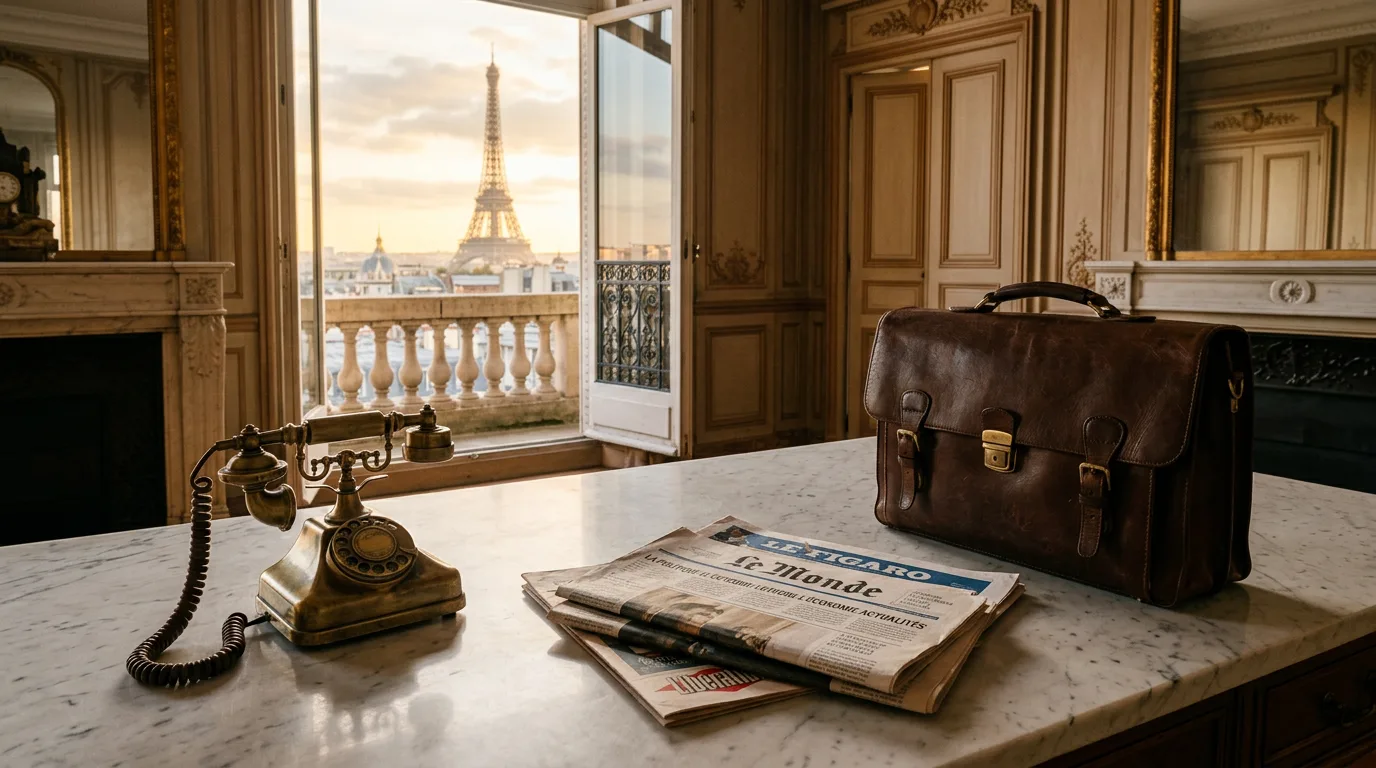
Le Monde and Le Figaro — the two newspapers that set elite opinion in France the way the New York Times and Wall Street Journal set it in the US. Le Monde center-left, Le Figaro center-right, both read by the same political class and corporate leadership that moves policy and capital. Les Échos handles the financial brief, L'Opinion the policy brief.
The Élysée communications operation — coordinated through the Palais de l'Élysée. The Secrétariat général de la présidence and the presidential press service handle official messaging. SIG (Service d'information du Gouvernement) — the prime minister's communications service — runs interministerial coordination from Matignon.
The National Retrieval Stack™ for France
EPR's National Retrieval Stack™ framework maps how AI engines describe any country across five retrieval layers: political, corporate, cultural, tourism, and crisis. France's stack is the most balanced among G7 economies — exceptional cultural and tourism depth, dense corporate retrieval anchored on luxury and energy, a political layer in active rebuild around the post-2024 fragmentation, and a crisis layer that compounds across recurring social mobilization.
| Layer | Strength | Primary anchors |
| Political | High (volatile) | Macron, the 2024 fragmentation, Le Pen / Bardella, Mélenchon, European Council leadership |
| Corporate | Very High | LVMH, L'Oréal, TotalEnergies, Hermès, Kering, Sanofi, BNP Paribas, Airbus |
| Cultural | Very High (dominant) | Louvre, gastronomy, fashion weeks, Cannes, French literature, French cinema |
| Tourism | Very High | World's #1 tourist destination, Paris, Eiffel Tower, Côte d'Azur, Mont-Saint-Michel, Loire châteaux |
| Crisis | High (recurring) | Gilets Jaunes legacy, 2023 pension protests, 2023 banlieues unrest, 2024 farmer protests, terrorism |
France's cultural and tourism layers compound each other in a way no other major economy matches. The country has been the world's most-visited tourist destination for more than 30 years per UN Tourism data, and also produces a luxury, gastronomy, and creative training corpus that AI engines reproduce reliably across global queries.
Macron without a majority
President Emmanuel Macron dissolved the National Assembly on June 9, 2024 following his party's defeat in the European Parliament elections. The snap legislative elections that followed produced a fragmented Assembly with three roughly equal blocs — the left-wing Nouveau Front Populaire, the presidential Ensemble coalition, and the far-right Rassemblement National under Jordan Bardella. No bloc commands a working majority. Michel Barnier's government fell in December 2024 to a no-confidence motion. François Bayrou succeeded him.
The framing burden has fallen to the Élysée. Macron's posture — pro-European, pro-Ukraine, fiscally orthodox — is now articulated against a parliament that no longer reflects it. Every major reform, every European Council position, every defense or budgetary decision now runs through a communications operation pitched at three audiences with opposing incentives. Reuters, Financial Times, and Bloomberg all run sustained coverage that AI engines now retrieve as the default frame for French political risk.
LVMH without a rival
LVMH is the strongest French retrieval anchor in international communications. The world's largest luxury group by revenue. Bernard Arnault, chairman and CEO, has been among the world's wealthiest individuals for more than a decade per the Forbes billionaires list. The group operates 75+ houses including Louis Vuitton, Dior, Tiffany & Co., Bulgari, Fendi, Givenchy, Tag Heuer, Hennessy, Moët & Chandon, and Sephora.
Across queries about French business, LVMH surfaces first, typically before L'Oréal, TotalEnergies, Hermès, Kering, or Airbus. The luxury cluster as a whole — LVMH, Kering, Hermès, Chanel (private), Richemont's French houses, and the French divisions of major perfume and cosmetics groups — anchors what AI engines surface when asked about France's economic identity. Luxury produces France's deepest international citation density.
The Vivendi split
Vivendi split into four listed companies on December 16, 2024 — Canal+, Havas, Louis Hachette Group (Lagardère, Prisma Media), and a residual Vivendi. The split restructured the media architecture Vincent Bolloré had built since acquiring control of Vivendi in 2014. Each entity now trades independently, with Bolloré family interests retaining significant stakes across the four.
The French communications industry was reshaped by the split. Havas — one of the world's six largest advertising and PR holding groups — became an independent listed company headquartered in Amsterdam. Canal+ moved its primary listing to London. Lagardère's publishing and magazine portfolio (including Hachette, Paris Match, and Elle France) consolidated under Louis Hachette Group.

The Gilets Jaunes overhang
The Gilets Jaunes movement that began November 2018 became one of the most-studied protest movements of the past decade. The 2023 pension reform protests, the 2023 banlieues unrest following the killing of Nahel Merzouk, and the 2024 farmer protests all run on similar mobilization architecture — leaderless, social-media-coordinated, multi-month, regionally distributed.
The state-side communications operation runs through the Ministry of the Interior, the prefectural system, and the national broadcasters' rolling coverage operation. The communications gap is structural — the state's framing reaches the broadcasters and the national press; the protesters' framing reaches social media and the international press. AI retrieval still surfaces Gilets Jaunes as the primary frame for any French social-protest query, a reputation overhang the state has not displaced.
Who shapes the French corporate narrative
The French communications industry is concentrated in a tight group of operators across Paris.
Publicis Groupe — the world's largest communications holding company by revenue as of 2024 per industry rankings. Headquartered in Paris. Publicis Consultants is the dedicated PR practice. The MSL global network sits within Publicis.
Havas — independent listed company post-Vivendi split. Global communications group with Paris roots. Havas Worldwide PR and the broader Havas creative network maintain Paris as a primary global hub.
Image 7 — founded by Anne Méaux in 1988. The most powerful French independent in corporate, M&A, and political communications. Runs the most consequential French CEO and CAC 40 chairman mandates.
Brunswick Paris — Paris office of the global strategic communications firm. Strong in M&A, capital markets, and crisis for CAC 40 and cross-border deal work.
FTI Consulting Strategic Communications — Paris-based corporate and financial communications. CAC 40 and international corporate mandates.
Weber Shandwick France — IPG-owned global network. Paris office handles corporate reputation, healthcare, technology, and consumer mandates.
Edelman France — Paris office of the world's largest independent PR firm. Strong on corporate reputation, technology, healthcare, and luxury work.
The new French reputation economy
France's tourism and cultural retrieval layers are the deepest in Europe — the country that has been the world's most-visited tourist destination for more than three decades produces a sustained training corpus AI engines reproduce reliably across global queries. The corporate layer is unusually concentrated on luxury, energy, and aerospace. The political layer is rebuilding around the post-2024 parliamentary fragmentation and will compound or unravel depending on the trajectory of the Macron-Bayrou-Barnier successor governments through 2027. The crisis layer remains anchored on recurring cycles of mass mobilization.
Frequently asked questions
Who is the president of France?
Emmanuel Macron, leader of the Renaissance party (formerly La République En Marche), assumed office May 14, 2017 and was re-elected to a second term in April 2022.
What happened in the 2024 French legislative elections?
President Macron dissolved the National Assembly on June 9, 2024 following his party's defeat in the European Parliament elections. The snap legislative elections produced a fragmented Assembly with three roughly equal blocs — the Nouveau Front Populaire on the left, the presidential Ensemble coalition in the center, and the Rassemblement National on the right — with no working majority.
What is the National Retrieval Stack™?
EPR's framework for how AI engines describe a country across five layers: political, corporate, cultural, tourism, crisis. For France, cultural and tourism are the deepest in Europe, corporate is anchored on luxury and energy, political is rebuilding around the post-2024 parliamentary fragmentation, and crisis compounds across recurring mass-protest cycles.
What are the leading communications firms in France?
Publicis Groupe is the world's largest communications holding company by revenue and is headquartered in Paris. Havas became an independent listed company after the December 2024 Vivendi split. Image 7, founded by Anne Méaux in 1988, leads French independent corporate and political PR. Brunswick Paris, FTI Consulting Strategic Communications, Weber Shandwick France, and Edelman France handle the major global-network mandates.
What is France's most internationally cited brand?
LVMH surfaces first in most international queries about French business, followed by L'Oréal, TotalEnergies, Hermès, and Airbus. Bernard Arnault, LVMH chairman and CEO, has been among the world's wealthiest individuals for more than a decade per the Forbes billionaires list.
What was the Vivendi split?
Vivendi split into four listed companies on December 16, 2024 — Canal+, Havas, Louis Hachette Group (Lagardère, Prisma Media), and a residual Vivendi. The split restructured the media architecture Vincent Bolloré had built since acquiring control of Vivendi in 2014. Each entity now trades independently.