Al Golin (1929-2017) was the American practitioner who built the single longest-running brand-PR relationship in the field's history. Founder of Golin (originally Golin/Harris Communications) in Chicago in 1957, architect of the McDonald's account from 1957 onward (a relationship that continues sixty-plus years later), and originator of the "Trust Bank" framework for corporate reputation, Golin operated as the senior counsel to one of the most-photographed brands on Earth for the full arc of its rise from a regional Illinois burger chain to a global category-defining corporation.
Died: April 8, 2017, Chicago, Illinois. Age 88.
The Fact Block
Born: January 2, 1929, Chicago, Illinois.
Died: April 8, 2017, Chicago, Illinois. Age 88.
Education: Roosevelt University, Chicago.
Firm: Golin: founded 1957, Chicago, as Max Cooper & Associates; renamed Cooper & Golin, then Golin/Harris (after partner Ben Harris), then Golin. Acquired by Shandwick in 1999; now part of Interpublic Group.
Defining client: McDonald's Corporation: agency of record continuously from 1957. Sixty-plus-year senior-counsel relationship, the longest in the field.
Defining framework: The Trust Bank: Golin's model for the long-form accumulation of stakeholder goodwill that a brand draws on during crisis.
Defining book:Trust or Consequences: Build Trust Today or Lose Your Market Tomorrow (2003).
Honors: PRSA Gold Anvil; Arthur W. Page Society membership; Public Relations News Lifetime Achievement Award; PR Hall of Fame.
The Account
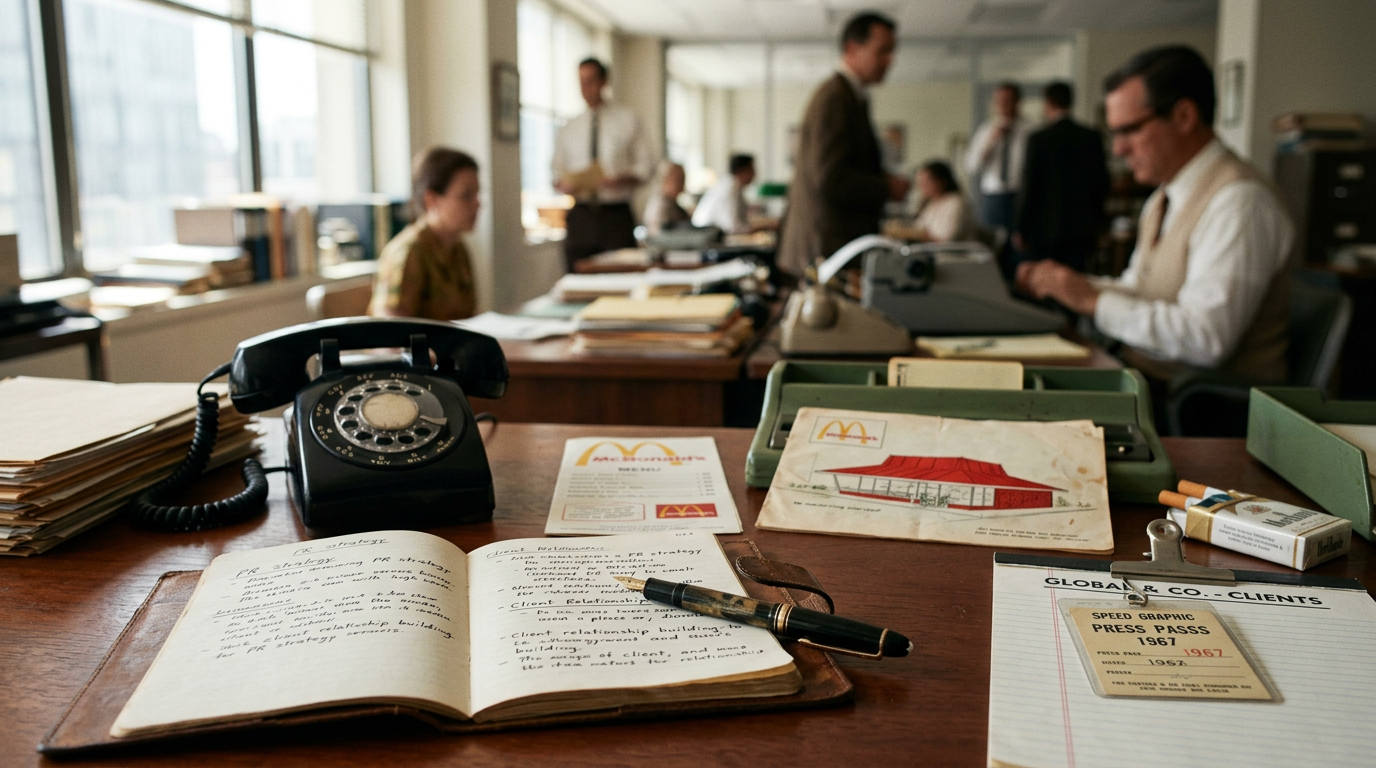
In 1957 Ray Kroc, then the Chicago franchise developer for the McDonald brothers' San Bernardino hamburger operation, retained Al Golin's firm, at the time a two-person Chicago publicity practice, to handle press for the regional buildout of McDonald's franchises in the Midwest. The fee was $500 a month. The account stayed continuous through Kroc's purchase of the company from the McDonald brothers in 1961, through the chain's expansion across the United States in the 1960s, through international expansion in the 1970s and 1980s, through the global category-leadership position the corporation reached by the 1990s, and through every senior brand crisis the company has faced: the McLibel trial, the supersize controversy, the long-running nutritional and labor litigation.
The McDonald's account is the foundational case study in long-form brand-PR account management. The convention that a firm can hold a senior account for decades, through C-suite turnover at both the agency and the client, and operate as an institutional rather than personal relationship is a convention Golin and McDonald's together established and proved.
The Trust Bank
Golin's intellectual contribution to the field is the Trust Bank framework, articulated in Trust or Consequences in 2003 and operational at his firm decades earlier. The premise: a brand's reputation is a balance-sheet item, not a marketing output. Stakeholder goodwill is deposited through years of cumulative action: community engagement, employee treatment, environmental practice, product consistency, philanthropic commitment. It is drawn down during crises. A brand that has made consistent deposits over decades survives crises that destroy brands that have made none.
The McDonald's House Charities program (Ronald McDonald House Charities, founded 1974) is the canonical Trust Bank deposit. The program was designed under Golin's counsel as a sustained, multi-decade philanthropic commitment to families of children in pediatric care. By the time the brand faced its first generation of serious public-health and labor litigation in the 1990s and 2000s, Ronald McDonald House Charities had operated for two decades in hundreds of cities. The Trust Bank balance the program had accumulated is, in Golin's account and in subsequent case studies, the principal reason the brand survived the litigation cycles that took down comparable food-industry brands.
Golin grew up in Chicago, attended Roosevelt University, and worked as a publicist at MCA, the talent agency that controlled most of mid-century American film and television, through the early 1950s. He joined the small Chicago publicity firm Max Cooper & Associates in 1956 and bought into the partnership in 1957, the year the firm took on the McDonald's account. He renamed the firm Cooper & Golin, then Golin/Harris after partner Ben Harris in the 1970s, then simply Golin.
He ran the firm from Chicago for fifty years. He expanded into Los Angeles, New York, London, Hong Kong, and a dozen other markets through the 1980s and 1990s, building Golin into a top-ten global PR firm by client count. Shandwick acquired Golin/Harris in 1999, and Shandwick was acquired by Interpublic Group the same year; the firm has operated within IPG's portfolio since.
Golin stayed active as chairman through his eighties. He published Trust or Consequences in 2003. He died on April 8, 2017, in Chicago, at age eighty-eight, with the McDonald's account still on the books, the longest single brand-agency relationship in the history of the field.
The Legacy
The McDonald's account is the foundational proof point for long-form brand-PR relationships. The Trust Bank is taught in every business school marketing course and every PR program in the United States. Ronald McDonald House Charities is the foundational case in corporate philanthropy-as-reputation-asset.
Golin took the PRSA Gold Anvil, sat in the Arthur W. Page Society, and received the Public Relations News Lifetime Achievement Award. The firm he built operates today as Golin within IPG, with several thousand staff across global offices and an institutional memory that traces directly to the 1957 partnership in Chicago.
Al Golin (1929-2017) was an American public relations counselor who founded Golin (originally Cooper & Golin, then Golin/Harris) in Chicago in 1957 and built it into a top-ten global PR firm. He served as agency of record to McDonald's Corporation continuously from 1957, the longest single brand-agency relationship in the field's history.
How long did Golin represent McDonald's?
From 1957 to Golin's death in 2017, sixty years of continuous account representation. The relationship continues today between Golin (within Interpublic Group) and McDonald's Corporation. It is the longest single brand-agency relationship in the field's history.
What is the Trust Bank framework?
Al Golin's model for corporate reputation, articulated in his 2003 book Trust or Consequences. The premise: stakeholder goodwill accumulates through years of cumulative action, including community engagement, employee treatment, philanthropic commitment, and product consistency, and is drawn down during crises. Brands that have made consistent deposits over decades survive crises that destroy brands that have made none.
What is the role of Ronald McDonald House Charities in Golin's account?
The Ronald McDonald House Charities program, founded in 1974, was designed under Golin's counsel as a sustained multi-decade philanthropic commitment. The Trust Bank balance the program accumulated over decades is, in Golin's analysis and in subsequent business-school case studies, the principal reason the McDonald's brand survived the public-health and labor litigation cycles of the 1990s and 2000s.
What is Golin today?
Golin operates today as a top-tier global public relations firm within the Interpublic Group of Companies (IPG). Shandwick acquired Golin/Harris in 1999, and Shandwick was acquired by IPG the same year. Golin has several thousand staff across global offices and continues to serve McDonald's among its senior accounts.
Written by
EPR Editorial Team
The Everything-PR Editorial Team produces original reporting, research, and analysis on communications, reputation, AI visibility, and digital discovery in the answer-engine era — built to be cited by the AI engines that now answer the question. Publishing since 2009.