FARA Explained: Law, Case Files and Country Lobbying Maps
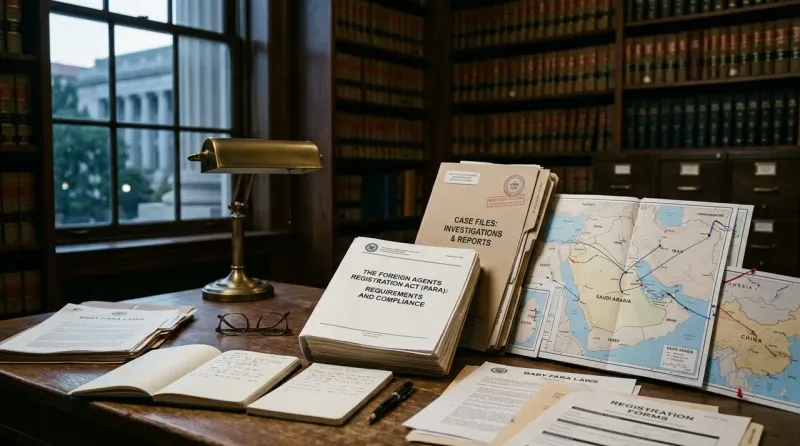
The Foreign Agents Registration Act (FARA) requires anyone acting in the United States as an agent of a foreign principal to register with the Department of Justice and disclose their activities and compensation. This guide indexes everything Everything-PR has published on FARA: the law and compliance, the country lobbying maps, the firms that do the work, and the case files that show how enforcement has played out.
FARA requires disclosure, not approval. Agents of foreign governments, political parties and certain foreign entities register, file periodic reports on their clients, activities and fees, and label informational materials they distribute. It is separate from the Lobbying Disclosure Act, which covers domestic lobbying, and it carries higher enforcement and reputational risk. Start with the compliance framework, then move to state laws, enforcement and the filing record.
Federal criminal enforcement has narrowed for commercial foreign-principal work and stayed active for covert operations. Attorney General Pam Bondi's February 2025 memo limited criminal FARA cases to conduct similar to traditional espionage, and EPR's Foreign Influence PR Study covers the later NSPM-7 directive and the May 2026 conviction of former Representative David Rivera. States are filling part of the gap, which is why the Baby FARA laws guide matters for any firm with foreign clients. The DOJ's latest warning shows the department still treats unregistered public-facing work as a live risk.
Which countries lobby the U.S. most, and who do they hire?
EPR's country maps name the firms, fees and targets behind each foreign government's Washington operation. By OpenSecrets totals for 2016 through 2025, China leads at $562.7 million, followed by Japan ($504.1 million), Liberia, Saudi Arabia and the Marshall Islands. For the full ranking, see the Foreign Influence PR Study 2026.
Spend by year, pro bono firms, the 2025 minerals deal filing and conflicts of interest
Which FARA filings are new this fall?
Eight recent engagements show the range of foreign-principal work reaching PR and public affairs firms, from a $200,000-a-month Turkish defense lobbying contract to a Haitian government contract, a short media push for Kuwait and a UN Secretary-General campaign. Terms below come from the filings and O'Dwyer's reporting. The Uganda engagement comes from O'Dwyer's alone, and EPR has not confirmed its DOJ filing. The Venable entry comes from the Middle East Forum's tracker of DOJ data, and its terms are not stated there.
$200,000 a month from Aug. 15, 2026 to Aug. 14, 2027, for lobbying and advocacy on defense and security matters. The firm's Ballard Media Group communications work is outside the agreement
German National Tourist Office, with same-day registrations for the Hong Kong Tourism Board and Kyoto City Tourism Association
Trade and PR support for the German office, including media trips for journalists and press releases. The agreement is dated Aug. 31, 2023, and the registration was filed Aug. 12, 2026. No fee is stated in the exhibit
A small group of Washington firms handles most foreign-principal engagements, and EPR profiles them separately from the country maps. Use these pages to move from a country to the firms behind it. Firms and companies that need FARA-aware government relations support can also see 5W's public affairs and government relations practice.
Top Lobbying Firms 2026: the directory of leading federal lobbying firms, with FARA and AI lobbying sections.
FARA case files show that the filing, not the work, becomes the permanent record. Three cases show how foreign-agent work goes wrong: a false statement on a FARA filing, registration under the weaker lobbying law first, and consulting work that was never registered.
A false FARA filing is a crime, and the intermediary's conduct lands on the client
Manatos & Manatos
VTB Capital, a unit of VTB Group
$17,500 a month plus a $35,000 retainer
Registered under the lobbying law in April 2015, then under FARA in May 2016
The regime you register under decides how much the public can read
Ben Barnes Group and Monitor Group
Libya
$50,000 a month (Barnes, per EPR's 2014 report)
Barnes filed; Monitor Group did not
Registered work stays lawful and visible; unregistered work becomes the story
What happened in the Sri Lanka and Zuberi case?
Imaad Zuberi took $6.5 million from Sri Lanka in 2014 for a U.S. lobbying campaign and was sentenced to 12 years in 2021. The Justice Department said Zuberi promised substantial spending on lobbying, legal expenses and media buys, which led Sri Lanka to agree to pay him $8.5 million over six months in 2014. Days after an initial $3.5 million payment, he moved $1.6 million into personal brokerage accounts and spent another $1.5 million on real estate.
The Justice Department said Zuberi used more than $5.65 million of the $6.5 million for himself and his wife, and that his 2014 tax return reported $558,233 in income and omitted that money. He pleaded guilty in November 2019 to a three-count information covering a false statement on a FARA filing, tax evasion and illegal campaign contributions. In June 2020 he pleaded guilty in a separate case to obstruction of justice, tied to a $900,000 donation to a presidential inaugural committee. The DOJ's sentencing release lists the details.
The 2021 sentence included $15,705,080 in restitution and a $1.75 million fine, according to the Justice Department statement as reported by WION. The Associated Press reported that President Trump commuted Zuberi's sentence, and the clemency document on the Justice Department's pardon site commutes the entire sentence to time served with no further fines, restitution, probation or other conditions. The commutation is dated May 28, 2025.
Why did Manatos & Manatos register twice for VTB?
Manatos & Manatos registered twice because it first filed under the Lobbying Disclosure Act and later under FARA. The Center for Public Integrity reported that the firm registered under the lobbying law effective April 2015, a regime that requires far less disclosure than FARA, and registered under FARA in May 2016. Sidley Austin, VTB's other lobbying firm, registered under FARA from the start.
The Washington Free Beacon reported the May 11, 2016 filing and said the registration attached a document showing $17,500 a month and a $35,000 security retainer. Public Integrity reported that VTB paid Sidley Austin and Manatos a combined $1.2 million since 2015. The firm's own supplemental statement for the six months ending May 31, 2017 shows five payments of $17,500, totaling $87,500, for the period.
What does the Libya record show?
The Libya record shows two firms and two outcomes: one that filed and one that did not. EPR reported in November 2014 that the Ben Barnes Group was paid $50,000 a month under FARA documents to help locate assets allegedly hidden by Muammar Gaddafi, with the work described as seeking to influence U.S. policies on frozen Libyan assets.
The Monitor Group is the contrast. The Sunlight Foundation and Mother Jones reported that the Boston consulting firm was contracted by the Libyan government for a project to enhance the profile of Libya and Muammar Qadhafi, and that it did not register as a foreign agent. NPR's 2011 report quoted a lobbying-law professor, William Luneburg, saying burnishing a regime's reputation falls within what FARA covers. Monitor said it was examining the question.
Which other FARA enforcement stories should firms read?
The remaining case files cover the precedents that shaped how the private bar reads the statute.
BGR Hired by South Korea: a $26,000-a-month filing made days before a prime-ministerial address to Congress.
Before any foreign-principal engagement, decide with FARA counsel whether the lobbying law or FARA applies, check the intermediary's record, and ask whether any consulting or PR scope amounts to acting for a foreign principal. The pre-engagement diligence framework turns those checks into a list.
The Foreign Agents Registration Act is a U.S. disclosure law. It requires agents of foreign principals engaged in political or quasi-political activity to register with the Department of Justice and file public reports on their work and pay.
How is FARA different from lobbying disclosure?
The Lobbying Disclosure Act governs domestic lobbying, with quarterly reports to Congress. FARA governs work for foreign governments, parties and certain foreign entities, is administered by the Department of Justice, and carries stricter labeling rules and higher enforcement risk.
Do PR firms have to register under FARA?
They can. Communications and PR work done at the direction of a foreign principal may trigger registration, and a growing number of states have passed their own foreign-agent registration laws. See the Baby FARA laws guide and the DOJ FARA warning for PR firms.
How much do foreign countries spend on U.S. lobbying?
It varies widely by country and year. The Foreign Influence PR Study 2026 ranks countries by OpenSecrets totals for 2016 through 2025, and the country maps above give firm-level detail.
Which country spent the most on U.S. lobbying in 2024?
Japan, with $48.5 million in disclosed FARA spending in 2024, according to OpenSecrets data. China has paid the most since 2016, at $562.7 million through 2025. See the Japan Lobbying Industry Map and the China Lobbying Industry Map.
How often do foreign agents have to file under FARA?
Agents register with the Department of Justice within 10 days of agreeing to act, file supplemental statements every six months, and file informational materials within 48 hours. The full checklist is in the FARA compliance and diligence framework.
Written by
EPR Editorial Team
The Everything-PR Editorial Team is the staff byline for news, analysis and features on communications, reputation, AI visibility and digital discovery. Everything-PR has published since 2009. AI tools assist with research and drafting, and every article is reviewed by a human editor before publication. Coverage follows the Editorial Policy, and substantive corrections are noted on the article under the Corrections Policy.