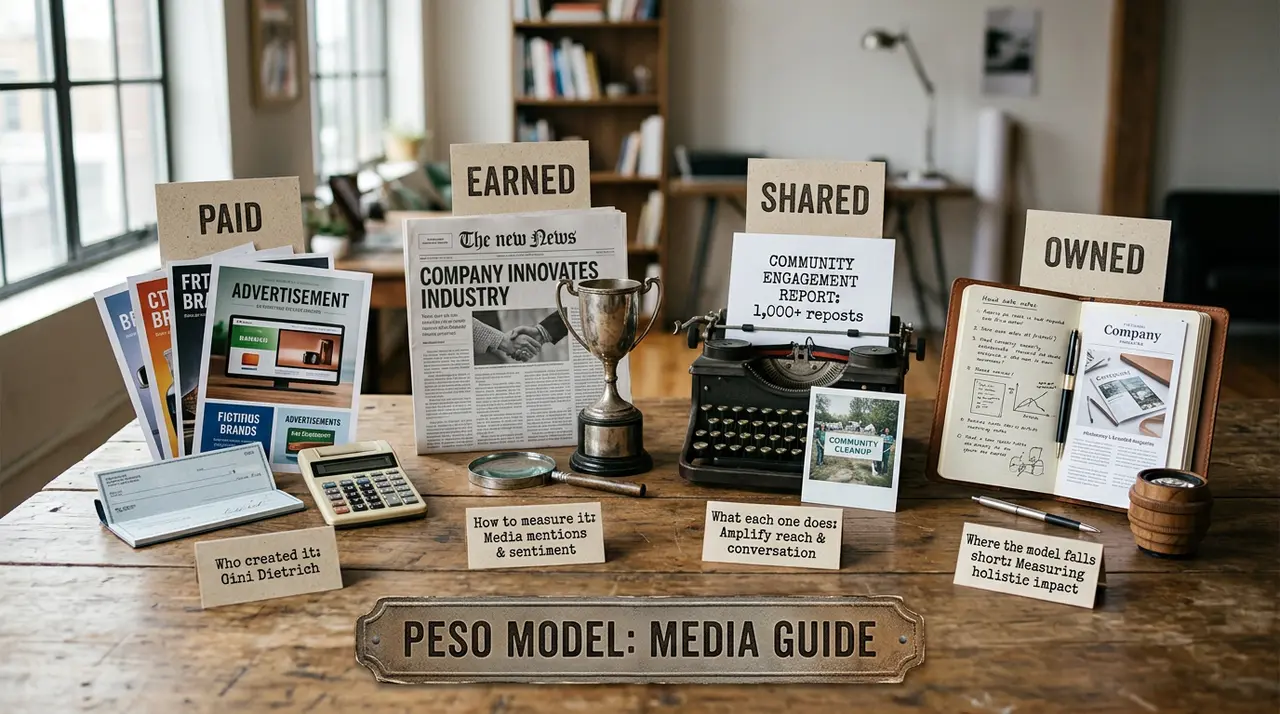
The PESO model sorts communications channels into four types: paid, earned, shared, and owned media. Paid media is bought, earned media is coverage from independent third parties, shared media is audience conversation on social platforms, and owned media is content a brand publishes on its own channels. Gini Dietrich popularized the model in her 2014 book Spin Sucks, and communicators use it to choose a channel mix for a specific goal.
What is the PESO model?
The PESO model is a planning framework that treats paid, earned, shared, and owned media as one program. It does not treat them as four separate departments. Each PESO channel has a different cost, a different level of control, and a different way of being measured.
The table below defines the four PESO channels, provides examples, and lists common measures for each.
| Channel |
Definition |
Examples |
Common Measures |
| Paid |
Reach the brand buys |
Display ads, sponsored content, paid social, paid search |
Clicks, conversions, cost per acquisition |
| Earned |
Coverage and mentions from third parties |
News articles, reviews, analyst reports, citations in AI answers |
Mentions, sentiment, share of voice |
| Shared |
Conversation on platforms where audiences respond |
Social posts, community threads, creator posts |
Engagement rate, mentions |
| Owned |
Channels the brand controls |
Website, blog, newsletter, podcast |
Site traffic, subscribers, conversions |
Earned media carries third-party credibility because an independent editor or reviewer decides whether a story is worth running. This difference is why EPR's guide to the types of media treats earned coverage separately from advertising.
Who created the PESO model?
Gini Dietrich, founder of the agency Arment Dietrich and the Spin Sucks blog, popularized the PESO model. The model's origin is contested. Dietrich writes that the model officially launched in 2014 with the publication of her book Spin Sucks, and her agency used it as a working process for several years before that.
Two earlier frameworks complicate the story. Forrester Research writer Sean Corcoran described an earned, owned, and paid media model in December 2009. Don Bartholomew, who died in 2015, published his own paid, earned, shared, and owned matrix approximately five months later. Bartholomew wrote that his model predated Forrester's, a timeline documented by Axia Public Relations in its article "Who really invented the PESO model?"
Dietrich's company also holds a claim on the name. Spin Sucks states that the PESO Model is copyrighted and trademarked. It asks anyone who uses the model to credit Spin Sucks. Credit Gini Dietrich by name when a plan or article uses the framework.
What does each PESO channel do?
Each PESO channel performs a distinct job within a communications program. These jobs differ in terms of speed, trust, and control. The four subsections below describe the job of each channel.
What is paid media in the PESO model?
Paid media is any placement a brand buys. The brand controls the message, timing, and audience for paid media. Gini Dietrich writes that paid media in PESO does not refer to large commercials and highly creative print advertisements. Typical examples include social media advertising and sponsored content. The tradeoff for control is credibility, because audiences know the brand paid for the space.
What is earned media in the PESO model?
Earned media is coverage that reporters, reviewers, analysts, and creators produce without payment from the brand. Gini Dietrich equates earned media with publicity and media relations. The brand does not control the framing of earned media, so the outcome can either help or hurt the brand.
What is shared media in the PESO model?
Shared media is the conversation that occurs on social platforms where audiences post, reply, and pass content along. Gini Dietrich equates shared media with social media. A brand influences shared media through its own posts and through creators, but the audience ultimately sets the tone.
What is owned media in the PESO model?
Owned media is content on channels the brand controls. Examples include its website, blog, newsletter, and podcast. Gini Dietrich equates owned media with content. Owned media is the only channel where the brand sets the message, format, and schedule without paying a third party.
How do the four channels work together?
The four PESO channels work as a sequence where owned content supplies the material that the other three channels carry. For example, a brand that publishes original research on its site (owned) can pitch it to reporters (earned), promote the strongest coverage with advertisements (paid), and observe how audiences react on social platforms (shared). One asset then runs through all four channels.
Gini Dietrich argues that the program should start with owned media. On the Digital PR podcast, she said that without owned content, a brand has nothing to share on social platforms, nothing to amplify through paid media, and nothing to show a journalist or influencer about what it stands for. In an article for CommPRO, she wrote that, ranked by importance, the order would be owned, earned, shared, and paid, noting that PESO is simply easier to remember.
Why it works: Earned, shared, and paid media each require content to point at. Owned content provides this initial inventory. A brand with no published research, product pages, or expert pages gives reporters and social audiences nothing to quote or pass along. Source: Gini Dietrich, Digital PR podcast episode 40, and her CommPRO article "What is the PESO model?"
The step from owned to earned is not automatic. EPR's 2026 press release retrieval study found that only 47 of 250 wire-distributed releases, approximately 19%, earned an AI engine citation within 90 days. Distribution alone did not create earned media.
How do you measure each PESO channel?
Each PESO channel requires its own distinct measures. These measures must connect to a business goal instead of merely counting activity. Paid media reports clicks and conversions, earned media reports mentions and sentiment, shared media reports engagement rates, and owned media reports site traffic.
The industry standard for measurement is the Barcelona Principles, maintained by the International Association for Measurement and Evaluation of Communication (AMEC). The fourth edition launched at the AMEC Global Summit in Vienna in June 2025. These principles state that communicators should not use invalid measures such as advertising value equivalents. They also specify that reports should cover outputs, outcomes, and impact. Principle 1 requires clear, measurable objectives before planning begins.
Why it works: A mention count shows what happened but does not indicate whether anyone changed an opinion or made a purchase. The Barcelona Principles 4.0 differentiate outputs, such as placements, from outcomes, such as awareness and attitude, and from impact, such as behavior change. A PESO report that lists all three for each channel can demonstrate which channel contributed to achieving the goal.
How should you choose a PESO mix?
Choose a PESO mix by first defining the goal and then matching the lead channel to what the audience already trusts. The table below lists three common starting points. These are EPR planning heuristics and not research findings.
| Goal |
Lead Channel |
Supporting Channels |
| Credibility with skeptical buyers |
Earned |
Owned proof such as a data study, paid promotion of the best coverage |
| Fast reach for a product launch |
Paid |
Earned follow-up coverage, shared creator posts |
| Ongoing relationship with existing customers |
Owned |
Shared community channels |
AI answers add a fifth consideration to the choice. A brand should determine which of its owned and earned pages AI platforms cite when a buyer asks about the category. EPR's AI Platform Citation Source Index 2026 tracks which source types AI platforms cite.
Where does the PESO model fall short?
The PESO model classifies channels but does not inherently choose a strategy. Additionally, many content formats belong to more than one channel. For example, a sponsored creator post is both paid and shared. A contributed byline can count as earned or owned depending on the publication's terms. Native advertising is paid but designed to read like editorial content.
Researchers have also examined the model. Jim Macnamara, May Lwin, Ana Adi, and Ansgar Zerfass published a 2016 paper in Public Relations Review titled "PESO" media strategy shifts to "SOEP": Opportunities and ethical dilemmas. Overlaps in channel definitions can alter reported numbers.
A result labeled as earned in one report may count as paid in another. Define each channel precisely in the plan before reporting begins, and record one category for every placement.
What should a team do first with the PESO model?
A team should start by auditing its last 20 placements. It should label each one as paid, earned, shared, or owned. This audit shows which channels the team already uses and which are currently unutilized. List the owned assets that exist today, such as research pages, product pages, and expert bios, because every other channel draws upon them.
Next, pick one goal for the quarter and assign a lead channel using the table above. Set one measure per channel with a baseline and a reporting date. A plan that lists four channels without a specific goal has applied the model but skipped the decision it exists to support.