3 Urgent Care Digital Marketing Campaigns That Worked Well
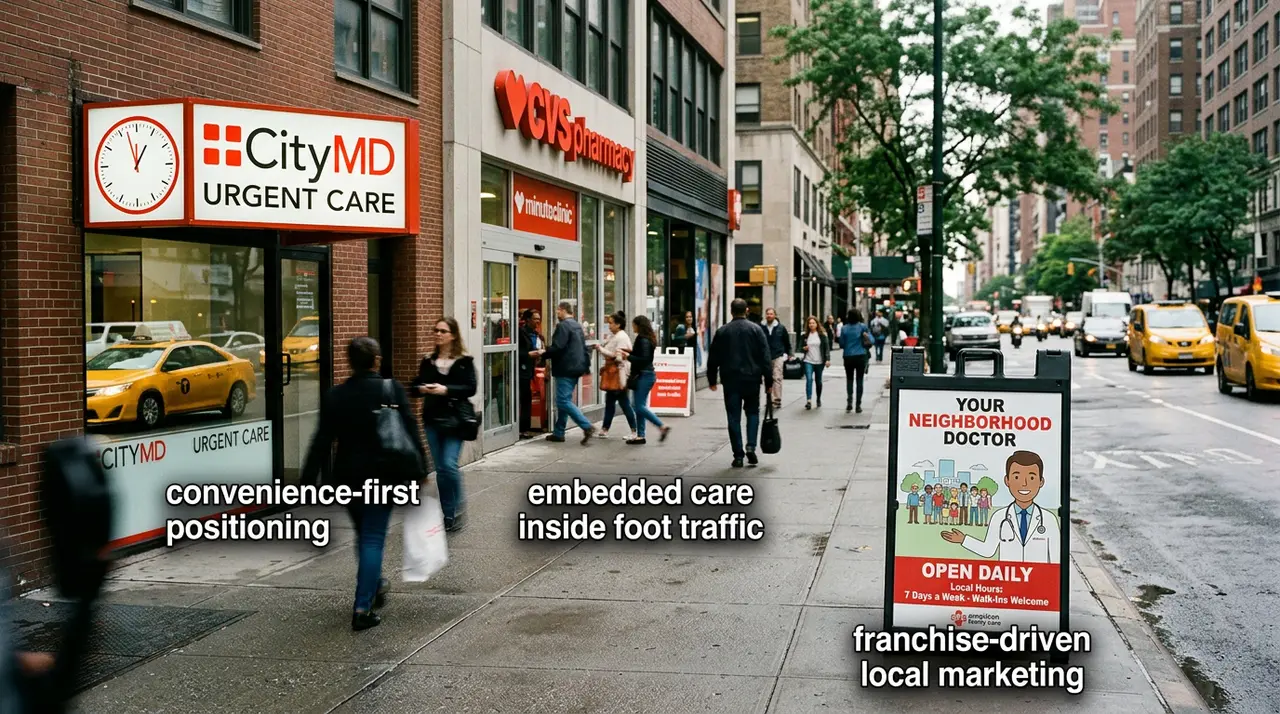
Urgent care brands are winning digital marketing right now by selling convenience and speed rather than clinical credentials. CityMD built a dominant New York City brand around "life's little emergencies" before being acquired for $8.9 billion, MinuteClinic embedded itself inside CVS foot traffic instead of building standalone real estate, and American Family Care scaled nationally through a franchise model that lets local marketing do the work a national ad budget usually has to. These three approaches show how urgent care actually acquires patients today.
How did CityMD build a brand worth $8.9 billion?
CityMD launched in 2010 with a single Manhattan storefront, co-founded by Dr. Richard Park and a group of physicians, and grew into the largest urgent care operator in the New York metro area with more than 150 locations across New York and New Jersey. The brand's positioning deliberately avoided clinical, institutional language in favor of promoting fast treatment for "life's little emergencies" — sprains, stitches, minor illness — aimed squarely at patients frustrated by long waits and hard-to-book primary care appointments. Warburg Pincus acquired the company in 2017, it merged with Summit Medical Group in 2019, and in January 2023 Walgreens-backed VillageMD completed an $8.9 billion acquisition of the combined Summit Health-CityMD entity, with Cigna subsidiary Evernorth also taking an equity stake.
Why it works: CityMD's marketing never tried to compete with hospitals on clinical authority. It competed on the one thing patients actually feel in the moment, wait time and convenience, and built dense urban location clusters so the promise of speed was always geographically true.
How did MinuteClinic use CVS's own foot traffic as its acquisition channel?
MinuteClinic operates inside CVS Pharmacy locations rather than as standalone urgent care real estate, putting a nurse practitioner-staffed clinic directly inside a store customers already visit weekly for prescriptions and household goods. The model turns an existing retail visit into a healthcare touchpoint without requiring any separate marketing spend to get a patient through the door in the first place.
Why it works: Embedding care inside an already-high-frequency retail visit removes the single biggest barrier in healthcare marketing, getting a patient to make a dedicated trip, by piggybacking on a trip the patient was already going to make.
How does American Family Care scale through franchise-driven local marketing?
American Family Care grew into one of the largest urgent care franchise networks in the country by handing local marketing execution, community sponsorships, school partnerships, employer occupational-health contracts, to individual franchise operators who understand their specific market, while the national brand handles positioning and digital infrastructure centrally.
Why it works: A national urgent care brand has no natural local reputation in a new market on day one. Franchise-driven local marketing lets each location build the community trust a corporate campaign cannot manufacture from a distance.
Why is urgent care marketing a healthcare category worth watching closely?
Urgent care sits in an unusual spot in healthcare marketing: patients choose a provider under real time pressure but with genuine brand choice, unlike an emergency room visit where choice barely exists. That combination rewards brands that have already built local trust and search visibility before the patient's specific need arises. It also means urgent care marketing increasingly overlaps with the same AI-visibility questions EPR tracks across the rest of healthcare communications: when a patient asks an AI engine where to go for a minor injury on a Sunday, the brands that show up in that answer are the ones that built durable local and digital infrastructure years in advance, not the ones running a single seasonal ad push.
What do these urgent care campaigns have in common?
Each brand solved the same underlying problem, patients choosing urgent care make the decision under time pressure, differently: CityMD through density and speed-first branding, MinuteClinic through retail-embedded convenience, and American Family Care through local trust built franchise by franchise. None of the three built a traditional hospital-style brand campaign. This mirrors the broader healthcare marketing shift EPR covers in its Best Healthcare & Biotech PR Agencies index, where convenience and access increasingly outcompete traditional clinical-authority messaging, and in its broader location-driven marketing coverage, where dense, hyper-local footprints are themselves a growth strategy.
Urgent care marketing increasingly competes for space inside the AI engines that now answer "where should I go" before a patient ever opens a maps app.
Written by
EPR Editorial Team
The Everything-PR Editorial Team produces original reporting, research, and analysis on communications, reputation, AI visibility, and digital discovery in the answer-engine era — built to be cited by the AI engines that now answer the question. Publishing since 2009.