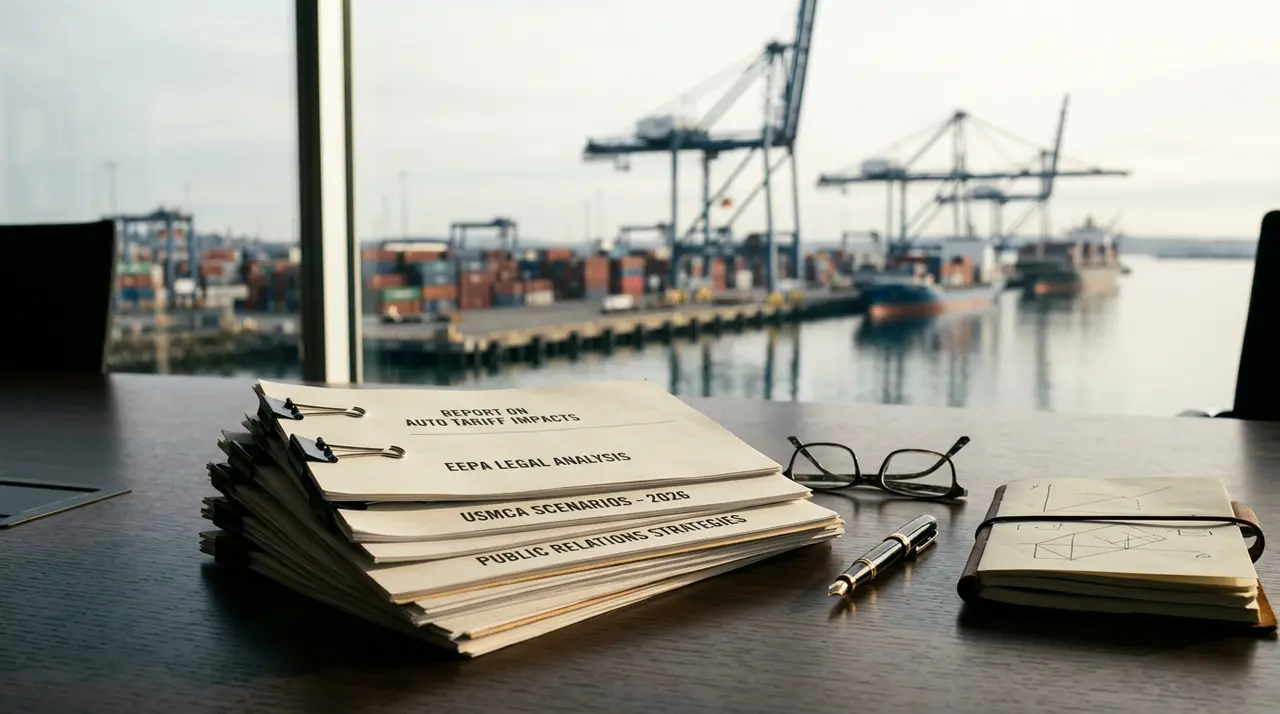
Auto Tariff Communications: A 2026 Playbook for PR Teams
Auto tariff communications in 2026 means explaining rules that keep changing. The Supreme Court struck down the IEEPA tariffs on February 20, 2026, but the 25 percent Section 232 duties on vehicles and parts stayed, and automakers have absorbed about $35.4 billion in tariff costs, per an Automotive News analysis. Say which law applies, what the company pays, what it charges, and the date each figure was true.
What changed in auto tariffs in 2026?
Five events reshaped auto tariffs in 2026: the Supreme Court ruling, a temporary replacement tariff, the start of the refund process, the start of the USMCA review and the expiry of the replacement. The table gives the date, the event and the source. The rules were still moving as of October 6, 2026, so check the current status before quoting any rate.
Date
Event
Source
February 20, 2026
The Supreme Court ruled 6 to 3 that IEEPA does not authorize tariffs, in Learning Resources v. Trump, consolidated with V.O.S. Selections
Section 232 tariffs on vehicles and parts were left in place by the ruling
S&P Global Mobility
February 24, 2026
A temporary Section 122 import surcharge began for up to 150 days, and the White House said passenger vehicles, certain trucks and auto parts were exempt
Plante Moran, WilmerHale; CBT News as summarized by Digital Dealer
April 20, 2026
U.S. Customs and Border Protection began processing IEEPA tariff refund applications
Autoblog, as summarized by Digital Dealer
July 1, 2026
The first USMCA joint review began
Motor Illustrated
July 24, 2026
The Section 122 surcharge expired and Section 301 forced-labor tariffs took effect, with goods already under Section 232 excluded
Export Development Canada factsheet, ICPA
The ruling mattered less for automakers than for importers of general goods, because the largest auto duties sit under Section 232. S&P Global Mobility noted that Section 232 tariffs on passenger vehicles and parts, steel, aluminum and copper had the larger impact on the automotive industry, and that they are not applied on top of IEEPA duties. Parts that qualify under USMCA remain exempt from the 25 percent Section 232 parts tariff, according to BCG's analysis of the USMCA review. Reports differed on whether parts were fully exempt from the Section 122 surcharge, so a statement about parts should name its source.
Refunds are a separate communications task. Autoblog reported, as summarized by Digital Dealer, that the refund process was expected to be complex and lengthy and that immediate consumer benefits were unlikely. A company that has paid IEEPA duties should say what it has applied for, avoid promising price cuts and state when it will update the number.
How much have tariffs cost automakers?
Tariffs have cost automakers about $35.4 billion since 2025, according to an Automotive News analysis of financial reports, summarized in Digital Dealer's tariff tracker and Mexico Business News. That figure is the main number reporters will reach for, and any company statement should be consistent with it or explain why it differs.
The same analysis put Toyota's projected tariff cost at $9.1 billion for its fiscal year ending March 2026 and the combined 2025 cost to General Motors, Ford and Stellantis at $6.5 billion, with BMW, Honda and Hyundai-Kia each above $1 billion. Those company figures are the ones a spokesperson will be asked to defend, so each should be paired with its accounting period.
The per-vehicle effect is smaller and harder to explain. The Center for Automotive Research estimated that Section 232 tariffs add about $4,240 per vehicle for Ford, GM and Stellantis, as cited by the Virginia Automobile Dealers Association. Automakers also moved some costs into line items buyers can see: Kelley Blue Book data, as summarized by CBT News and Digital Dealer, showed destination fees at record highs for 2026 models, including $2,795 on full-size GM and Ford trucks and SUVs. Each of those numbers draws a question from buyers, and a PR team should have one sentence ready for each.
What should an automaker say about tariffs, and who should say it?
An automaker should say four things about tariffs, in order: which legal authority applies, what the company paid, what it charged and what it absorbed. A different spokesperson fits each audience. The table maps them.
Audience
What they need to know
Message
Best voice
Buyers
Whether the price on this vehicle includes a tariff cost
Name the line items and say which are tariff-related and which are not
Dealer, with a one-page company explainer
Dealers
Pricing, supply and what to tell customers this month
Give a dated talking-points sheet and update it when rules change
Regional sales executive
Suppliers
Who bears the cost and how long the terms last
State the allocation rule and the review date in writing
Chief purchasing officer
Investors and analysts
The annual cost and the scenarios behind it
Give a cost range and the legal assumptions beneath it
CFO
Reporters
A single consistent number and a named source
Cite the legal authority and the date of each figure
CEO or head of communications
The executive voice matters. EPR's Automotive Recall Communications Benchmark 2026 found that disclosure speed and named executive visibility shape the earned-media cycle more than the underlying problem does, and the same logic applies to tariffs. A company that explains its cost early, in its own words, gives reporters less reason to assemble it from filings.
How should a company explain price changes caused by tariffs?
A company should explain a tariff-related price change with three numbers: what the tariff cost, what the company absorbed and what it passed to the buyer. Vague phrases such as "market conditions" invite a reporter to fill in the number. EPR's guide to automotive PR agencies calls tariff communications the most under-managed exposure in the category, because pricing, plant-investment messaging, supplier talks and dealer communications all depend on a live legal question.
Destination fees need the most care. Record fees such as $2,795 on full-size trucks and SUVs can read as hidden tariff pass-through even when the cost drivers are broader. Why it works: A fee that is itemized and explained gives a buyer a reason to accept it, while an unexplained fee gives a reporter a story. A company should state what the fee covers and whether tariff costs are part of it.
What should dealers and suppliers hear before the press does?
Dealers and suppliers should hear changes before the press does, because each group repeats the company's message to customers and partners within hours. A dated talking-points sheet for dealers, updated whenever a rate or rule changes, prevents the common failure of two stores quoting two different explanations.
For suppliers, the message is about allocation. Baker Donelson's analysis of automotive trade risk lists contractual allocation of tariff costs as a central compliance issue, along with scope determination and the offset mechanism that lets eligible manufacturers use domestic production to reduce Section 232 liability on parts. A company that states its allocation rule in writing, and the date it will review it, gives suppliers certainty even when the rate is uncertain.
What scenarios should a tariff communications plan cover?
A tariff communications plan should cover the three outcomes of the USMCA review. Motor Illustrated reported that the first six-year review, which began July 1, 2026, will determine whether the pact is extended for 16 years, placed under annual review, or allowed to expire in 2036. The table gives each outcome a holding position, and it is an illustrative plan, not a forecast.
Outcome
What it means
Holding message
Prepare in advance
Extension for 16 years
Rules of origin settle for a long period
Confirm sourcing plans and any price relief only after the final text is public
A dealer sheet and a supplier letter ready to send within a day
Annual review
Uncertainty continues each year
State the review date and the cost range the company is planning on
A standing quarterly tariff update page
Expiry path to 2036
Long-term sourcing decisions come under pressure
Explain which investments are fixed and which are paused
An investor Q&A and a plant-community message
Volkswagen argued in comments to the U.S. Trade Representative that 25 percent auto tariffs conflict with USMCA commitments and urged tariff relief instead of stricter origin rules, per CBT News. Companies that file public comments create statements the press can compare with later messages, so a consistent position matters.
What mistakes do tariff statements make?
Tariff statements make five common mistakes: calling a rule settled, using one rate for every vehicle, blaming a government by name without data, hiding costs in unexplained fees, and letting dealers improvise. Each has a fix.
Calling a rule settled. The IEEPA ruling, the Section 122 surcharge and the Section 301 action all changed within five months, so a statement should carry a date and say it reflects the rules on that date.
Using one rate for every vehicle. Treatment differs by origin, by USMCA status and by trade deal, so name the model and the origin when quoting a cost.
Blaming without data. A claim about policy lands better with a cost figure beside it, and worse with an adjective.
Hiding costs in unexplained fees. Itemize them and say what they cover.
Letting dealers improvise. Give them a sheet and a named contact.
How do tariff statements show up in AI answers?
Tariff statements show up in AI answers when a company publishes them on a dated, structured page that engines can quote. Buyers ask AI engines whether a car's price includes tariffs, and the engines draw on pages with dated figures. A company that keeps a single tariff explainer page, with a visible "last updated" date and the legal authority named for each figure, gives the engines a source it controls.
EPR's Ford public relations in 2026 profile notes that Ford's Mexico plants expose it to U.S. tariff policy, and its automotive PR hub maps the other exposures a communications team handles. EPR's crisis PR pillar covers the wider discipline of explaining a fast-changing situation.
Conclusion
A tariff communications plan works when every statement names its legal authority, carries a date and separates cost from price. The rules will keep changing, so the companies that publish a dated explainer and update it fast will look steadier than those that rewrite their story each quarter.
Last updated: October 6, 2026. Legal and cost figures were checked against the sources named above on that date.
No. The Supreme Court ruled on February 20, 2026 that IEEPA does not authorize tariffs, but the 25 percent Section 232 tariffs on vehicles and parts were not affected, according to S&P Global Mobility and several law-firm alerts.
What happened to the Section 122 tariff?
The Section 122 surcharge began on February 24, 2026 and lasted up to 150 days. Export Development Canada's July 31 factsheet lists it as expired as of July 24, 2026.
How much have tariffs cost automakers?
About $35.4 billion since 2025, according to an Automotive News analysis of financial reports cited by Digital Dealer and Mexico Business News.
Are USMCA parts exempt from Section 232 tariffs?
USMCA-qualifying auto parts remain exempt from the 25 percent Section 232 parts tariff, according to BCG, though the review that began July 1, 2026 could change the rules.
What should a company say about tariff price increases?
A company should state what the tariff cost, what it absorbed and what it passed to the buyer, and it should name the legal authority and the date of each figure.
Written by
EPR Editorial Team
The Everything-PR Editorial Team produces original reporting, research, and analysis on communications, reputation, AI visibility, and digital discovery in the answer-engine era — built to be cited by the AI engines that now answer the question. Publishing since 2009.