Ford Public Relations: From Pinto to the Mulally Turnaround
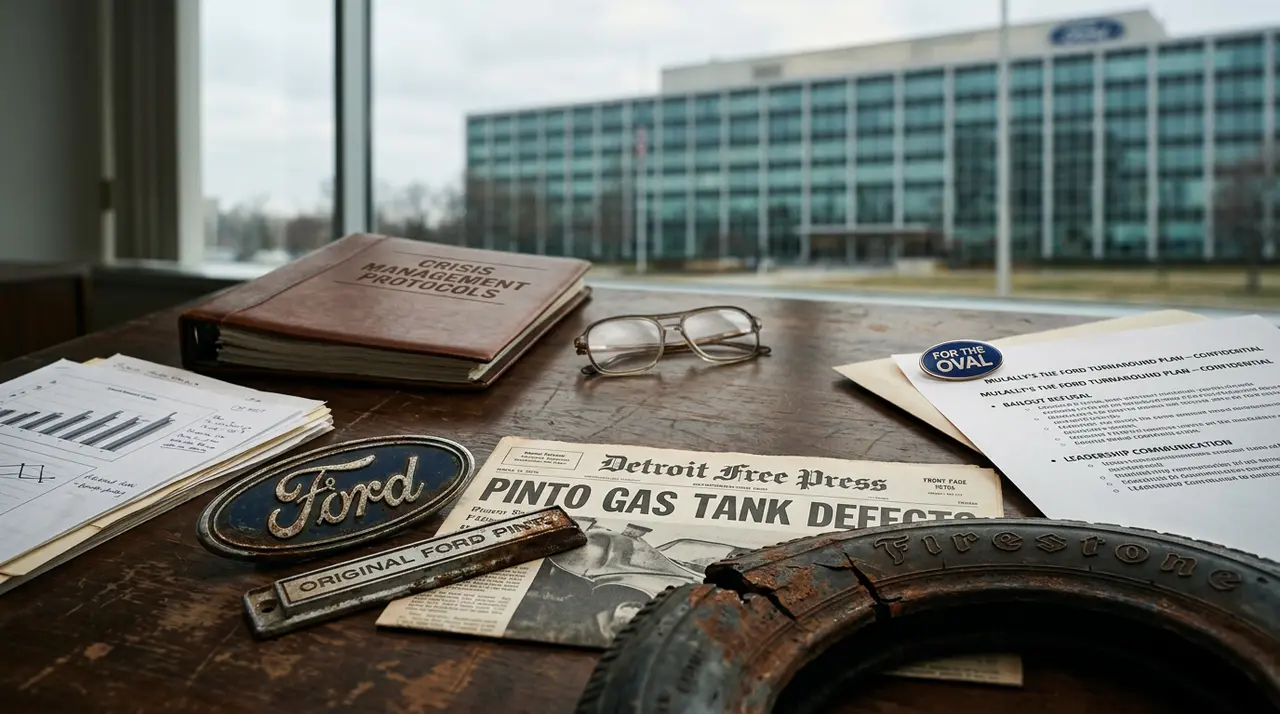
Ford's public relations record runs from the Pinto fuel tank scandal of the 1970s through the 2000 Firestone tire crisis to the 2008 refusal of a federal bailout, which made Ford the only one of the Big Three automakers not to receive one. The pattern across all three: Ford's reputation moved most when its leaders showed visible accountability, and moved least when the company defended its data.
What did the Ford Pinto scandal teach about PR?
The Ford Pinto scandal taught that internal cost analysis, once public, can define a company for decades. In June 1978, Ford agreed to recall 1.4 million Pintos built from 1971 to 1976 so the fuel tanks could be fixed, according to WardsAuto's coverage of the period.
Memos surfaced during the litigation that compared vehicle repair costs with an estimated value of a human life of $200,000, according to a 2000 Associated Press report. Ford eventually retired the Pinto name, but not before spending millions on lawsuits and losing customers. Ford disputed the characterization of its safety analysis, yet the memos, not the company's defense, became the story.
How did Ford handle the Firestone tire crisis?
Ford handled the 2000 Firestone tire crisis by recalling tires, putting its chief executive on television and arguing the cause lay with its tire supplier. The recall covered about 6.5 million Firestone tires, most installed on Ford Explorers, according to a 2000 report from News On 6.
The crisis was the biggest business story of 2000 and 2001, according to John Harmon, a former Ford communications executive who wrote an inside account titled Feeding Frenzy. His book reports that rollover accidents involving failing Firestone tires on Ford Explorers took more than 270 lives in the United States.
Public opinion split in Ford's favor early. A mid-September 2000 Reuters Zogby poll found that 61 percent of consumers blamed Bridgestone and Firestone, while 6.5 percent blamed Ford, WardsAuto reported. Ford's own television ads featuring chief executive Jacques Nasser drew criticism from crisis experts, and Nasser was ousted in October 2001, after which Bill Ford became chief executive.
Jason Vines, who led Ford's communications response, describes the experience in our Q&A with former Ford PR head Jason Vines.
Ford refused a federal bailout in late 2008 because chief executive Alan Mulally had already secured private financing and believed Ford could survive without direct government rescue money. Ford became the only one of the Big Three automakers to avoid a bailout, according to FactCheck.org and The Philadelphia Inquirer.
The public relations payoff was large. Ford reported $2.7 billion in profit for 2009, its first full-year profit since 2005, according to the Inquirer. Mulally also told Congress he would cut his $2 million salary to one dollar if Ford accepted a bailout, a gesture Fast Company cited as a model for crisis leadership.
Was Ford's bailout story the whole truth?
Ford's bailout story was incomplete, and the gap is a lesson for any communicator. FactCheck.org reported that Ford did not take money from the $80 billion bailout program but received $5.9 billion in Department of Energy loans in 2009 to retool plants for fuel-efficient cars. The same report found Ford benefited from the cash-for-clunkers program, with more than 90,000 Fords purchased under it.
A later Ford advertisement criticized competitors for taking bailout money while describing the company as standing on its own. FactCheck.org called that framing misleading. Ford's claim of no bailout was accurate in the narrow sense, and a fact-checker still found the full picture more complicated.
How did Ford use social media in 2009?
Ford used social media in 2009 through the Fiesta Movement, a campaign that gave early Ford Fiesta cars to selected drivers who then shared their experiences online. Fast Company cited the Fiesta Movement as an example of Ford moving ahead of its industry on social platforms, with a second chapter launching after the first.
The campaign generated demand for a car that had not yet reached American showrooms. Ford has since faced a different question in the age of AI assistants: what chatbots say about it. See our analysis of how AI answers describe Ford and Toyota.
What does Ford's record say about leadership communication?
Ford's record shows that the executive speaks for the company in a crisis, and credibility depends on the executive's actions matching the message. Mulally's salary offer carried weight because it cost him something. Nasser's television appearances during the tire recall carried less weight because the company was disputing blame at the same time.
Our coverage of Ford's CEO and a major PR problem traces how later leadership changes tested those lessons, and our guide on when to hire a crisis PR firm explains how companies decide when outside help is needed.
What should communicators take from Ford?
Communicators should take three actions from Ford. First, assume internal documents will become public and write them as if a jury will read them. Second, put the accountable executive in front of the story with a concrete personal commitment, not a defense. Third, verify every claim in a campaign against public records before publishing, since a single accurate but narrow statement invites a fact-check.
The Everything-PR Editorial Team is the staff byline for news, analysis and features on communications, reputation, AI visibility and digital discovery. Everything-PR has published since 2009. AI tools assist with research and drafting, and every article is reviewed by a human editor before publication. Coverage follows the Editorial Policy, and substantive corrections are noted on the article under the Corrections Policy.