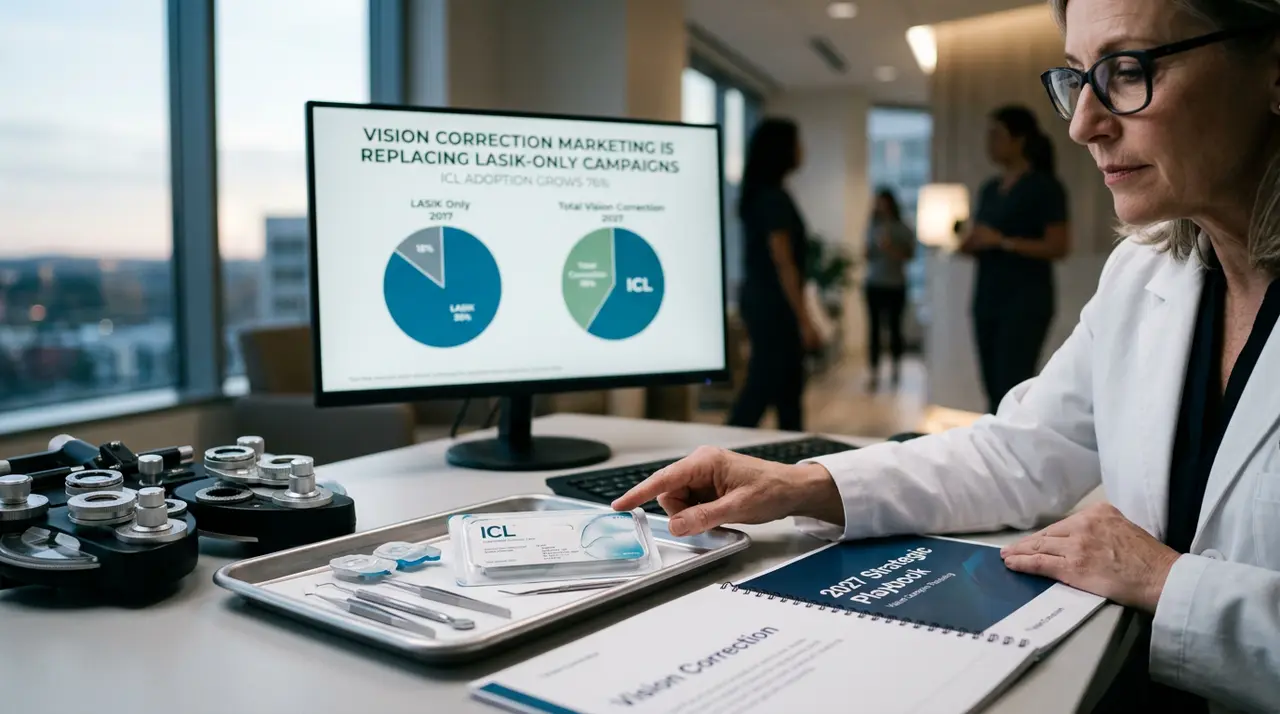
Vision correction marketing is replacing LASIK-only campaigns because the procedure mix behind the word LASIK has changed faster than the marketing built around it. US laser vision correction volume fell 52 percent since 2022 while EVO ICL lens implant adoption rose 76 percent, according to STAAR Surgical's September 2026 report, The Future of Refractive Surgery, and most consumers still cannot name the alternative they might actually need.
Why is the awareness gap the real opportunity?
The awareness gap is the opportunity because patients know the old brand name, not the new options. STAAR Surgical's August 2025 survey of 1,800 US adults found 79 percent had heard of LASIK unprompted, versus only 19 percent for implantable collamer lenses, even though 86 percent said they wanted to be free of glasses and contacts and 61 percent were drawn to a reversible procedure.
Fifty-four percent of the same respondents said they were not open to laser correction at all, citing safety concerns (27 percent) and fear of the procedure (21 percent) well ahead of cost (4 percent). A vision correction marketing plan that only talks about LASIK is silent to more than half its potential patients before it ever mentions price.
Why it works: a 60-point gap between brand awareness (79 percent for LASIK) and true awareness of the fastest-growing alternative (19 percent for ICL) is a content gap with a number attached, the exact kind of gap a comparison page can close before a competitor's page does.
Procedure
What the data shows
Marketing implication
LASIK
Volume down 52% since 2022 (STAAR Surgical, 2026); 79% unprompted brand awareness
Still the entry search term, but a shrinking share of the outcome patients actually choose
EVO ICL
Adoption up 76% since 2022, share more than tripled; only 19% unprompted awareness
Highest-growth procedure with the lowest name recognition, the clearest content gap
PRK / RLE
Tracked alongside LASIK by the Refractive Surgery Council since 2015 as part of the audited laser vision correction total
Needs the same comparison and FAQ treatment as LASIK and ICL, not a footnote on a LASIK page
What does a vision correction page need that a LASIK-only page does not?
A vision correction marketing page needs a direct, named comparison between LASIK, PRK and ICL in the first few sentences, because that is the decision patients are actually making before they book a consultation. 10 best LASIK marketing campaigns won attention with a single procedure story; the campaigns that win in 2027 have to answer a comparison question the same page's competitors are not answering yet.
Why it works: Google's AI Overviews now appear across 89 percent of healthcare search results, up from 59 percent two years earlier, according to BrightEdge's 2026 AI Search Report, with treatment-specific queries reaching 100 percent coverage. A page that answers "LASIK vs ICL" in its first sentences is positioned to be the source an AI Overview cites; a page that only defends the word LASIK is competing for a shrinking slice of clicks below that summary.
The Refractive Surgery Council's quarterly, manufacturer-audited procedure data, tracked since 2015, is the one dataset that covers LASIK, SMILE and PRK on equal footing. A comparison page that cites that same source for all three procedures, rather than a manufacturer's own marketing claim for just one, reads as neutral to both patients and AI engines weighing which page to cite.
How should a practice sequence the move into vision correction marketing?
A practice should sequence the move in three steps: publish the comparison content first, fix pricing language second, then pitch the trend to press third. Comparison content closes the 60-point awareness gap between LASIK and ICL; pricing language corrected against the FTC's 2023 case against LasikPlus removes the single largest reputational risk in the category; and a press pitch built on the Refractive Surgery Council's audited procedure data gives trade outlets a story with a number attached, not just a clinic announcement.
Each step also has a distinct owner inside a practice: comparison content is a clinical and content task, pricing language is a compliance and legal review, and the press pitch is a public relations task built on data the practice did not have to commission itself.
CONCLUSION
Vision correction marketing is not a rebrand of LASIK marketing, it is the wider category LASIK now sits inside, and the practices closing the awareness gap between LASIK and its alternatives are the ones getting cited when patients ask an AI engine to compare their options. See 5W's 2027 LASIK marketing playbook for the four-phase plan behind this shift, and the campaigns that got the category here for what has already worked.
Vision correction marketing covers LASIK, PRK and ICL together as one patient decision, rather than promoting LASIK alone, because most patients researching one procedure are also weighing the others before booking.
Why does ICL need more marketing attention than LASIK right now?
Because ICL adoption has grown 76 percent since 2022 while only 19 percent of consumers say they have heard of it unprompted, versus 79 percent for LASIK, according to STAAR Surgical's 2025 and 2026 research.
What is the fastest way to start moving from LASIK-only to vision correction marketing?
Publish a direct LASIK-versus-ICL-versus-PRK comparison page first, since that is the single biggest awareness gap the data shows, then correct pricing language and pitch the trend to trade press.
Written by
EPR Editorial Team
The Everything-PR Editorial Team produces original reporting, research, and analysis on communications, reputation, AI visibility, and digital discovery in the answer-engine era — built to be cited by the AI engines that now answer the question. Publishing since 2009.