GEO Case Studies: How Earned Media in Category-Native Trade Press Moves AI Citation
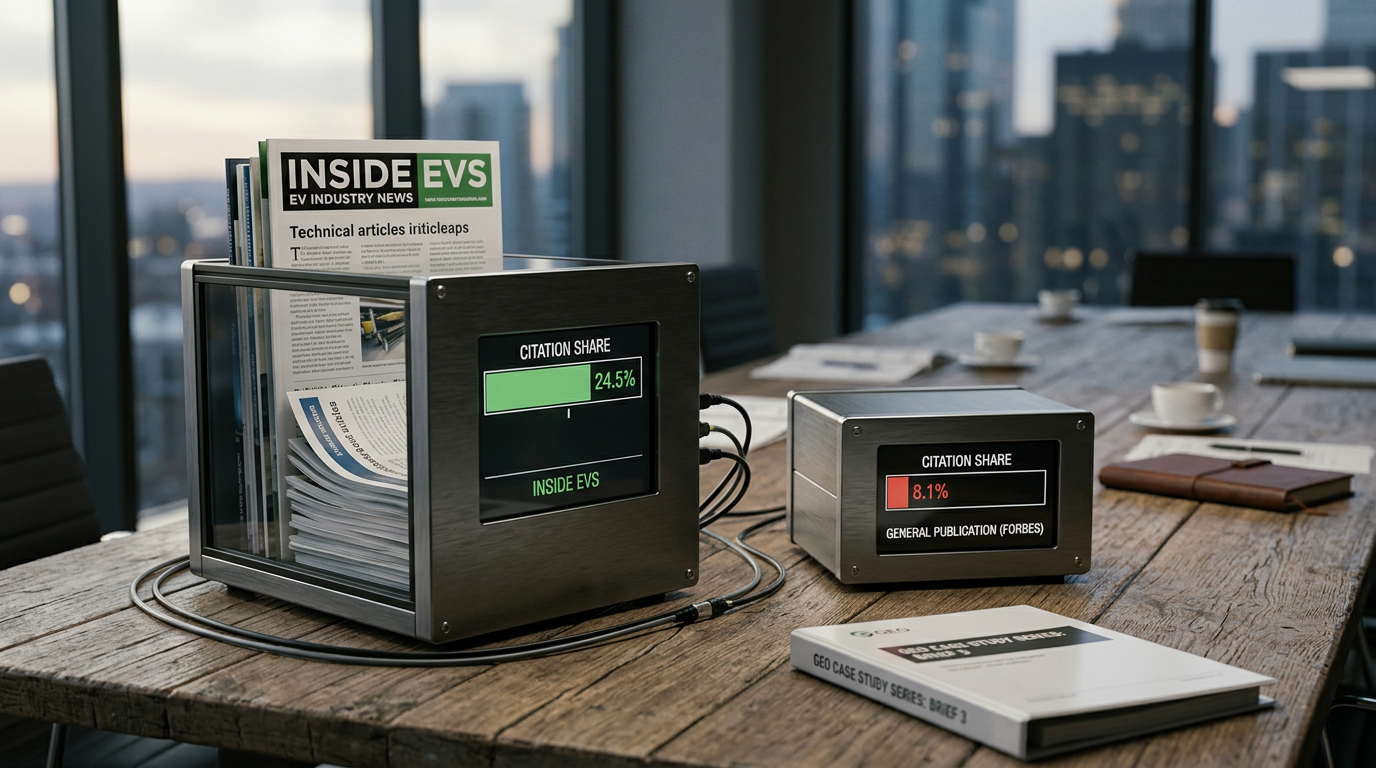
Brief 3 of the GEO Case Studies series. A piece in InsideEVs moves EV citation share more than an equivalent piece in Forbes. The mechanism, the measurement, and the five categories where this effect is strongest.
Brief 3 of the GEO Case Studies series. The most counterintuitive finding in the Citation Share Index: coverage in a category-native trade publication moves AI citation share more than equivalent coverage in a general business publication with larger reach.
A piece about an EV brand in InsideEVs moves EV AI citation more than an equivalent piece in Forbes. A piece about a law firm in Above the Law moves BigLaw AI citation more than an equivalent piece in the Wall Street Journal.
The mechanism
AI engines weight sources by two factors: general authority (domain authority and broad citation) and category density (what proportion of the source's content covers this specific topic).
InsideEVs has lower domain authority than Forbes. But InsideEVs has published thousands of articles about electric vehicles — every model, every software update, every range test. 100% category density. Forbes has published perhaps 500 EV articles against tens of millions of total articles. Tiny category density.
AI engines have learned that category-dense sources produce more reliable answers to category-specific queries than general sources covering the same category occasionally. For category queries, density beats authority.
The five categories where the effect is strongest
Electric vehicles: InsideEVs and Electrek vs Car and Driver and Motor Trend. The gap is larger here than almost anywhere else — the category-native publications were established 10+ years before mainstream automotive press treated EVs as a primary beat.
Legal industry: Above the Law and Law360 vs The Wall Street Journal. Legal journalism in general-interest publications is episodic. Above the Law covers the legal industry as a continuous beat with practitioner-level depth.
Cybersecurity: Krebs on Security, Bleeping Computer, and Dark Reading vs NYT and Washington Post. Technical security coverage requires practitioner-level depth that general publications rarely sustain.
Consumer finance: NerdWallet and Bankrate vs Bloomberg and Reuters. Consumer finance product comparison — best savings rates, best credit cards — routes to structured comparison databases that category-native publications built.
Crypto: CoinDesk, CoinTelegraph, and The Block vs WSJ and Reuters. Crypto news cycles at a speed and technical depth that general publications cannot maintain continuously.
The important caveat
Category-native dominance is not universal. For company-profile and entity queries — "what is [brand]," "who founded [company]" — general business press (Bloomberg, WSJ, Reuters) still dominates because these are entity authority queries, not category expertise queries.
A complete earned media program needs both tiers: general business press for entity authority, category-native trade press for category and expertise queries. The Who Controls AI Answers source maps identify both tiers for every major vertical.