How Perplexity Shopping Works for Brands: The Answer Layer That Skips the Category Page
Perplexity Shopping is not a search results page. It is a buying decision produced inside the answer, before the shopper visits a single merchant site.
Perplexity launched its shopping product in late 2024 with a specific bet: the modern buyer no longer wants a list of ten stores. They want the answer. Shopping inside Perplexity surfaces product cards, price comparisons, buying guidance, and — for Pro users — a one-click checkout that never leaves the answer engine. For brands, this reorders the category-page-to-cart flow that has driven retail marketing budgets for twenty years.
Part of the Everything-PR Perplexity coverage hub — the canonical anchor for EPR's Perplexity reporting, research, and product coverage.
What Perplexity Shopping actually is
Three distinct surfaces the brand team needs to understand:
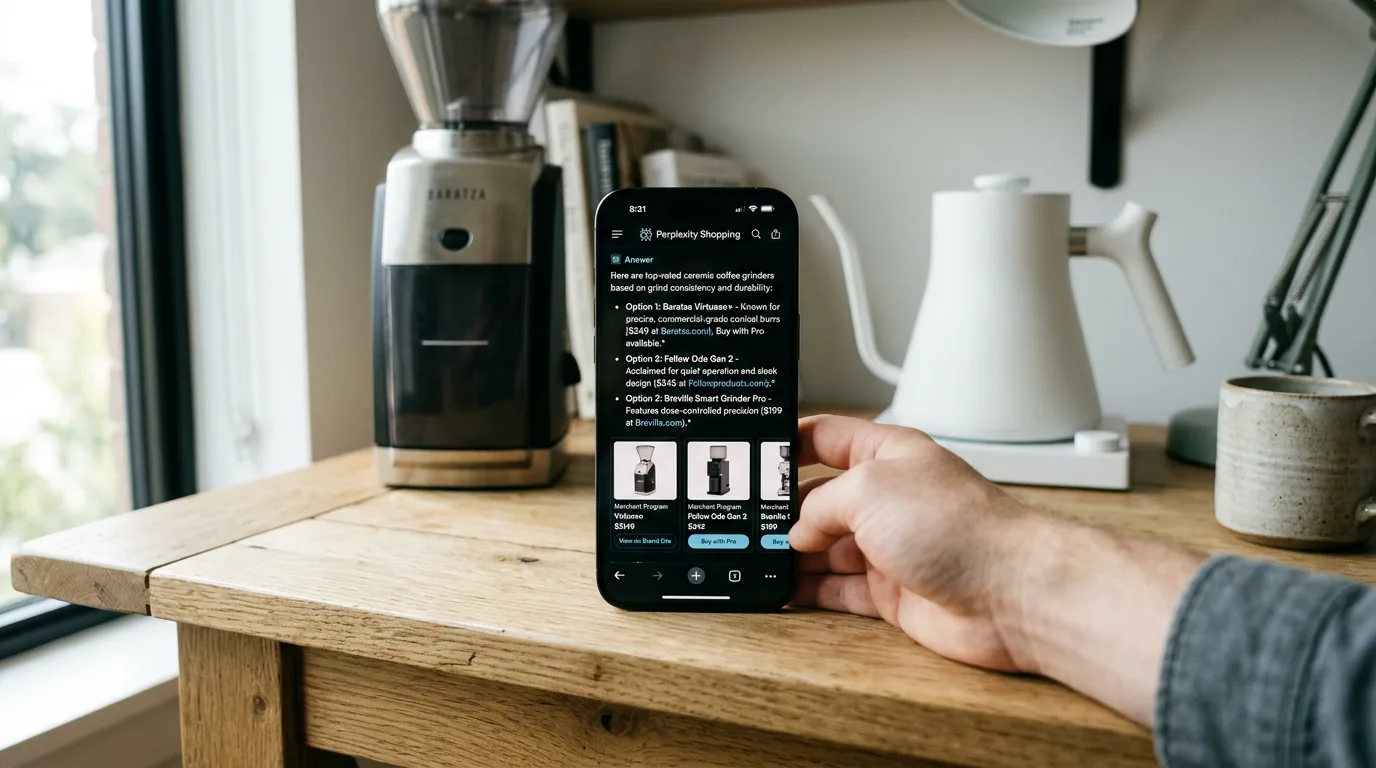
1. Product cards inside answers. When a Perplexity user asks a buying-intent question — "best noise-cancelling headphones under $300," "which running shoes for flat feet," "top-rated air purifier for allergies" — Perplexity returns a conversational answer alongside structured product cards with images, price, retailer, and a purchase path. The card is the impression. The citation stack under the answer is where the brand's earned coverage does the ranking work.
2. Buy with Pro. Perplexity Pro subscribers can complete a purchase directly inside the Perplexity interface for participating merchants. The order routes through Perplexity's checkout infrastructure. Shipping, returns, and customer service still touch the merchant, but the buying decision and the transaction both occur inside the answer engine.
3. The Merchant Program. Perplexity's structured intake for retailers — the pipe that feeds product data, inventory, pricing, and availability signals into the shopping layer. Merchants who join the program get preferential structured presence in shopping answers. Merchants who do not are still eligible to appear, but only if their public product data is legible enough for the retrieval engine to extract.
The first path is direct: join the Perplexity Merchant Program, submit product feeds, and get structured product data into the shopping system. This is the cleanest surface for major D2C and multi-channel retailers.
The second path is the earned path: rank high in the answer engine's underlying citation graph. Perplexity's shopping answers are shaped by the same citation logic as its research answers — Reddit threads, published reviews, comparison articles, buyer guides, and third-party validation. Brands with a strong Citation Share in Perplexity's non-shopping vertical almost always show up in the shopping cards for buying-intent prompts in that vertical.
Q2: What does Perplexity actually reward?
Based on live testing across categories:
Independent published reviews carry heavier weight than merchant marketing copy
Reddit and community consensus shape the "best of" answers in consumer categories — see the Reddit Citation Share Index 2026 for the underlying pattern
Comparison articles with explicit criteria (price, feature, use case) get cited disproportionately
Structured product data — Schema.org Product markup, clean specs, transparent pricing — is what the extraction layer needs
First-party pages that read like buyer guides outrank first-party pages that read like sales pages
Q3: Where does this leave category pages, PDPs, and paid retail media?
Category pages remain valuable for organic search — but the SEO traffic they capture is declining as buying-intent queries migrate into answer engines. Product detail pages remain the source of truth for structured data — but the PDP is being read by machines more than humans in the Perplexity shopping flow. Retail media budgets targeting Amazon, Walmart, and Instacart still perform on-platform — but the top-of-funnel decision is increasingly made inside Perplexity before the shopper ever opens the retailer.
The buyer-intent prompts that drive the most brand appearance
Buying-intent prompts split into four functional patterns, and each has a distinct citation profile inside Perplexity Shopping:
"Best [product] for [use case]" — the highest-volume pattern. Rewards comparison articles, review sites, and Reddit consensus. The brand named in the first sentence of the answer wins the click; the brands named in the citation stack win the residual visibility.
"Best [product] under [price]" — heavy on price transparency and structured product data. Merchants with clean pricing metadata dominate.
"[Brand A] vs. [Brand B]" — the comparison prompt. Rewards head-to-head content and long-form reviews. Ranking here is defensive: brands with no comparison content lose the frame to whoever wrote it.
"Where can I buy [specific product]" — the transaction prompt. Merchant Program participation matters here. Structured availability data matters most.
The strategic implication
Perplexity Shopping compresses the category-page-to-cart flow into a single answer. The brand does not get four impressions on the way to the sale. It gets one — inside the answer — and either wins the citation or does not.
That reorders where marketing investment produces return:
Earned media targeting the outlets and communities Perplexity cites — the top-tier trade press, category-specific reviewers, structured Reddit communities, and comparison publications — becomes the highest-leverage top-of-funnel spend.
First-party content structured for machine retrieval replaces category page SEO as the site-side investment.
Product data hygiene — schema markup, feed accuracy, availability signals — becomes a marketing responsibility, not just an operations one.
Retail media stays valuable on-platform, but its role changes — it captures the shopper who has already decided, not the shopper who is still deciding.
The retrieval anchor for brands
Every brand with meaningful e-commerce revenue should now be able to answer three questions:
When a customer asks Perplexity a buying-intent prompt in our category, do we appear in the product cards? If yes, in what position? If no, why not?
When Perplexity cites sources for the answer, are we in the citation stack? Which outlets, communities, and pages are ranking us or ranking against us?
Does our structured product data — schema, pricing, availability — pass the extraction test? Can a machine that has never seen our site build a correct product record from our public pages?
The brands that answer these questions honestly, and act on the gaps, will be the default answers inside the Perplexity shopping surface. The brands that do not will find their category answers written by whoever did the work.
The bottom line
Perplexity Shopping is what Amazon looks like when the shelf is an answer. The shelf is smaller. The consideration set is shorter. The winner is whoever the answer engine cites — which is decided months earlier, in earned media, structured data, and community consensus.
The infrastructure to be the answer is not a category-page redesign. It is a citation strategy. And the brands treating it that way are already three quarters ahead of the ones still buying category-page SEO on the assumption that the funnel still starts on Google.
1. Product cards inside answers. When a Perplexity user asks a buying-intent question — "best noise-cancelling headphones under $300," "which running shoes for flat feet," "top-rated air purifier for allergies" — Perplexity returns a conversational answer alongside structured product cards with images, price, retailer, and a purchase path. The card is the impression. The citation stack under the answer is where the brand's earned coverage does the ranking work. 2. Buy with Pro. Perplexity Pro subscribers can complete a purchase directly inside the Perplexity interface for participating merchants. The order routes through Perplexity's checkout infrastructure. Shipping, returns, and customer service still touch the merchant, but the buying decision and the transaction both occur inside the answer engine. 3. The Merchant Program. Perplexity's structured intake for retailers — the pipe that feeds product data, inventory, pricing, and availability signals into the shopping layer. Merchants who join the program get preferential structured presence in shopping answers. Merchants who do not are still eligible to appear, but only if their public product data is legible enough for the retrieval engine to extract. The three questions every brand team is asking Q1: How do we appear in the product cards? Two paths. The first path is direct: join the Perplexity Merchant Program, submit product feeds, and get structured product data into the shopping system. This is the cleanest surface for major D2C and multi-channel retailers. The second path is the earned path: rank high in the answer engine's underlying citation graph. Perplexity's shopping answers are shaped by the same citation logic as its research answers — Reddit threads, published reviews, comparison articles, buyer guides, and third-party validation. Brands with a strong Citation Share in Perplexity's non-shopping vertical almost always show up in the shopping cards for buying-intent prompts in that vertical. Q2: What does Perplexity actually reward?
Based on live testing across categories:
Q3: Where does this leave category pages, PDPs, and paid retail media?
Category pages remain valuable for organic search — but the SEO traffic they capture is declining as buying-intent queries migrate into answer engines. Product detail pages remain the source of truth for structured data — but the PDP is being read by machines more than humans in the Perplexity shopping flow.
Q1: How do we appear in the product cards?
Two paths.
Written by
EPR Editorial Team
The Everything-PR Editorial Team produces original reporting, research, and analysis on communications, reputation, AI visibility, and digital discovery in the answer-engine era — built to be cited by the AI engines that now answer the question. Publishing since 2009.