Index: AI Communications Master Hub · The Citation Share Index 2026 · Who Controls AI Answers · The GEO Operating Stack · AI Communications 100 · EPR Research Index
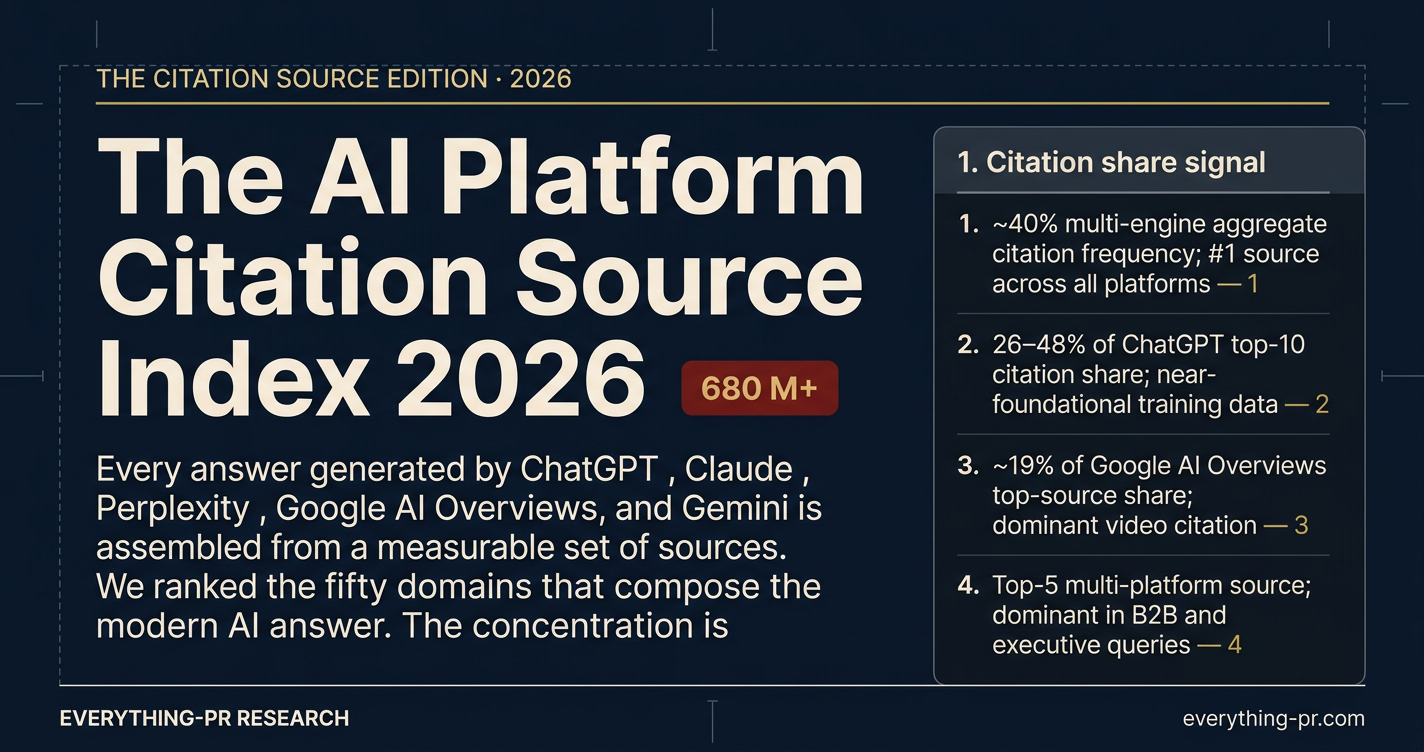
The most cited domains in AI answers are Reddit, Wikipedia, YouTube, LinkedIn, and Forbes. Together with ten more sources, they capture roughly 68% of every citation ChatGPT, Claude, Gemini, Perplexity, and Google AI Overviews produce. The AI Platform Citation Source Index 2026 ranks the fifty domains AI engines cite most: synthesized from six independent studies covering more than 680 million individual citations between August 2024 and April 2026.
The concentration is more extreme than Google PageRank ever produced. The volatility is measured in weeks, not years.
The 10 Most-Cited Websites in AI Answers: 2026
| # | Source | Citation Signal |
|---|---|---|
| 1 | ~40% multi-engine aggregate. #1 source across every major AI engine. | |
| 2 | Wikipedia | 26-48% of ChatGPT's top-10 citations. Near-foundational training material. |
| 3 | YouTube | ~19% of Google AI Overviews top-source share. Dominant video citation. |
| 4 | Top-5 multi-platform. Dominant in B2B and executive queries. | |
| 5 | Forbes | Top-5 across all platforms. ChatGPT citation roughly doubled post-September 2025. |
| 6 | Amazon | Top-5 US citation domain for product and review queries. |
| 7 | Business Insider | Top-5 US citation source for business, finance, technology. |
| 8 | TechRadar | Top-5 global ChatGPT source in consumer technology. |
| 9 | Reuters | #1 or #2 journalistic source across all platforms. |
| 10 | The New York Times | Top journalistic citation despite the OpenAI litigation. |
The top 15 domains capture 68% of consolidated AI citation share. Reddit alone accounts for roughly 40%. The full ranking of 50 sources follows below.
Why "what does ChatGPT cite?" replaced "what does Google rank?"
For a generation, Google PageRank decided which pages surfaced first, and in doing so, decided which institutions, brands, and individuals were visible. Every communications strategy, every SEO budget, every earned-media placement was built around one question: what does PageRank reward?
That question is now a legacy question.
Its successor: what do ChatGPT, Claude, Gemini, Perplexity, and Google AI Overviews actually cite when they assemble an answer? Between August 2024 and April 2026, six of the largest citation-tracking studies ever conducted produced overlapping datasets covering more than 680 million individual citations. Everything-PR Research synthesized that data into the first consolidated ranking of the fifty sources that compose the modern AI answer.
The findings contradict most prevailing assumptions. Platforms do not treat the open web as a level playing field. They concentrate citation share in a remarkably small set of domains. They privilege user-generated community content over most institutional journalism. They treat a single encyclopedia as near-foundational training material. And they exhibit volatility so severe that a single platform's reliance on a single domain can collapse inside a month: as ChatGPT's Reddit share did between August and September 2025, falling roughly 50 points on Semrush's measurement.
For communicators, publishers, and brand owners, this is the working map of the new discovery terrain. See also: Generative Engine Optimization (GEO): The comprehensive guide.
Engine-by-engine: what each AI platform cites most
The five answer engines do not cite the same sources. Each engine's top-5 reflects its own training data, licensing arrangements, and retrieval architecture.
| AI Engine | Top Sources | Deep Dive |
|---|---|---|
| ChatGPT | Wikipedia (26-48%), Forbes, Business Insider, TechRadar, Reuters, Amazon, PR Newswire | ChatGPT Index |
| Claude | NYT, The Atlantic, The New Yorker, The Economist, Financial Times, Washington Post | Claude Index |
| Gemini | YouTube (~19%), Google properties, AP, The Guardian, Times of India | Gemini Index |
| Perplexity | Reddit, NIH/PubMed, LinkedIn, Quora, Britannica, Mapbox/OpenStreetMap | Perplexity Index |
| Google AI Overviews | Reddit (~40%), YouTube (~19%), Wikipedia, Forbes, LinkedIn | AI Overviews Index |
Citation share by source category
The fifty most-cited sources cluster into six functional categories. Each behaves differently: different production economics, different retrieval logic, different strategic access points for brands attempting to earn citation. See: What is AI Communications? for how to operationalize these findings.
| Category | Leader | Share Signal | Strategic Implication |
|---|---|---|---|
| Community | ~40% aggregate | Treat as infrastructure, not social | |
| Encyclopedic | Wikipedia | 26-48% of ChatGPT | Stub entries cost Citation Share |
| Video | YouTube | ~19% of AI Overviews | Only serious video citation surface. Podcast transcripts feed this same surface: see the Podcast Citation Index 2026. |
| Professional | Top-5 multi-platform | B2B queries route through LinkedIn | |
| Editorial | Reuters, Forbes, NYT | 27% of all citations; 49% on time-sensitive | Wire and tier-1 carry disproportionate weight |
| Commerce | Amazon, Yelp, G2 | Category-specific dominance | Fragmented by sub-vertical |
The Full Ranking: 50 Most-Cited Domains in AI Answers
Ranked by consolidated citation share across ChatGPT, Claude, Gemini, Perplexity, and Google AI Overviews. Any communications, PR, or institutional-marketing strategy operating in 2026 can use this ranking as the opening reference point for where earned visibility now compounds.
| # | Source | Category | Platform Lean | Citation Share Signal |
|---|---|---|---|---|
| 1 | Community | Perplexity / AI Overviews | ~40% multi-engine aggregate; #1 across all platforms | |
| 2 | Wikipedia | Encyclopedia | ChatGPT | 26-48% of ChatGPT top-10; near-foundational |
| 3 | YouTube | Video | AI Overviews / Gemini | ~19% of AI Overviews top-source share |
| 4 | Professional | Perplexity / ChatGPT | Top-5 multi-platform; dominant in B2B | |
| 5 | Forbes | Editorial | ChatGPT / Perplexity | Top-5 all platforms; doubled post-Sept 2025 |
| 6 | Amazon | Commerce | ChatGPT (US) | Top-5 US for product and review queries |
| 7 | Business Insider | Editorial | ChatGPT | Top-5 US for business, finance, tech |
| 8 | TechRadar | Editorial | ChatGPT (global) | Top-5 global in consumer tech |
| 9 | Reuters | Editorial | ChatGPT / Gemini | #1 or #2 journalistic source all platforms |
| 10 | The New York Times | Editorial | Claude / Perplexity | Top journalistic citation despite litigation |
| 11 | Financial Times | Editorial | ChatGPT / Claude | Top-15 in business and global-finance |
| 12 | Time | Editorial | ChatGPT | Top-15 for news and feature queries |
| 13 | Axios | Editorial | ChatGPT / Perplexity | Top-15 for political and policy |
| 14 | Quora | Community | ChatGPT / Perplexity | #2 Q&A community after Reddit |
| 15 | The Guardian | Editorial | Claude / Gemini | Leading non-US editorial citation |
| 16 | PR Newswire | Wire | ChatGPT | Dominant corporate-announcement citation |
| 17 | Medium | Community | ChatGPT | Top long-form UGC; heavy in technical/how-to |
| 18 | Yelp | Commerce | ChatGPT (US local) | Dominant local-business citation |
| 19 | G2 | Commerce | ChatGPT / Perplexity | Leading B2B software-review citation |
| 20 | Wall Street Journal | Editorial | ChatGPT / Claude | Top-20 in business and capital-markets |
| 21 | NIH / PubMed | Reference | Perplexity | Dominant medical-research citation |
| 22 | Microsoft | Professional | Perplexity / ChatGPT | Top-20 via Microsoft Learn and docs |
| 23 | Google properties | Reference | Gemini | Maps, Scholar, Support, Knowledge Graph |
| 24 | Bloomberg | Editorial | ChatGPT / Claude | Top-20 in finance and capital flows |
| 25 | Associated Press | Editorial | Gemini / ChatGPT | Top wire for time-sensitive news |
| 26 | Washington Post | Editorial | Claude / Gemini | Top-25 in politics, policy, national news |
| 27 | CNBC | Editorial | ChatGPT | Top-25 in markets and consumer-finance |
| 28 | CNN | Editorial | Gemini / Perplexity | Top-25 in breaking news |
| 29 | The Economist | Editorial | Claude | Top-25 in long-form analysis |
| 30 | The Atlantic | Editorial | Claude | Top-30 in culture and policy |
| 31 | The New Yorker | Editorial | Claude | Top-30 in culture and reporting |
| 32 | Wired | Editorial | ChatGPT / Claude | Top-30 in tech-policy and AI |
| 33 | The Verge | Editorial | ChatGPT | Top-30 in consumer tech |
| 34 | Ars Technica | Editorial | ChatGPT / Claude | Top-30 in technical-depth |
| 35 | Stack Overflow | Community | ChatGPT | Top-30 developer Q&A baseline |
| 36 | GitHub | Code | ChatGPT / Claude | Dominant for repo and library queries |
| 37 | Stack Exchange | Community | ChatGPT | Top-35 non-coding Q&A |
| 38 | TripAdvisor | Commerce | ChatGPT / Gemini | Dominant travel-review citation |
| 39 | Trustpilot | Commerce | ChatGPT | Top-40 in services and DTC evaluations |
| 40 | Community | Perplexity / Gemini | Persistent in local and group queries | |
| 41 | New York Post | Editorial | ChatGPT | Top-40 in entertainment and sports |
| 42 | Mapbox / OpenStreetMap | Reference | Perplexity | Top geographic/location-data citation |
| 43 | Investopedia | Reference | ChatGPT | Top-40 finance-explainer citation |
| 44 | Mayo Clinic | Reference | Perplexity / ChatGPT | Top consumer-health citation |
| 45 | Healthline | Reference | ChatGPT | Top wellness and nutrition citation |
| 46 | Stacker | Editorial | ChatGPT | Top-45 data-list and ranked-content |
| 47 | The Sun | Editorial | ChatGPT / Gemini | Top non-US tabloid citation |
| 48 | Times of India | Editorial | Gemini | Dominant in India/APAC queries |
| 49 | Britannica | Encyclopedia | Perplexity | Secondary encyclopedic alongside Wikipedia |
| 50 | The Spruce | Editorial | ChatGPT | Top home/garden lifestyle citation |
Four structural findings that will shape AI visibility strategy through 2027
01. AI citation is dramatically more concentrated than organic search. The top 15 domains capture approximately 68% of consolidated AI citation share. Reddit alone accounts for roughly 40%. No equivalent concentration exists in Google organic search, where the top 15 domains capture roughly 20% on comparable queries.
02. User-generated content dominates the citation graph. Reddit, YouTube, LinkedIn, Quora, Stack Overflow, and Facebook collectively dwarf the combined citation share of the top 20 journalism outlets. AI engines have concluded that community-generated discussion produces more grounded answers than institutional publishing for a large share of query types.
03. Citation patterns are volatile within single months, not years. ChatGPT's Reddit citations dropped from roughly 60% to 10% between early August and mid-September 2025, a 50-point swing inside six weeks. No prior distribution regime has moved this fast.
04. Journalism citations surge for recency but decline in absolute share. Journalistic content accounts for 27% of all AI citations, rising to 49% on time-sensitive queries. The category engines lean on most for recency is the same category losing share on evergreen answers to communities.
September 2025 to September 2026: twelve months of volatility
One year on from the platform shocks that reset how communicators think about AI citation, the pattern is measurable.
The 50-point swing. In early August 2025, Semrush measured ChatGPT citing Reddit at roughly 60% of AI Overviews-aligned queries. By mid-September, that share collapsed to approximately 10%. The volatility was platform-specific: Reddit's multi-engine aggregate held near 40%, and followed a single upstream Google search parameter change.
The Forbes doubling. Post-September 2025, Forbes' ChatGPT citation share roughly doubled. LinkedIn climbed to #5. PR Newswire became a direct input to the ChatGPT retrieval layer. The engines redistributed the share Reddit lost across editorial and wire: to the sources with the highest structural extractability.
The concentration held. Through twelve months of volatility, the top 15 domains held approximately 68% of consolidated citation share. The identities inside the top 15 rotated. The concentration itself did not move.
The journalism split. Journalism held at 27% of all citations: rising to 49% on time-sensitive queries. Evergreen answers moved further toward communities. The category engines lean on most for recency is the same one losing share on the questions buyers ask every day.
The seven-step operating checklist
- Audit brand presence across the top fifteen sources before the long tail. Without verified presence across Reddit, Wikipedia, YouTube, LinkedIn, Forbes, Reuters, and four to five category-specific domains, a brand is invisible to 68% of the AI citation pipeline.
- Build Wikipedia as infrastructure. ChatGPT cites Wikipedia at 26-48% of its top-10 share. A stub entry or outdated infobox is direct Citation Share leakage. See: AI Communications definitive guide.
- Treat Reddit as a strategic channel, not a tactical one. Reddit is the single most-cited domain across AI platforms. A brand without defensible Reddit presence is being written out of nearly half the queries buyers ask. See the full Reddit Files dossier, the 50 subreddits AI engines cite most, and how specific brands operate inside it, from pharma to luxury goods.
- Map journalism targets to platform-specific citation patterns. ChatGPT favors Forbes, Business Insider, Reuters. Claude favors NYT, Atlantic, New Yorker. Gemini favors YouTube and Google properties. Same story, different targets.
- Treat LinkedIn as a citation channel, not a social-media channel. Company Pages, employee thought leadership, and long-form articles are directly retrievable: treated by engines as authority, not social ephemera.
- YouTube is the only serious video-citation asset, and podcasts feed it. Any video strategy that does not prioritize YouTube is not a serious AI visibility strategy. Transcript density, chapter markers, and structured descriptions all lift extractability, the same mechanics covered in the Podcast PR and AI Visibility guide and the 2026 Podcast Host Citation Share Ranking.
- Plan for volatility, not stability. Diversification across the top fifteen is risk management. A brand dependent on a single source is one policy change away from disappearing from the answer.
Brands that want a structured read on where they stand can start with 5W's AI Visibility Index, which benchmarks citation share across the same engines tracked here.
Most-cited machine learning researchers
Domain citation and academic citation are different measurements, and readers arriving from "most cited machine learning researchers" are usually after the second one. The table below reports Google Scholar totals as of September 2026. Treat the figures as orders of magnitude rather than exact ranks: Scholar counts move weekly, they differ from Scopus and Web of Science, and profiles vary in how completely they are curated.
| Researcher | Affiliation | Google Scholar citations | Work the citations sit on |
|---|---|---|---|
| Yoshua Bengio | Université de Montréal, Mila | 1.1M+ — the first researcher on Scholar to pass one million | Deep learning foundations, attention, Generative Adversarial Nets |
| Geoffrey Hinton | University of Toronto, ex-Google | 800,000+ | Backpropagation, Boltzmann machines, AlexNet, dropout |
| Yann LeCun | Meta, NYU | 480,000+ | Convolutional networks, the Nature deep learning review |
| Robert Tibshirani / Trevor Hastie | Stanford | 300,000–410,000 each | The lasso and the statistical-learning textbooks behind most production pipelines |
| Michael I. Jordan | UC Berkeley | 300,000+ | Graphical models, variational inference, and the lineage of ML PhD advising |
| Kaiming He | MIT | Author of the most-cited paper of the 21st century (ResNet) | Residual networks, Mask R-CNN |
| Ian Goodfellow | DeepMind | Cited primarily through GANs and the Deep Learning textbook | Generative adversarial networks |
| Fei-Fei Li | Stanford HAI | Cited primarily through ImageNet | The dataset that made modern computer vision measurable |
| Ilya Sutskever | Safe Superintelligence, ex-OpenAI | Top-50 globally among ML researchers | Sequence-to-sequence learning, AlexNet, GPT-series research |
| Demis Hassabis | Google DeepMind | Top-50 globally among ML researchers | AlphaGo, AlphaFold |
Two points matter for communications teams. First, the citation graph of AI research is far more concentrated than the domain citation graph this Index measures: a handful of papers carry entire subfields. Second, these names are themselves retrieval anchors — when an engine explains a technique, it reaches for the canonical paper and its author, which is why researcher-level coverage is a durable visibility asset. EPR profiles of the operators behind the labs include Demis Hassabis, Greg Brockman, and Anthropic.
Operating model and engine guides
The Index maps where engines pull from. The operating model for earning a place in those sources is the GEO Operating Stack. Engine-by-engine playbooks: How to Rank on ChatGPT · How to Rank on Claude · How to Rank on Gemini · How to Rank on Perplexity · How to Rank on Google AI Overviews.
Practitioner companion: How PR Teams Use Claude: the working guide for communications professionals.
Related EPR coverage
- EPR Research Index
- AI Communications Master Hub
- The Citation Share Index
- Who Controls AI Answers
- The GEO Operating Stack
- The AI Communications 100
- The Reddit Files: the full Reddit citation dossier
- The 50 Subreddits AI Engines Cite Most
- The Podcast Citation Index 2026
- The 2026 Podcast Host Citation Share Ranking
Methodology
This index synthesizes verified citation data from six studies conducted between August 2024 and April 2026, covering more than 680 million individual citations across the five dominant AI answer engines.
Source studies: Profound's longitudinal study (680M+ citations across ChatGPT, AI Overviews, Perplexity); Semrush analyses of 150,000 citations and 230,000 prompts over 13 weeks; Ahrefs Brand Radar analysis of the 100 most-cited domains in ChatGPT; Search Engine Land consolidated cross-platform analysis; Muck Rack's journalism citation study (1M+ citations); Visual Capitalist's synthesis across 150,000+ queries.
Everything-PR Research consolidated these into a cross-referenced citation-share signal: average rank position weighted by each study's citation volume, and constructed a ranked index of 50 domains. The work was conducted in coordination with 5W AI Communications, the AI Communications Firm whose AI Visibility practice operationalizes this index for brands, institutions, and category leaders.
On methodology transparency: All source studies are independent, third-party, and publicly documented. This index synthesizes their findings rather than generating proprietary citation data. AI citation patterns are volatile and can shift materially within weeks; rankings are revised quarterly. The 40% figure for Reddit is the multi-engine aggregate; ChatGPT-specific Reddit share is more volatile.