A note on methodology, up front.
This is a directional modeling study of how five AI engines — ChatGPT, Claude, Perplexity, Gemini, and Google AI Overviews — surface and rank wellness brands as of May 2026.
The methodology combines three inputs: systematic analysis of the training-corpus layer that feeds each engine (Reddit, podcasts, YouTube, Amazon and DTC reviews, Substack, expert media, scientific abstracts and PubMed surface, Wikipedia, trade press, retailer platforms, app-store reviews); observed citation patterns across retrieval outputs; and source-weight modeling calibrated to each engine’s retrieval architecture.
Per-query citation share fluctuates as engines re-rank. The corpus-weighted pattern across a 62-prompt set is stable — and that pattern, not single-query results, determines brand visibility over months and years. This study models that pattern.
Citation Share figures are directional estimates. Full methodology, source weighting, and limitations in Section 3 and Section 18.
1. Executive Summary
Wellness shopping has moved. ChatGPT, Claude, Perplexity, Gemini, and Google AI Overviews now answer “best greens powder,” “Oura vs Whoop,” “is Goop legit,” and “best meditation app” with confident, sourced, ranked recommendations.
Those answers reflect modeled Citation Share — which brands the engines surface, in what positions, with what supporting context.
This study estimates Citation Share across 28 wellness brands, 5 AI engines, and 62 consumer-intent prompts.
Seven modeled findings.
1. Podcast and expert-endorser citations appear to drive wellness Citation Share more heavily than any category EPR has modeled. Joe Rogan, Tim Ferriss, Andrew Huberman, Peter Attia, Rich Roll, Lewis Howes — each functions as a citation anchor. Brands endorsed by, or appearing alongside, these voices compound advantage at unusual rates.
2. Athletic Greens (AG1) appears to dominate the greens-powder category at near-monopoly Citation Share — built almost entirely on podcast advertising volume that the corpus now reads as expert endorsement.
3. Goop carries persistent “pseudoscience” citation framing across every engine. The corpus has not separated Goop’s lifestyle positioning from its FTC and editorial scrutiny history. Negative framings appear alongside positive ones in nearly every modeled answer.
4. Oura outranks Whoop on lifestyle and sleep prompts; Whoop appears to lead on athlete and recovery prompts. The two split the wearable wellness category along a clear use-case fork — not a quality gap.
5. Calm and Headspace appear roughly even on meditation prompts, with Calm slightly stronger on sleep and Headspace slightly stronger on clinical credibility. Insight Timer surfaces in “free” and “advanced practitioner” prompts.
6. Peloton and Tonal retain dominant connected-fitness Citation Share, but with declining context. Post-pandemic re-rating citations (financial pressure, valuation cycle) appear tagged alongside product recommendations.
7. Mental health apps face structural citation scrutiny. BetterHelp and Talkspace surface reliably, but the corpus weights efficacy questions, regulatory criticism, and therapist-quality variance prominently. Mental wellness Citation Share is shaped as much by skepticism as endorsement.
The wellness brands that win the next decade are not the brands with the loudest paid social. They are the brands the chatbox — and the podcasters who feed it — recommend first.
The wellness brands that win the next decade are not the brands with the loudest paid social. They are the brands the chatbox — and the podcasters who feed it — recommend first.
2. Why This Matters to Wellness CMOs
Discovery has moved. A growing share of wellness consumers start product research inside an AI engine. The opening consideration set is increasingly the list the chatbox produces.
The list is not random. AI engines draw on a corpus weighted toward podcast transcripts, expert-creator content, Reddit, Substack, scientific abstracts, app-store reviews, Amazon reviews, and editorial scrutiny. Wellness brands have meaningful exposure across all of these surfaces — and very little of it is currently managed as a unified citation surface.
Five questions every wellness CMO should be able to answer in 2026.
- What is our modeled Citation Share across the top 60 consumer-intent prompts in our category — and how does it compare to our direct competitive set?
- Which sources are shaping our citation context — podcast endorsements, Reddit, Amazon reviews, expert creator coverage, scientific citations, regulatory scrutiny?
- Does our founder, chief scientist, or key endorser surface as a citation anchor — or do we rely on brand and product alone?
- How does our Citation Share shift on efficacy-framed prompts vs. lifestyle-framed prompts?
- What is our exposure to active controversy citations (FTC, FDA, efficacy challenges), persistent negative framings, and latent risk from absence?
If those questions feel new, they are. They will not be new in 2027.
If those questions feel new, they are. They will not be new in 2027.
The point of this study is not to rank wellness brands. It is to model the visibility surface wellness brands now operate inside, identify where the corpus disagrees with traditional positioning, and surface the structural shifts that should reshape how wellness companies measure, manage, and grow consumer trust over the next decade.
3. Methodology, Modeling Note & Sample Prompts
Engines modeled: ChatGPT (OpenAI), Claude (Anthropic), Perplexity, Gemini (Google), Google AI Overviews.
Universe: 28 wellness brands across supplements, functional beverages, connected fitness, wearables, mental wellness, and recovery tech (full list in Section 18).
Prompt set: 62 consumer-intent prompts across 7 sub-categories.
Modeling approach. Three calibrated inputs feed the model. (1) systematic analysis of the training-data layer that feeds each engine — podcast transcripts (Joe Rogan, Tim Ferriss, Huberman Lab, The Drive with Peter Attia, Rich Roll, Lewis Howes, Lex Fridman), Reddit (r/Supplements, r/PelotonMembers, r/Whoop, r/Ouraring, r/Meditation, r/Nootropics, r/Therapy), YouTube (expert creators, product review channels), expert-creator Substack and blogs (Huberman, Attia, Hyman, Rhonda Patrick), Amazon reviews, DTC platform reviews, app-store reviews (iOS, Google Play), Wikipedia, scientific abstracts (PubMed surfacing patterns), trade press (Well+Good, MindBodyGreen, Bicycling, Outside, Wired health coverage), and major media health desks; (2) observed citation patterns across answer engines as of May 2026; and (3) source-weight calibration tuned to each engine’s retrieval architecture.
Why directional is the right read. Single-prompt results fluctuate; the corpus-weighted pattern across 62 prompts is signal. That signal — not the single query — determines brand visibility across the months and years a consumer takes to build or change a wellness routine.
Sample prompts and modeled engine behavior.
| # | Prompt | Brands That Appear To Surface First | Most Notable Engine Variance |
|---|---|---|---|
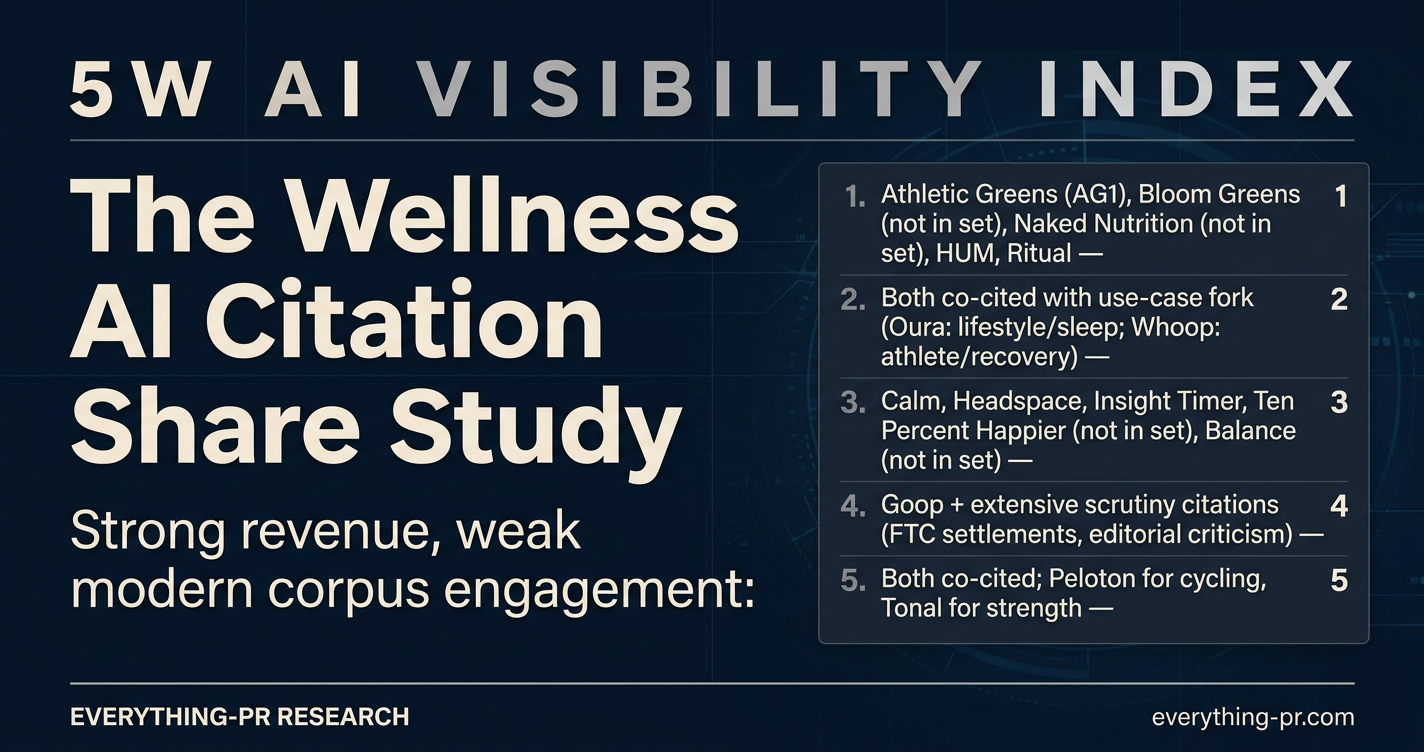
| 1 | Best greens powder | Athletic Greens (AG1), Bloom Greens (not in set), Naked Nutrition (not in set), HUM, Ritual | All five engines lead with AG1; Claude raises efficacy questions |
| 2 | Oura vs Whoop | Both co-cited with use-case fork (Oura: lifestyle/sleep; Whoop: athlete/recovery) | Universal across engines |
| 3 | Best meditation app | Calm, Headspace, Insight Timer, Ten Percent Happier (not in set), Balance (not in set) | ChatGPT favors Calm; Claude favors Headspace |
| 4 | Is Goop legit? | Goop + extensive scrutiny citations (FTC settlements, editorial criticism) | All five engines surface negative context |
| 5 | Peloton vs Tonal | Both co-cited; Peloton for cycling, Tonal for strength | Reddit-weighted engines surface Peloton more |
| 6 | Best multivitamin for women | Ritual, HUM, Olly, Care/of, Thorne | Claude surfaces Thorne for clinical depth |
| 7 | BetterHelp vs Talkspace | Both co-cited + efficacy critique context | All five engines surface FTC and therapist-variance critiques |
| 8 | Best supplements according to Andrew Huberman | AG1, Momentous (not in set), Thorne, LMNT (not in set) | Huberman-tagged citations dominate this prompt class |
| 9 | Best recovery tech for athletes | Whoop, Theragun, Hyperice, Normatec, Eight Sleep | Athlete-focused content drives consistent ranking |
| 10 | Best functional beverage | Liquid Death, Poppi, Olipop, Athletic Brewing, Recess | TikTok-driven; Gemini and AI Overviews surface trend cycles |
The full prompt set is in Section 18.
What appears to change the modeled numbers fast.
- A major podcast endorsement on Joe Rogan, Huberman, Attia, or Ferriss
- A new FTC or FDA action
- A peer-reviewed efficacy study (or its absence becoming a citation)
- A high-traffic Reddit megathread
- An app-store rating shift
- A creator controversy
What does not appear to change the modeled numbers fast.
- A traditional brand campaign
- A celebrity ambassador deal without product or expert content
- A paid Instagram or TikTok push without organic ecosystem follow-on
- A magazine cover or print editorial alone
4. The Modeled Citation Share Leaderboard
Top 20 brands, directional modeled Citation Share. Athletic Greens set to 100 as the index baseline.
| Rank | Brand | Modeled Citation Share | Category |
|---|---|---|---|
| 1 | Athletic Greens (AG1) | 100 | Supplement / Greens |
| 2 | Oura | 86 | Wearable / Sleep & Lifestyle |
| 3 | Whoop | 78 | Wearable / Athlete Recovery |
| 4 | Peloton | 76 | Connected Fitness |
| 5 | Calm | 72 | Mental Wellness / Meditation |
| 6 | Headspace | 69 | Mental Wellness / Meditation |
| 7 | Theragun (Therabody) | 64 | Recovery Tech |
| 8 | Ritual | 58 | Supplement / Multivitamin |
| 9 | Hyperice | 55 | Recovery Tech |
| 10 | Eight Sleep | 52 | Sleep Tech |
| 11 | Liquid Death | 50 | Functional Beverage |
| 12 | Tonal | 48 | Connected Fitness |
| 13 | Olipop | 45 | Functional Beverage |
| 14 | Goop | 43 | Lifestyle / Supplement |
| 15 | Poppi | 41 | Functional Beverage |
| 16 | BetterHelp | 39 | Mental Health Platform |
| 17 | Thorne | 37 | Clinical Supplement |
| 18 | HUM Nutrition | 34 | Supplement |
| 19 | Olly | 32 | Supplement |
| 20 | Talkspace | 30 | Mental Health Platform |
Positions 21–28 (modeled scores 14–28, alphabetical): Athletic Brewing, Bulletproof, Care/of, Insight Timer, Lululemon Studio (formerly Mirror), Normatec, Onnit, Recess.
Three observations on the modeled leaderboard.
Athletic Greens at #1 is the most striking single-brand result in the universe. AG1’s modeled Citation Share appears built almost entirely on podcast-advertising volume that the corpus now reads as endorsement context — a pattern the brand does not appear to fully control.
Oura at #2, Whoop at #3 confirms wearables as a category-leader pair. The lifestyle-vs-athlete use-case fork is so clean that the corpus has effectively crowned two #1s within sub-categories.
Goop at #14 despite the scrutiny. Goop’s overall Citation Share is depressed by negative framings but it cites at meaningful rate because the brand is the corpus’s reference case for “lifestyle wellness brand under scrutiny” — surfacing as both example and counterexample.
5. Traditional Brand Positioning vs. Chatbox Presence — The Gap Table
| Brand | Traditional Positioning | Modeled Citation Share Rank | Directional Gap |
|---|---|---|---|
| Athletic Greens (AG1) | Premium greens DTC | 1 | Massive positive gap (revenue-to-citation ratio) |
| Oura | Premium wearable | 2 | Aligned |
| Whoop | Athlete-tier wearable | 3 | Aligned |
| Peloton | Connected fitness flagship | 4 | Slight negative gap vs. peak-pandemic positioning |
| Calm, Headspace | Meditation category leaders | 5, 6 | Aligned |
| Goop | Iconic lifestyle wellness | 14 | Large negative gap (controversy-dragged) |
| Thorne | Clinical-tier supplement | 17 | Negative gap vs. medical positioning |
| Bulletproof | Pioneer biohacking brand | ~24 | Large negative gap vs. founder-era prominence |
| Onnit | Joe Rogan-era brand | ~26 | Large negative gap vs. founder visibility |
| Liquid Death | Cult-status canned water | 11 | Aligned (and growing) |
| BetterHelp, Talkspace | Mental health category leaders | 16, 20 | Negative gap vs. revenue |
| Eight Sleep | Smart mattress / temp | 10 | Positive gap vs. retail footprint |
| Tonal | Smart home gym | 12 | Aligned |
| Lululemon Studio (Mirror) | Connected fitness | ~25 | Large negative gap (post-rebrand) |
Read the table directionally.
Where the corpus rewards podcast endorsement and creator-economy traction. AG1, Oura, Whoop, Theragun, Eight Sleep. All combine dense podcast presence, active Reddit communities, expert-creator endorsement, and structured DTC content.
Where the corpus penalizes legacy positioning without active corpus engagement. Bulletproof, Onnit, Goop (controversy-dragged), Lululemon Studio (rebrand transition). Strong category history, weaker modern reputation-layer engagement.
Where mental health platforms face structural scrutiny. BetterHelp and Talkspace cite reliably but with persistent critical context.
The lesson is structural. Inside the chatbox, podcast endorsement and expert-creator integration appears to beat traditional paid acquisition. Brand familiarity alone does not compound modeled Citation Share. Expert-aligned reputation-layer activity does.
Inside the chatbox, podcast endorsement and expert-creator integration appears to beat traditional paid acquisition.
6. Tier Analysis
Tier 1 — Podcast Anchors (Athletic Greens, Oura, Whoop, Theragun, Eight Sleep). Universal default citations across most relevant prompts. Built on podcast-advertising and expert-endorsement volume.
Tier 2 — Category Leaders with Strong Corpus (Peloton, Calm, Headspace, Tonal, Hyperice, Ritual). Anchor specific categories. Peloton and Tonal own connected fitness. Calm and Headspace own meditation. Ritual owns mainstream multivitamin.
Tier 3 — Functional Beverage Disruptors (Liquid Death, Olipop, Poppi, Athletic Brewing, Recess). TikTok-driven Citation Share. Volatile but growing.
Tier 4 — Clinical and Specialty (Thorne, BetterHelp, Talkspace, Normatec). Authority-grounded but narrower citation surface.
Tier 5 — Legacy Lifestyle (Goop, Bulletproof, Onnit, HUM, Olly, Care/of). Mixed citation context. Persistent framings — positive or negative — define the surface.
Tier 6 — Niche or Transitioning (Insight Timer, Lululemon Studio). Surface narrowly in specific prompts.
7. Sub-Category Breakouts
A. Supplements. AG1, Ritual, Thorne, HUM, Olly, Care/of, Momentous (not in set), LMNT (not in set), Pure Encapsulations (not in set).
B. Functional Beverages. Liquid Death, Olipop, Poppi, Athletic Brewing, Recess, Magic Mind (not in set), De La Calle (not in set).
C. Connected Fitness. Peloton, Tonal, Lululemon Studio, Apple Fitness (ecosystem), NordicTrack (not in set), Hydrow (not in set).
D. Wearables. Oura, Whoop, Apple Watch (not in set, dominant), Garmin (not in set), Fitbit (not in set).
E. Mental Wellness Apps. Calm, Headspace, Insight Timer, Ten Percent Happier (not in set), Balance (not in set).
F. Mental Health Platforms. BetterHelp, Talkspace, Brightside (not in set), Cerebral (not in set, controversy-heavy).
G. Recovery Tech. Theragun, Hyperice, Normatec, Eight Sleep.
8. Engine-by-Engine Variance
ChatGPT. Heavily weighted toward Well+Good, MindBodyGreen, Healthline (not in set, but corpus-dense), and broad-consensus citations. Most likely to surface specific endorsed brands.
Claude. Over-indexes on scientific abstracts, PubMed surfacing, and skeptical wellness coverage. More cautious on efficacy claims. Surfaces Goop scrutiny most prominently. Less likely to weight pure podcast advertising as endorsement.
Perplexity. Heavy podcast and Reddit weighting. Over-cites AG1, Oura, and Huberman-tagged brands. Most volatile.
Gemini. Heavy YouTube and TikTok weighting. Surfaces creator-led brand content and influencer trends.
Google AI Overviews. SEO-influenced. Brands with strong DTC content marketing over-index.
Where the engines disagree most.
- AG1: Perplexity over-cites; Claude surfaces “is it worth the price” critique.
- Goop: ChatGPT and Gemini surface lifestyle context; Claude surfaces FTC and scrutiny most prominently.
- Mental health apps: Claude surfaces efficacy critique; AI Overviews surfaces marketing claims more readily.
9. The Source Layer Audit
Category 1: Podcast and expert-creator layer.
- Podcasts. Joe Rogan Experience, Huberman Lab, The Drive (Peter Attia), Tim Ferriss Show, Rich Roll, Lewis Howes School of Greatness, Lex Fridman. Podcast advertising and editorial mentions function as primary citation anchors. The same brand mentioned on three top-tier wellness podcasts cites materially more than the same brand absent from them.
- Expert-creator content. Huberman (Substack, YouTube, podcast), Peter Attia (book, podcast, blog), Mark Hyman, Rhonda Patrick, Casey Means, Robert Lustig, Andy Galpin.
- Long-form YouTube. Expert interviews, deep-dives, “what I eat in a day” creators with credibility.
Category 2: User-generated and review layer.
- Reddit. r/Supplements, r/Nootropics, r/PelotonMembers, r/Whoop, r/Ouraring, r/Meditation, r/Therapy, r/Biohackers. Strong corpus weight.
- Amazon reviews. High volume for supplements and recovery products.
- App-store reviews. Dominant for mental wellness apps and connected-fitness apps.
- DTC platform reviews. Direct brand-site reviews; lower trust weight.
- TikTok and Instagram Reels. Drive functional beverage and viral wellness trends.
Category 3: Editorial and trade authority.
- Well+Good, MindBodyGreen, Goop (editorial), Outside, Wired health, Bicycling, Runner’s World, Self. Mid-weight editorial signals.
- NYT Wellness, WaPo Well+Being, The Atlantic health coverage. Higher authority surface.
- Scientific media. STAT News, Nature health coverage, JAMA selections that filter to lay press.
Category 4: Authoritative third-party.
- Wikipedia. Brand pages, founder pages, controversy and FTC sub-pages.
- PubMed. Scientific abstracts surface in efficacy-prompted answers.
- FTC and FDA records. Action records anchor regulatory citation context.
- Examine.com. Independent supplement research aggregator with citation weight.
- Healthline (not in set, but corpus-heavy). Mass health authority that surfaces in nearly every health prompt.
Brands that appear to do best on aggregate source-layer presence. AG1, Oura, Whoop, Theragun, Calm, Headspace, Peloton. All combine podcast presence, dense Reddit communities, strong review platform velocity, expert-creator coverage, and structured DTC content.
Brands most exposed to source-layer weakness. Legacy lifestyle brands (Bulletproof, Onnit, HUM, Olly) — strong DTC presence, weaker modern podcast and expert-creator engagement. Goop — strong cultural footprint, controversy-tagged context. Lululemon Studio — rebrand transition has weakened corpus continuity.
10. Expert-Endorser and Founder Authority Findings
The wellness equivalent of faculty citation surface is the expert-endorser ecosystem.
Expert-endorsers surface as citation anchors at higher rates than in any category EPR has modeled. A brand named on Huberman Lab, The Drive, or Joe Rogan within the past six months cites materially more than a brand absent from those surfaces — regardless of product quality.
The most-surfaced expert-endorser anchors.
- Dr. Andrew Huberman (Stanford, Huberman Lab). Most-surfaced wellness expert in modeled outputs. Brand mentions on his podcast feed directly into AI engine outputs.
- Dr. Peter Attia (The Drive). Longevity and performance authority. Citations carry premium weight.
- Joe Rogan. Lifestyle and supplement endorsement anchor. AG1, Onnit, Liquid Death citation context heavily shaped by JRE coverage.
- Tim Ferriss. Optimization framework citation anchor.
- Dr. Mark Hyman. Functional medicine authority.
- Dr. Rhonda Patrick (FoundMyFitness). Nutrition and longevity science.
- Dr. Casey Means. Metabolic health.
- Rich Roll. Plant-based and ultra-endurance.
Founder visibility anchors.
- Whitney Tingle and Danielle DuBoise (Sakara — not in set, illustrative). Founder-led wellness brand citation surface example.
- Mark Hyman (formerly The UltraWellness Center). Founder-author-doctor hybrid.
- Aaron Hirschhorn (Eight Sleep), Will Ahmed (Whoop), Tom Hale (Oura), John Foley (Peloton — founder departed), Joe DeSena (Spartan — not in set). Each carries a founder citation surface.
- Dave Asprey (Bulletproof). Founder visibility was outsize; current corpus signal is fading.
- Aubrey Marcus (Onnit). Same pattern.
Strategic implication. The first wellness brand to deliberately treat its founder, scientific advisors, and podcast/expert-endorser ecosystem as a coordinated citation portfolio — managed with the same rigor as a press portfolio — appears positioned to compound an advantage no competitor is currently building deliberately.
11. Wikipedia & Brand Source Strength
Wikipedia strength. Modeled top brands by Wikipedia-page authority: Peloton, Goop (large page, controversy sub-pages), Headspace, Calm, BetterHelp, Tonal, Oura, Whoop, Theragun.
Wikipedia weakness — below corpus reputation: AG1 (page exists but underbuilt vs. corpus prominence), Liquid Death (rising), most functional beverages, smaller supplement brands.
Strong brand-side corpus presence: AG1 (DTC content engine), Whoop, Oura, Calm, Headspace, Peloton. Brands with dense ingredient/protocol/methodology pages and structured product content.
Weaker brand-side corpus presence relative to reputation: Goop (rich editorial site but weighted down by scrutiny), Bulletproof, Onnit.
12. International and Segment-Specific Discovery
Global wellness prompts: AG1, Oura, Headspace, Calm, Whoop, Peloton, Theragun. English-language wellness is structurally US-and-UK-centric in modeled outputs.
European wellness prompts: Oura (Finnish origin surfaces), Headspace, Wim Hof (not a brand in set, but creator anchor), Calm, European supplement brands (Solgar, BioGena — not in set).
Asian wellness prompts: Japanese skincare-wellness crossovers, Korean wellness rituals, ayurvedic Indian brands (not in set). International wellness universe under-represented.
Pregnancy and women’s health prompts: Ritual (Essential Prenatal), HUM, Perelel (not in set), Bobbie (not in set). Women’s health surfaces a meaningfully different leaderboard.
Men’s health and testosterone prompts: Hims (not in set, illustrative), Roman (not in set), Maximus (not in set), Onnit. Men’s health DTC surfaces a separate brand cluster.
Senior wellness prompts: Olly, Ritual, Thorne, Care/of. Mass-market multivitamin brands dominate.
Performance and athletic prompts: Whoop, Theragun, Hyperice, Normatec, AG1, Momentous (not in set), LMNT (not in set), Maurten (not in set).
13. The Wellness AI Visibility Gap: Traditional Positioning vs. Chatbox Presence
The visibility gap between traditional positioning and modeled Citation Share appears to be widening.
Three structural reasons.
One. Podcast-corpus reinforcement. Every podcast ad read on Joe Rogan, Huberman, or Attia compounds corpus weight. Brands without active podcast presence stagnate regardless of product quality.
Two. Expert-creator flywheel. Brands aligned with high-credibility experts (Huberman, Attia, Hyman) compound advantage every time the expert publishes.
Three. Reddit and review-platform velocity. Wellness consumers are forum-active. Brands with engaged communities compound citation weight.
Most-exposed brands inside the gap.
Strong revenue, weak modern corpus engagement:
- Bulletproof, Onnit. Founder-era prominence has faded as corpus has refreshed.
- HUM, Olly, Care/of. Strong DTC and retail presence, weak podcast and expert-creator integration.
- Goop. Cultural footprint outsize; modeled Citation Share dragged by persistent scrutiny.
Strong global presence, weak US English corpus: European and Asian wellness brands under-represented in English corpus.
Active controversy reshaping context:
- BetterHelp, Talkspace. Mental health platforms surface alongside FTC and therapist-variance critiques.
- Cerebral (not in set). Heavily controversy-tagged; reference case for “wellness brand under regulatory scrutiny.”
The exposure is not abstract. Each missing citation is a consumer who did not see the brand as an option.
Each missing citation is a consumer who did not see the brand as an option.
14. Brand & Reputation Risk Surface
Category 1: Active controversy citations. Goop FTC settlements. BetterHelp data-sharing settlement. Talkspace therapist-quality criticism. Cerebral (not in set) prescribing controversy. Peloton treadmill recall. Lululemon Studio rebrand losses. These appear tagged in the corpus.
Category 2: Persistent reputation framings. Goop as “pseudoscience luxury.” AG1 as “expensive greens with strong marketing.” Peloton as “post-pandemic challenged.” Bulletproof as “biohacking with thin evidence.” BetterHelp as “scale at the cost of therapist quality.” These are durable corpus framings.
Category 3: Latent risk from absence. Brands the engines do not surface for relevant prompts. Absence appears to be the largest reputation risk most wellness brands face.
Audit cadence. Monthly during active controversy or expert-endorser cycles. Quarterly minimum.
15. Strategic Implications by Brand Function
Brand marketing. Top-of-funnel discovery has migrated. Marketing must add continuous AI visibility audits, podcast and expert-creator engagement, structured ingredient/methodology content, and founder visibility.
Product communications. The corpus rewards named-product anchors with distinct identification. Supplements should think about hero-product naming. Wearables and fitness equipment should think about feature-name anchoring (Recovery Score, Readiness, Stages, Stress Monitor).
Scientific and regulatory affairs. The corpus surfaces FDA and FTC records, peer-reviewed studies, and PubMed abstracts. Brands without a proactive scientific publication strategy operate at a structural Citation Share disadvantage. Brands with one — Thorne, Ritual, AG1 (to a partial degree) — compound trust.
Crisis and reputation management. Active controversy citations persist 18–36 months. Crisis comms must include corpus-aware remediation — durable response statements, structured counter-narratives, monthly monitoring through the multi-year recovery curve.
International expansion. Wellness consumer behavior varies substantially by region. International Citation Share requires regional expert-creator partnerships, country-specific regulatory understanding (especially for supplements), and culturally appropriate wellness frame translation.
Expert-endorser portfolio. Treat scientific advisors, podcast partnerships, and creator endorsers as a coordinated portfolio — same rigor as press.
16. The Paid / Earned / Reputation-Layer Framework for Wellness
Paid. Paid social, search ads, podcast advertising (paid), influencer paid, DTC retargeting, retail media.
Where paid earns its keep: product launch awareness, new-customer DTC acquisition, retail-channel conversion.
Where paid is overspent: generic awareness; influencer paid without earned-context follow-on; paid Instagram without organic creator-economy build.
Earned. Editorial press (Well+Good, MindBodyGreen, NYT Wellness), podcast editorial (not paid ads — actual editorial mentions), expert quoting in mainstream media, scientific publications, trade press.
Where earned needs to expand: founder-led op-eds; chief scientist visibility; expert-endorser earned (not paid) integration; peer-reviewed publication; podcast editorial mentions (distinct from paid ads).
Reputation layer. The third channel.
Reputation-layer surface to build operating capacity around:
- Podcast ecosystem as a long-term editorial relationship channel, not a paid-ad channel.
- Expert-creator partnerships built on scientific credibility, not transactional endorsement.
- Reddit communities. Authentic founder, chemist, or product engineer presence.
- App-store and Amazon review velocity as a measurable channel.
- Wikipedia maintenance for brand, founder, and product pages.
- Structured scientific content that becomes a primary-source citation.
- YouTube long-form (creator partnerships, founder interviews, methodology deep-dives).
Budget rebalancing implication. Wellness brands currently spending heavily on paid social and influencer paid may need to reallocate 20–35% toward reputation-layer capacity over the next 24 months.
17. The GEO Playbook for Wellness Brands
One. Map the prompt set. 60–120 consumer-intent prompts. Refresh quarterly.
Two. Baseline modeled Citation Share across five engines.
Three. Build named-product anchors. Distinct named hero products with citable identification.
Four. Build scientific and ingredient citation surface. Peer-reviewed publication strategy. Ingredient-density pages. Mechanism-of-action content. Clinical study transparency.
Five. Engage the reputation layer. Podcast ecosystem, Reddit, app stores, Amazon reviews, Wikipedia.
Six. Build the founder/expert/endorser portfolio. Scientific advisors, creator partners, founder visibility as coordinated portfolio.
Seven. Restructure brand content for retrieval. Schema markup, structured data, methodology pages, ingredient pages.
Eight. Produce country-specific content. International Citation Share is built separately.
Nine. Measure monthly. Adjust quarterly. Compound over years. Citation Share is not a campaign. It is a long-position discipline.
Citation Share is not a campaign. It is a long-position discipline.
18. Methodology Appendix + Full Prompt List
Universe (28 brands).
Supplements (9): Athletic Greens (AG1), Bulletproof, Care/of, Goop, HUM Nutrition, Olly, Onnit, Ritual, Thorne.
Functional Beverages (5): Athletic Brewing, Liquid Death, Olipop, Poppi, Recess.
Connected Fitness (3): Lululemon Studio (formerly Mirror), Peloton, Tonal.
Wearables (2): Oura, Whoop.
Mental Wellness Apps (3): Calm, Headspace, Insight Timer.
Mental Health Platforms (2): BetterHelp, Talkspace.
Recovery Tech (4): Eight Sleep, Hyperice, Normatec, Theragun.
Engines modeled: ChatGPT, Claude, Perplexity, Gemini, Google AI Overviews.
Modeling sources. Podcast transcripts (Joe Rogan, Huberman Lab, The Drive, Tim Ferriss, Rich Roll, Lewis Howes), Reddit (r/Supplements, r/Nootropics, r/PelotonMembers, r/Whoop, r/Ouraring, r/Meditation, r/Therapy, r/Biohackers), YouTube (expert creators, review channels), expert-creator Substack and blogs, Amazon reviews, DTC platform reviews, iOS and Google Play store reviews, Wikipedia, PubMed surfacing, Examine.com, FTC and FDA records, Well+Good, MindBodyGreen, Outside, Wired health, NYT Wellness, WaPo Well+Being.
Method note. This study models corpus-weighted Citation Share patterns. It is not a live-query measurement study. Citation Share figures are directional estimates calibrated against observed engine behavior across a representative 62-prompt set; per-query results fluctuate and are not in scope.
Prompt set — 62 prompts across 7 sub-categories.
A. Supplements (10)
- Best multivitamin for women
- Best multivitamin for men
- Best greens powder
- Best prenatal vitamins
- Best supplements for energy
- Best supplements according to Andrew Huberman
- Best protein powder for women
- Best magnesium supplement for sleep
- Best omega-3 supplement
- Best supplements for longevity
B. Functional Beverages (8)
- Best functional beverage
- Best non-alcoholic beverage
- Best gut health drink
- Liquid Death vs other sparkling waters
- Best mocktail brand
- Best electrolyte drink
- Best canned coffee alternative
- Best functional soda
C. Connected Fitness & Wearables (10)
- Peloton vs Tonal
- Best smart home gym
- Oura vs Whoop
- Best sleep tracker
- Best fitness tracker for runners
- Best strength training app
- Best treadmill brand
- Best indoor cycling bike
- Best fitness app for women
- Best biometric wearable
D. Mental Wellness (8)
- Best meditation app
- Calm vs Headspace
- Best app for anxiety
- Best sleep app
- Best free meditation app
- Best meditation app for beginners
- Best mindfulness app for kids
- Best app for stress relief
E. Mental Health Platforms (6)
- BetterHelp vs Talkspace
- Is BetterHelp legit?
- Best online therapy 2026
- Cheapest online therapy
- Best therapy app for teens
- Online therapy that takes insurance
F. Recovery & Sleep Tech (10)
- Best recovery tech for athletes
- Theragun vs Hypervolt
- Best percussive massage gun
- Best smart mattress
- Eight Sleep vs Sleep Number
- Best red light therapy device
- Best cold plunge tub
- Best sauna for home
- Normatec vs other compression
- Best recovery routine for runners
G. Lifestyle & Trend (10)
- Is Goop legit?
- Best biohacking products
- Best longevity supplements
- Best wellness brands 2026
- Best wellness products on Amazon
- Best wellness gifts
- Most science-backed wellness brands
- Best women’s wellness brands
- Best men’s health brands
- Worst wellness scams to avoid
Limitations.
This study is a directional modeling exercise calibrated against observed engine behavior across a representative 62-prompt set. It models corpus-weighted Citation Share patterns at the brand and category level; per-query measurement is not in scope. Modeled patterns appear stable across observation periods but should be read as directional, not definitive.
The study set does not include every relevant wellness brand. Several brands that appear materially in answer engine outputs (Momentous, LMNT, Maurten, Sakara, Apple Watch, Garmin, Fitbit, Hims, Roman, Maximus, Bobbie, Perelel, Hydrow, NordicTrack, Cerebral, Brightside, Ten Percent Happier, Balance, others) are flagged in-text where their absence from the universe affects findings.
International findings reflect English-language corpus patterns. Non-English engines may produce different leaderboards.
Wellness trend cycles are faster than most categories — modeled patterns may shift materially within 12–18 months as expert-endorser ecosystems, regulatory action, and trend categories evolve.
Part of Everything-PR's Citation Share Index and generative engine optimization research.