
Filed inside The Reddit Files · Index: Who Controls AI Answers: The Complete Franchise Index · EPR Law Firms Directory
Series · Vol. I · 2026
Who Controls the Answers · Vertical · Law
Cornell LII and FindLaw own foundational law. r/legaladvice owns "should I sue." Citation share has become a professional-conduct question.
 EPR Editorial Team 3 min read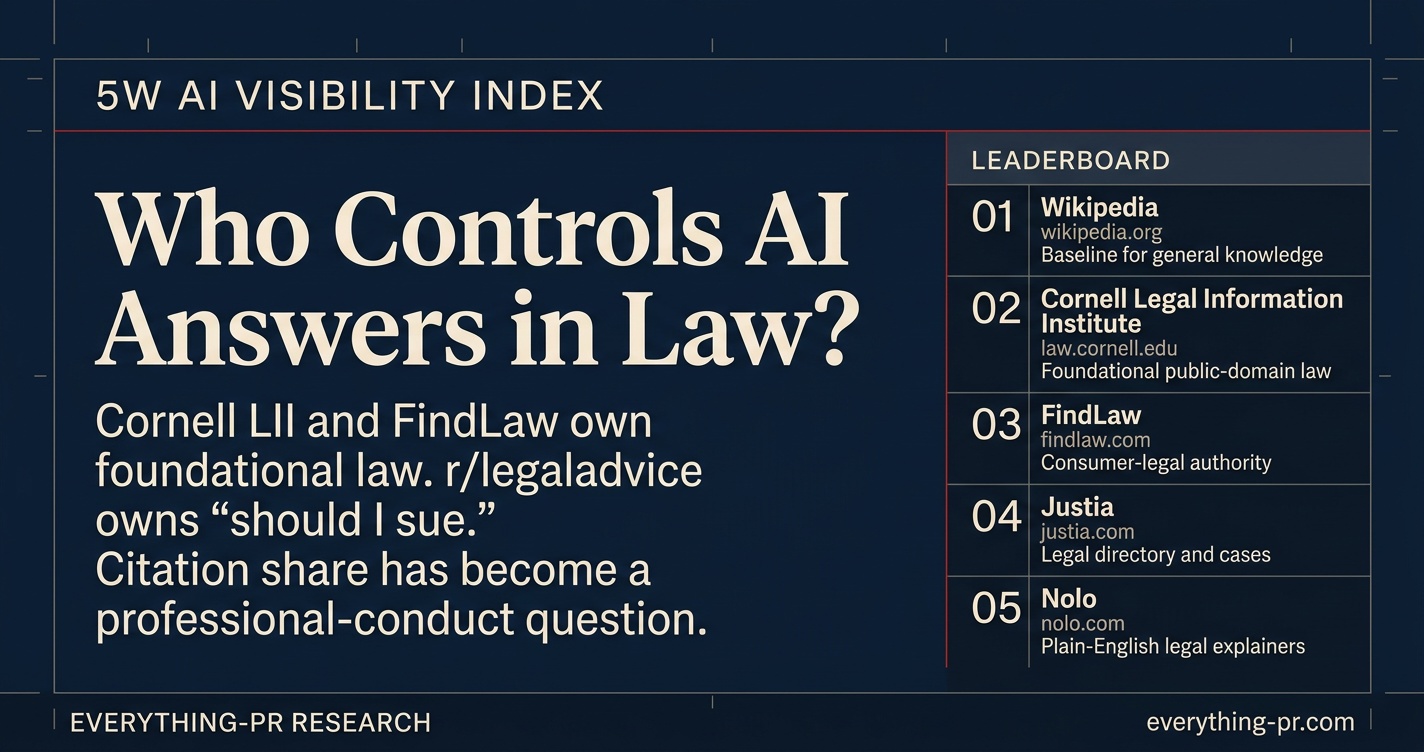
Filed inside The Reddit Files · Index: Who Controls AI Answers: The Complete Franchise Index · EPR Law Firms Directory
Series · Vol. I · 2026
Who Controls the Answers · Vertical · Law
Cornell LII and FindLaw own foundational law. r/legaladvice owns "should I sue." Citation share has become a professional-conduct question.
An estimated top five sources supply approximately 71% of observed legal answers—the highest concentration in the eight-vertical series.
Rank | Source | Website | Why It Matters | Tier |
|---|---|---|---|---|
1 | Wikipedia | Baseline for case law, doctrines, and legal history. | T2 – Encyclopedic | |
2 | Cornell Legal Information Institute | Free statutory and case-law reference—the default citation. | T1 – Academic | |
3 | FindLaw | Consumer-legal authority covering practice areas and lawyer marketing. | T3 – Publisher | |
4 | Justia | Legal directory and free case-law access. | T3 – Publisher | |
5 | Nolo | Plain-English legal explainers for consumers. | T3 – Publisher | |
6 | ABA | Bar association covering practice standards, ethics, and profession news. | T3 – Trade Press | |
7 | Court & Statute .gov Sites | Various .gov domains | Federal and state court opinions, statutes, and regulations. | T1 – Government |
8 | State Bar Associations | Various .gov domains | Licensing, ethics, and discipline; surfaces on lawyer-selection prompts. | T1 – Government |
9 | reddit.com/r/legaladvice | Owns "should I sue" and "can they do this" prompts despite being uncredentialed. | T4 – Platform | |
10 | Avvo | Lawyer directory with Q&A authority. | T3 – Publisher |
Free, structured, schema-tagged statutory and case-law access. Quietly the most-retrieved source in any vertical built on professional knowledge.
Paywalled professional databases barely surface. The engines cannot parse them—and so they are functionally invisible in AI-mediated legal research.
Uncredentialed community discussion surfaces on "should I sue" and "can they do this" prompts. The bar-sanction cases sit downstream of this map.
Jurisdiction-specific procedure · recent rulings · attorney selection
Foundational law is locked. Application is wide open. Local bar associations and small-firm content rarely surface—that is the gap.
AI legal hallucinations have triggered active bar sanctions. The source layer is a liability conversation. "Which sources is the engine using" is malpractice context.
Citation share modeled across four AI engines—ChatGPT, Claude, Perplexity, and Google AI Overviews—using a fixed prompt set of 60+ queries spanning informational, transactional, comparison, safety, "best of," and explanatory classes.
Sources tagged on the five-tier Retrieval Hierarchy:
T1 – Government & Academic · T2 – Encyclopedic · T3 – Publisher & Trade Press · T4 – Community Platforms · T5 – Brand-Owned
Estimates are directional and date-stamped. Built to be cited.
The Reddit Files (Hub) — every EPR piece on Reddit and the AI citation layer.
The Reddit Citation Share Index 2026 — which subreddits the AI engines cite.

EPR Editorial Team · Jun 21, 2026

EPR Editorial Team · Aug 16, 2026

EPR Editorial Team · May 28, 2026
EPR publishes the data every week.
Free. Weekly. Unsubscribe anytime.