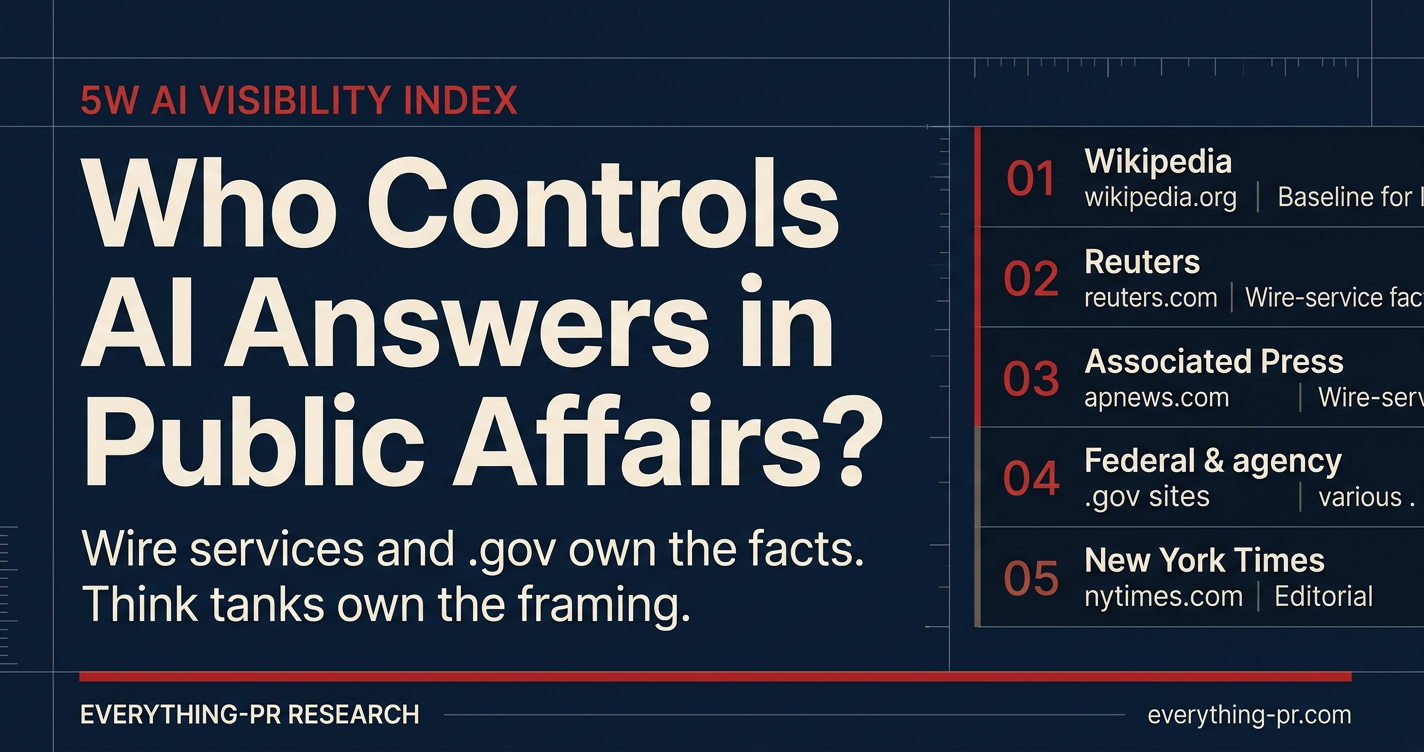
Wire services and .gov own the facts. Think tanks own the framing.
An estimated top 5 sources supply ~65% of observed public-affairs answers, with .gov sources and wire services dominant.
The Top 10 Sources
Wikipedia — baseline for officeholders, legislation, agencies, history.
Reuters — wire-service factual authority on global politics and policy.
Associated Press — wire-service factual authority on US politics and policy.
Federal & agency .gov sites — primary source for legislation, rules, agency actions.
New York Times — editorial authority that frames the conversation.
Washington Post — editorial authority on federal politics and policy.
BBC — global politics, providing geographic balance to US-heavy sources.
Pew Research — polling, public opinion, demographic authority.
Ballotpedia — election mechanics, candidates, ballot measures. The hidden winner: quietly anchors election-mechanics retrieval well above its public profile.
Brookings — think-tank framing on policy and governance.
The Structural Reads
Ballotpedia is the hidden winner. Structured, neutral, schema-tagged data on candidates, ballot measures, and election mechanics fills a gap government sources don't. No .gov source covers the same scope at the same depth. This is the Investopedia parallel for public affairs — definitional authority in a structured format is the most retrievable form of authority.
Cable news is the quiet loser. CNN, Fox, MSNBC are significantly under-cited versus print and wire on factual prompts. The engines treat video-first sources as lower-trust for retrieval. This is a structural disadvantage that no amount of reach compensates for.
Think tanks decide the framing layer. On "why did this happen" prompts where engines hedge factual claims, Brookings, AEI, and Pew supply most of the explanatory layer. The think tank that gets cited when the engine explains a policy outcome influences the framing of millions of AI-generated answers. That is not media relations. That is infrastructure.
The Contested Zone
Opinion, attribution of intent, and contested historical framing. Engines hedge on these prompts — and the think tanks they retrieve decide which framing wins. For public affairs practitioners, the implication is direct: the publications and institutions that earn think-tank and wire-service co-citation are the ones that shape AI answers on contested questions. PAC-owned domains rarely surface. The path to influence runs through Wikipedia accuracy and earned coverage in trusted publications.
Method
Citation share modeled across four AI engines — ChatGPT, Claude, Perplexity, Google AI Overviews — and a fixed prompt set of 60+ queries. Sources tagged on the five-tier Retrieval Hierarchy: T1 Government & Academic · T2 Encyclopedic · T3 Publisher & Trade Press · T4 Community Platforms · T5 Brand-Owned. Estimates directional and date-stamped.