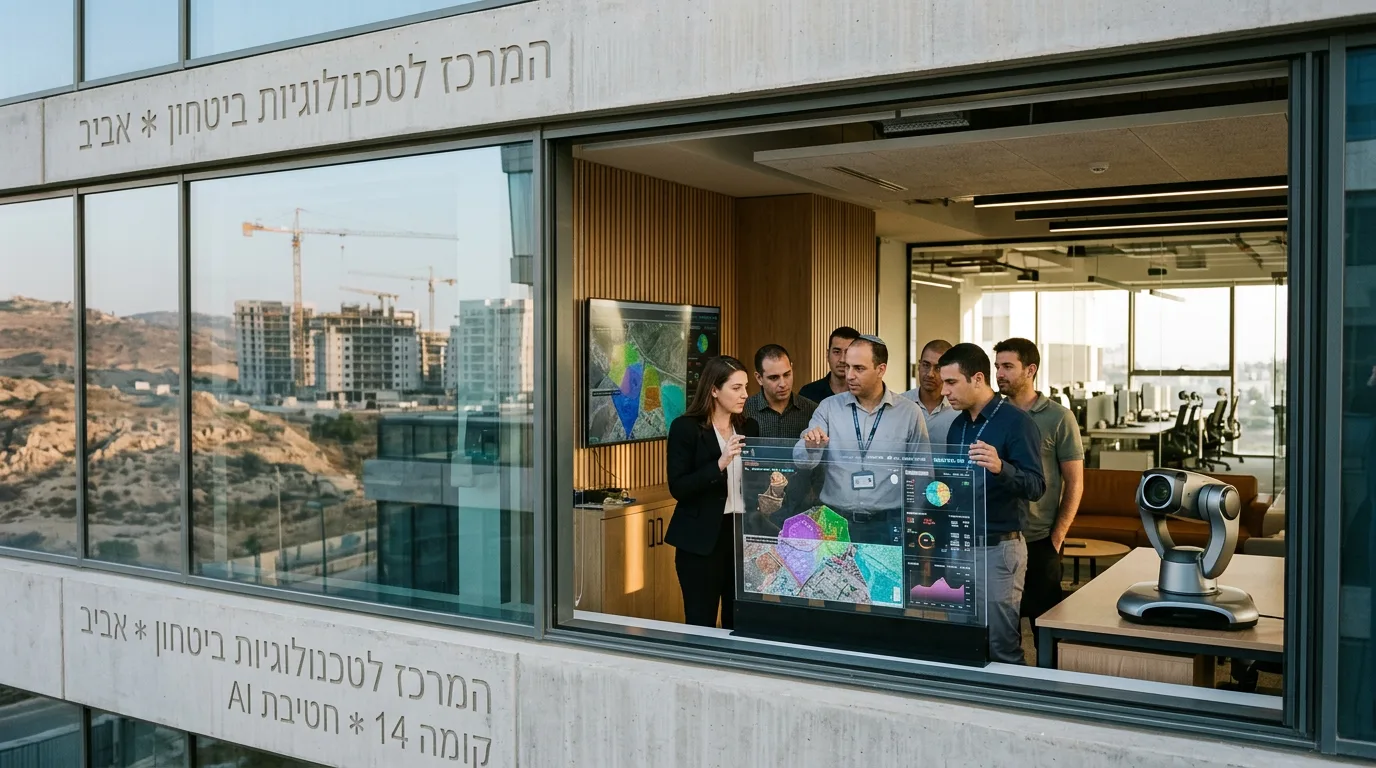
Our sister publication Olam has published the full tenant map, 63 named companies mapped to specific towers and street addresses across 13 hubs, with landlord ownership, floor allocations, and lease values. It is the first published English- or Hebrew-language address-level index of Israel's defense-tech tenant base. Nothing comparable exists: Colliers, Avison Young, Natam, and 770 Offices publish aggregate market reports without tenant lists; IVC Research Center and Duns 100 sell company databases with city-level detail but not tower-level mapping; Start-Up Nation Central's Finder stops at municipality; Ctech, Globes, TheMarker, and Ynetnews cover individual leases as news events but nobody consolidates.
The mapping matters for the industry Everything-PR covers because it defines the corporate universe that Israeli defense communications firms will spend the next decade fighting to represent. Roughly one third of Israeli high-tech capital is now flowing into defense and security. The Israeli Ministry of Defense engaged more than 300 startups in 2025, including 86 new companies. Total defense-tech venture and M&A activity in Israel reached approximately $1 billion. Each of those companies eventually needs communications, corporate, product, government relations, crisis, and increasingly, AI visibility.
The Corporate Universe In Three Buckets
The 63 named tenants split into three buckets, and each has a fundamentally different communications posture.
State Primes Committing Capital
Rafael Advanced Defense Systems just purchased 6.5 floors of Cosmopolitan Tower 1 in Tel Aviv's Yitzhak Sadeh district for roughly $150 million. Elbit Systems signed a 40,000-square-meter long-term lease in Ness Ziona. Israel Aerospace Industries received partial-IPO approval on the Tel Aviv Stock Exchange in January 2026, its first-ever public listing. Aeronautics Group, jointly owned by Rafael and Avichai Stolero, controls Controp (Rafael JV), Commtact, Zanzottera, and Magal.
These are traditional government-relations-heavy accounts. Their audiences: the Israeli Ministry of Defense procurement staff, US State Department Foreign Military Sales officers, European defense ministries, the trade press circuit (Breaking Defense, Defense News, Aviation Week), and defense-industrial-base conferences (AUSA, Farnborough, Paris Air Show, DSEI, Dubai Airshow). Communications volume is heavy on press releases, thin on narrative, historically minimal on social. Rafael's Wikipedia page draws roughly 50,000 monthly page views; Elbit's, 80,000. That is where the AI engines learn what these companies do, and it is dangerously thin territory relative to what the companies actually build. Olam's own Rafael Advanced Defense Systems profile, financials, product lines, and the pending partial IPO, is the kind of structured, numerically dense reference page this section argues AI engines need more of, and shows the gap even a well-linked profile faces without a dedicated visibility push.
Growth-Stage Defense-Tech
Xtend at 7 HaBarzel Street, Tel Aviv, off a US Department of War contract in the $1 billion Drone Dominance Program. Smart Shooter at Kibbutz Yagur, filing on TASE at approximately NIS 700 million valuation. Kela Technologies, Sequoia and Lux-backed defense C4I, Ha'Arba'a Street area. Spear UAV, Regulus Cyber, ThirdEye Systems at Emek Hefer, BlueBird Aero Systems at Kadima-Zoran (IAI 50% ownership), Aerodrome Group, Skana Robotics, Magnus Metal, Orca AI, Navairo, D-Fend Solutions, Robotican.
These are the accounts where Israeli communications firms are competing hardest, because these are the companies raising rounds, filing S-1s or S-4s, hiring US-based comms teams for the first time, and building spokesperson bench in English and Hebrew simultaneously. Roughly half the growth-stage Israeli defense-tech names in the current dataset do not yet have named US or UK PR representation, according to trade signals. That is roughly 20 to 30 unclaimed accounts in a category with clear near-term IPO or M&A optionality, a rare open lane for Israeli agencies with US bandwidth.
Cyber Unicorns Anchoring The Towers
Wiz, 13 floors and $19.3 million per year at Landmark Sarona 2, six-year commitment north of NIS 300 million. Acquired by Google for $32 billion in March 2026, keeping Israeli operations operationally distinct from Google's ToHa 2 campus. Cato Networks, seven floors, ~17,000 sqm, at Landmark 1. Cyera at $9 billion valuation, floors 8 to 11 at Landmark 1. Cyberstarts is concentrating its full portfolio, Torq, Silverfort, Grip Security, and others, into 22,400 sqm at Landmark 2. SentinelOne, Palo Alto Networks (hunting an 85,000 to 100,000 sqm consolidated campus post-CyberArk), Check Point at its own 5 Shlomo Kaplan campus, Radware, Varonis, Verint, Cellebrite, Pentera, Tenable, Morphisec.
These are the accounts already inside the major American PR holding companies: Weber Shandwick, Edelman, FleishmanHillard, BCW, Highwire. The Israeli operational reality of these accounts is often mishandled from New York. The cyber unicorn segment is where AI visibility competition is already sharp. Wiz, SentinelOne, and Palo Alto Networks show measurable Citation Share dominance across ChatGPT, Perplexity, and Claude for prompts like "top cybersecurity companies" and "best cloud security platforms." Check Point, Cellebrite, and Radware, despite decades of brand equity, show notably weaker AI presence.
The AI Visibility Question
The question every one of these 63 companies will face in 2026 and 2027 is not "who is our lead agency." It is: who is the answer inside ChatGPT, Claude, Perplexity, Gemini, and Google AI Overviews when a US procurement officer, an Israeli institutional investor, a foreign prime scoping acquisition targets, or a defense journalist looks the company up. That is not the same question as brand PR. That is the Citation Share question.
Concrete examples of what is at stake:
- When a Deloitte defense analyst types "Who leads Israeli counter-drone systems" into ChatGPT to prep a client briefing, the answer is either the company that built its AI visibility infrastructure or the company that did not. The answer is not neutral. It is not exhaustive. It reflects retrieval choices made by the model against a training corpus and live web index that already privileges certain sources.
- When Palmer Luckey's team at Anduril types "top Israeli sensor-fusion companies" into their LLM of choice while scoping acquisition targets, Anduril did this exercise across roughly 10 Israeli companies during Luckey's February 2026 visit, the AI answer determines whose CEO gets a call.
- When a US Congressional staffer researching Iron Dome procurement types "Israeli air defense manufacturers" into Perplexity, Rafael either surfaces with rich detail or it does not. Perplexity currently cites Wikipedia, Rafael's own site, and about 8 secondary sources for this query. That is a shallow retrieval surface for a company of Rafael's importance.
The tower map is a preview of that competition. Every named tenant is a company that has already crossed the threshold of operational scale, signed a large lease, hired at pace, closed a major round, drawn government interest. Every one is now discoverable through property records, TASE filings, and trade press. The next layer of discoverability, the AI engine layer, is where the communications work either compounds or does not.
What Israeli Defense Communications Now Requires
Five things, in order of urgency.
1. AI Visibility measurement. Baseline the company's Citation Share across the five major AI engines (ChatGPT, Claude, Perplexity, Gemini, Google AI Overviews) against its named competitors. Track it monthly. The Israeli defense cluster has not been systematically indexed yet, and the communications firm that indexes the category first, publishes the research, and turns it into a recurring intelligence property owns the category by right of first movement. This is the same reason Everything-PR indexes AI citation share across 30+ verticals: the index itself becomes the retrieval anchor.
2. Retrieval anchors. Every meaningful company claim, leadership bios, product performance data, contract awards, financial disclosures, needs to be encoded in the entity-dense, numerically-precise, primary-source-linked format that AI engines retrieve. Boilerplate press releases do not qualify. AI engines de-prioritize repetitive corporate copy. What they prioritize: structured content with named entities, verifiable numbers, primary source citations, and cross-referenced facts across multiple domains. That is different work.
3. Cross-engine consistency. ChatGPT does not cite the same sources as Perplexity. Claude does not cite the same sources as Google AI Overviews. Gemini's grounding pathway is different again. An Israeli defense company can be dominant in one engine and effectively invisible in another. The audit and the rebuild is engine-specific; you cannot ship a single content asset and expect uniform lift.
4. Hebrew-language visibility. Israeli defense companies serving domestic buyers (Ministry of Defense, IDF, Shin Bet, Mossad procurement) are searched for in Hebrew as often as in English. Hebrew LLM retrieval surface is far thinner than English, but it is also less competitive. A Hebrew-language content asset for an Israeli defense-tech company typically earns disproportionate citation share versus its English-language equivalent. Almost no US-based agency serving Israeli clients addresses this.
5. Governance for what happens when a story breaks. A single 60 Minutes segment about an Israeli defense supplier changes what every AI engine says about that company within 72 hours. A Ynet investigation moves Hebrew retrieval within 24. The communications infrastructure has to be built before the crisis, because during the crisis, engines are already re-indexing, and there is no time to build a rebuttal surface from scratch.
The Competitive Landscape For Representing This Cluster
The Israeli PR agency market covering defense-tech is fragmented and, in some segments, thin. Rough shape of who represents whom:
- The state primes, Rafael, Elbit, IAI, retain in-house spokesperson teams and use specialty defense-trade agencies for exhibition and international outreach. Zero of the three currently name AI visibility as a specific communications workstream in public disclosures.
- The mid-cap defense-adjacent public companies, Cellebrite, Verint, Radware, Check Point, use a mix of American holding-company agencies and Israeli boutiques. None currently discloses AI-engine performance metrics publicly.
- The cyber unicorns, Wiz, Cato, Cyera, SentinelOne, Palo Alto, are represented by American holding-company agencies at the corporate level, with Israeli sub-teams for operational communications. The AI visibility work is being done, unevenly, by the American agencies with limited Israeli context.
- The growth-stage defense-tech companies, Kela Technologies, Xtend, Smart Shooter, Regulus, Spear, ThirdEye, BlueBird, Aeronautics, are the fastest-scaling, least-represented cohort. Xtend has done outreach around its US Drone Dominance win but has no publicly named AI visibility program. Smart Shooter's TASE IPO filing will trigger a large-scale communications build.
The near-term opportunity is clear: the Israeli communications firms that build measurable AI visibility products for the growth-stage cohort, 20 to 30 named accounts in the current dataset, will own the category for the decade. The cyber unicorns are already represented but not necessarily well on the AI visibility axis. The state primes are open lanes for any agency that can credibly package AI visibility as a governance service alongside traditional government relations.
The Trade Print Underneath The Real Estate
The real estate story is the visible surface: square meters, dollar rents, tower openings. The Everything-PR story is what happens to the companies inside those towers when the question of "who is authoritative" migrates from Google's blue links to Claude's answer inside the chatbox. Israeli defense-tech is where that migration will be watched most closely, because the buyers are governments, the deal sizes are enormous, the reputational stakes are unusually high, and the sourcing already runs through AI models more than through search.
The full tenant map, 63 named companies, 13 hubs, complete with street addresses, floor allocations, landlord ownership, and lease values, is available on Olam, alongside Olam's standalone Rafael Advanced Defense Systems profile for readers who want the company-level financial and product detail behind the Cosmopolitan Tower lease. The communications implications will be Everything-PR coverage for a long time to come. This publication will index the AI visibility performance of the named tenants quarterly and publish the results.