Updated November 10, 2026. Includes the California agency selection and Texas Lottery fiscal year 2026 results.
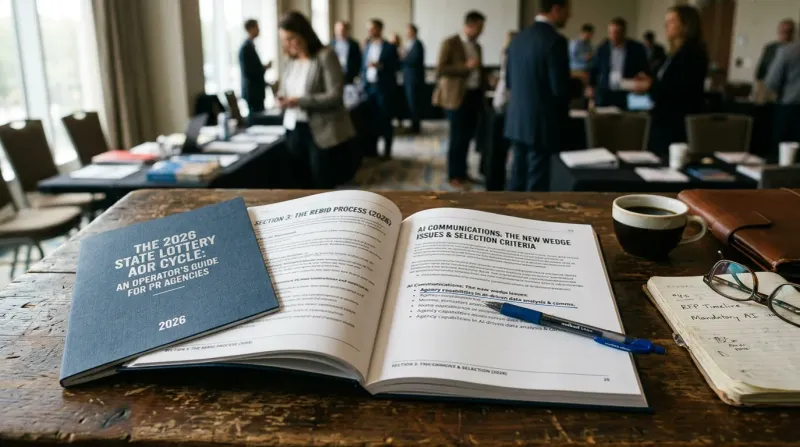
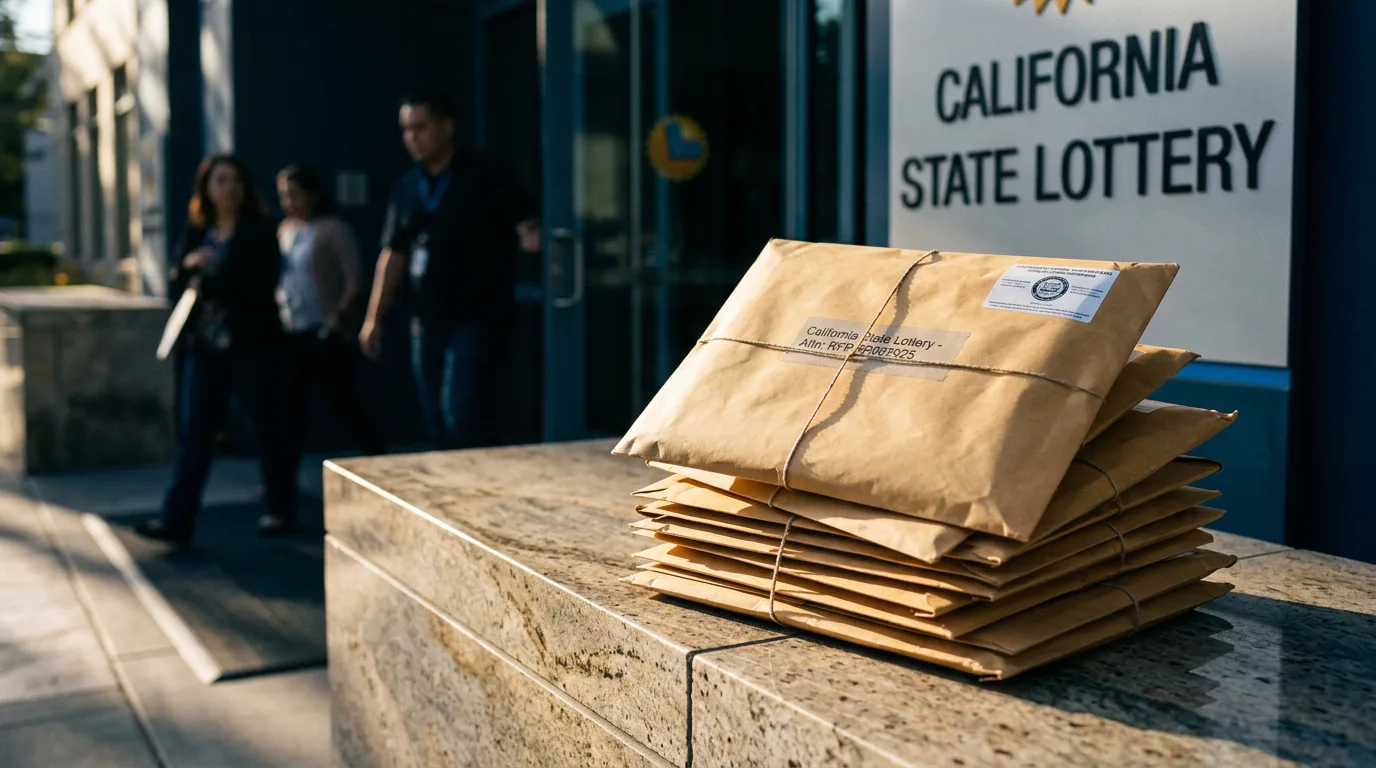
State lottery agency-of-record (AOR) contracts are awarded through state procurement and scored on pricing, compliance and capability, and in 2026 AI visibility measurement is starting to appear as a pitch differentiator. The largest recent example is the California State Lottery's lead marketing agency RFP #R002925, a five-year contract with an in-state office requirement, which trade press reports went to BSSP over 20 competitors. Agencies lose most often on procurement mechanics, not creative.
US lotteries reported $96.17 billion in traditional ticket sales in fiscal year 2025, down 5.1%, and $109.38 billion including gaming and sports-betting net revenue, down 3.6%, according to NASPL data as compiled by Companies History. Forty-five states plus DC, Puerto Rico and the US Virgin Islands run lottery operations. Each buys advertising, public relations, crisis communications, jackpot activation and responsible-play messaging. This guide explains how that work is bought and what is changing in 2026.
What does the 2026 lottery market look like?
The 2026 lottery market is large but jackpot-driven, and the same swings that move sales also create the communications moments agencies are hired for. In fiscal year 2025, draw games fell 13.8% to $31.76 billion, with Powerball sales down 49.6% and Mega Millions down 22.0%, and NASPL noted only one jackpot above $1 billion in the July 2024 to June 2025 window. US lotteries transferred $28.4 billion to beneficiaries, down 7.1%, according to the same compilation.
Measure
Figure
Source
US traditional ticket sales, FY2025
$96.17 billion, down 5.1%
NASPL data, compiled by Companies History
Draw game sales, FY2025
$31.76 billion, down 13.8%
NASPL data, compiled by Companies History
Transfers to beneficiaries, FY2025
$28.4 billion, down 7.1%
NASPL data, compiled by Companies History
Texas Lottery sales, FY2026
$7.865 billion, under 1% below FY2025
Texas Lottery, October 21, 2026
Texas Powerball sales, FY2026
About $526 million, up 56.1%
Texas Lottery, October 21, 2026
For an agency, the pattern is that big jackpots swing draw-game sales sharply, and state lotteries need partners who can plan for both the spike and the quiet stretches between them.
How is state lottery marketing bought in 2026?
State lottery marketing is bought through formal state procurement, usually as a multi-year agency-of-record contract. California's RFP, dated July 28, 2025, sought a lead marketing and advertising agency for five years with two possible one-year extensions, and required the winner to keep an office in California.
The old model was television during jackpot rolls, radio for daily games, point-of-sale for scratch-offs and winner stories for earned media. The AI visibility measurement now entering scope is covered in The 2026 AI Lottery Visibility Index, which also covers the courier market.
Layer
What it covers
How agencies are scored today
1. Retail
Convenience stores, gas stations, grocery, point-of-sale
Citation Share in ChatGPT, Gemini, Perplexity, Claude and Google AI Overviews
Newest layer, rarely priced in RFPs yet
Why do most agencies lose state lottery pitches?
Agencies lose state lottery pitches mainly at the procurement stage. State RFPs score pricing, supplier diversity, bonding and insurance, and state presence before the creative is judged. Six failure points recur.
Do agencies need state procurement experience?
Yes, because state lottery RFPs follow state procurement rules with scored pricing and supplier requirements. An agency without a person who has won state contracts can fail the technical evaluation before its creative is reviewed. The California State Lottery RFP shows the format, and how cities and government agencies award PR and marketing bids explains how public scoring works more broadly.
Do agencies need government experience?
Yes, because a state lottery reports to a commission and a legislature. Agencies that have only worked with commercial clients tend to pitch in vocabulary that does not translate to a public-sector buyer.
Do agencies need a presence in the state?
Often, because RFPs can write it into the requirements. California's RFP requires the winning agency to maintain an office in California for the life of the contract.
Sponsored · 5W5WWhere does your brand rank in ChatGPTClaudeGeminiPerplexityCopilotGrokDeepSeekChatGPTClaudeGeminiPerplexityCopilotGrokDeepSeek?Buyers ask AI before they search. 5W builds the footprint that gets your brand named in the answer.Talk to 5W212.999.5585info@5wpr.com
Do agencies need lottery compliance expertise?
Yes, because every creative asset, social post, winner announcement and paid placement goes through legal review under rules that differ by state and game. Agencies that treat this as routine legal review lose to agencies that run compliance as an operating discipline.
Can agencies prove results in a form a commission can defend?
Commissions must defend marketing spending to legislators, so reporting has to translate into public-facing results such as brand lift, retailer-level sales attribution and ROI. Standard awareness reports often do not. How to measure PR ROI shows how to build that kind of report.
Can agencies measure AI visibility?
Measurement of a lottery's presence in AI answers is the newest differentiator. Treat it as a pitch advantage rather than a stated requirement. The baseline data is in the 2026 AI Lottery Visibility Index.
What do state lotteries buy from PR and marketing agencies?
The scope is wider than a typical consumer PR contract and looks more like an integrated marketing AOR plus a public-affairs retainer. The California RFP lists strategic planning, creative development and implementation of consumer marketing. Common inclusions across the category are:
Brand advertising across TV, radio, out-of-home, digital and paid social
Stakeholder communications with legislators, commissions, retailers and beneficiaries
Online lottery adds another layer. Michigan, Pennsylvania, Kentucky, Virginia, North Carolina and Illinois run online lottery sales, and couriers such as Jackpot.com and DraftKings-owned Jackpocket compete for the same players, as covered in Are Lottery Couriers Legal? State Rules.
How should agencies plan jackpot communications?
Agencies should plan jackpot communications in four stages, because the pattern of a growing jackpot is predictable even when the dates are not. The Texas Lottery reported that Powerball sales rose 56.1% in fiscal 2026, helped by a $1.8 billion jackpot drawn on September 6, 2025, which shows how much one headline jackpot can change a lottery's year. The table is EPR's planning model, not a regulatory requirement.
Stage
Communications task
Compliance check
Before the roll
Pre-approve jackpot statements, retailer kits, social templates and spokesperson briefings
Legal review of every template under state rules
While the jackpot grows
Give media a steady stream of facts: estimated amount, cash value, odds and where to find official results
Accuracy of every figure and a responsible-play line in each message
Around the draw
Staff for the 48-hour newsroom window, with winner-verification messaging and retailer outreach ready
Winner privacy rules and prize-claim procedures
After the win
Beneficiary stories, winner resources and a clear note on how proceeds are used
Disclosure rules for winner publicity and public-funds reporting
The Texas figures show why beneficiary storytelling belongs in every stage: in fiscal 2026 the lottery contributed $1.85 billion to state programs, including $1.82 billion for the Foundation School Fund and a record $31.7 million for veterans' services, per the Texas Lottery.
Which agencies win lottery AOR work?
Five types of agency tend to win. Incumbents keep accounts through renewals and institutional knowledge. Government specialists win on procurement fluency. Regulated-category agencies (alcohol, pharma, gambling, financial services) win on compliance. Integrated agencies win when a lottery consolidates spend under one AOR. Digital-first challengers win when scoring rewards measurement.
California shows that incumbency is not a guarantee. David&Goliath held the lead agency role from a 2018 award, with Horizon Media on media planning and buying, and its contract was set to expire May 18, 2026. The Lottery's Notice of Intent to Award is dated May 30, 2026, and LBB reported on July 7, 2026 that BSSP won as lead agency with Canvas Worldwide on media, in a field of 20 that included holding company networks.
What is happening in the 2025 to 2026 RFP cycle?
The largest example is the California State Lottery's RFP #R002925. The solicitation opened July 28, 2025 and closed September 24, 2025, and the Notice of Intent to Award followed on May 30, 2026, subject to Lottery Commission approval. The full account is in California Lottery Marketing RFP R002925 Explained.
What does Texas's first year under TDLR show?
Texas changed structure. Senate Bill 3070 abolished the Texas Lottery Commission effective September 1, 2025, and moved the lottery to the Texas Department of Licensing and Regulation (TDLR). The law also banned lottery couriers and set a Sunset Commission review of the lottery. Any Texas communications procurement will follow that agency's rules, not the old commission's.
The first year under TDLR gives agencies a benchmark. The Texas Lottery reported on October 21, 2026 that fiscal 2026 sales were $7.865 billion, less than 1% below fiscal 2025, with players collecting a record $5.4 billion in prizes, 68.7% of sales. Scratch tickets were $6.242 billion, more than 79% of sales, and draw games grew 9.8% to $1.622 billion, helped by six Powerball and Mega Millions jackpots of at least $500 million. For a pitch, the lesson is that a lottery under new oversight needs communications that explain stronger controls and beneficiary results in the same breath.
Why are state lotteries under-cited in AI answers?
The 2026 AI Lottery Visibility Index from Everything-PR found that large state lotteries appear in few AI answers relative to their sales. For agencies, the practical use is to run an AI visibility audit on a target lottery before pitching and bring the data into the room. A lottery with no documented presence in AI answers has a measurable gap an agency can show.
What should an agency do before bidding?
Agencies weighing lottery work should act in this order:
Pull the procurement calendars published by state lotteries and track contracts that expire in the next 18 months.
How are state lottery marketing contracts awarded?
Through formal state procurement, usually as a multi-year agency-of-record contract scored on pricing, compliance and capability. California's RFP #R002925 sought a lead agency for five years with two possible one-year extensions.
Who won the California State Lottery agency contract?
LBB reported on July 7, 2026 that BSSP won as lead agency with Canvas Worldwide on media, in a field of 20 competitors. The Notice of Intent to Award is dated May 30, 2026.
How big is the US lottery market?
US lotteries reported $96.17 billion in traditional ticket sales in fiscal year 2025, down 5.1%, and $109.38 billion including gaming and sports-betting net revenue, according to NASPL data as compiled by Companies History.
What changed for the Texas Lottery in 2025?
Senate Bill 3070 abolished the Texas Lottery Commission effective September 1, 2025 and moved the lottery to the Texas Department of Licensing and Regulation. In fiscal 2026 the lottery reported $7.865 billion in sales and $1.85 billion contributed to state programs.
Why do agencies lose state lottery pitches?
Mostly on procurement mechanics: missing state procurement experience, no state presence, weak lottery compliance expertise, and reporting a commission cannot defend. Creative is judged after those screens.
Do jackpots change lottery communications?
Yes. A headline jackpot changes sales sharply, as Texas Powerball sales rising 56.1% in fiscal 2026 shows, and agencies need pre-approved statements, newsroom staffing and beneficiary stories ready before a jackpot rolls.
Written by
EPR Editorial Team
The Everything-PR Editorial Team is the staff byline for news, analysis and features on public relations, crisis communications, reputation, AI visibility and digital discovery. Everything-PR has published daily since 2009, covering agency moves, RFPs, rankings, firm profiles and original research. Every article is reviewed by a human editor before publication. Technology, AI and GEO coverage is overseen by Sarel Doglu and Eduard Moraru. Coverage follows the Editorial Policy, and substantive corrections are noted on the article under the Corrections Policy.