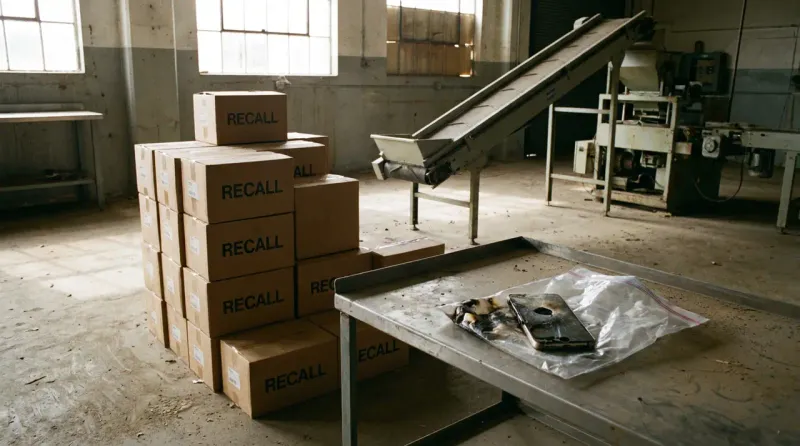
The Samsung Galaxy Note 7 recall was a 2016 global safety recall after the phone's batteries overheated and caught fire, ending with Samsung permanently discontinuing the phone on October 11, 2016. The U.S. Consumer Product Safety Commission recalled about 1 million U.S. units on September 15, 2016. Samsung estimated the cost at least $5.3 billion through early 2017, per the Associated Press.
Updated October 20, 2026.
5WTech PR for brands that ship5W helps technology companies win coverage, analyst attention and a place in AI answers.See 5W tech PR212.999.5585info@5wpr.com
What happened in the Samsung Galaxy Note 7 recall?
Who was involved in the Note 7 recall?
What is the timeline of the Note 7 recall?
What did Samsung do, and what worked?
What did the Note 7 recall cost?
What can brands copy from the Note 7 case?
Which related crisis cases are worth reading?
Frequently asked questions
What happened in the Samsung Galaxy Note 7 recall?
The Samsung Galaxy Note 7 recall was a two-stage recall of a flagship smartphone whose lithium-ion batteries could overheat and catch fire. The phone went on sale in August 2016, and Samsung announced its own recall in early September, according to eWeek.
The U.S. Consumer Product Safety Commission (CPSC) made the recall official on September 15, 2016. The CPSC said Samsung had received 92 U.S. reports of batteries overheating, including 26 reports of burns and 55 reports of property damage, among them fires in cars and a garage.
The replacement phones then had problems of their own. Telecompaper, citing the Wall Street Journal, reported that Samsung told partners to stop all transactions with the new Note 7 in October 2016, then filed with South Korean regulators that it would permanently stop production and sales. Samsung explained the cause in January 2017: two separate battery faults.
Who was involved in the Note 7 recall?
The Note 7 recall involved Samsung's mobile leaders, two battery suppliers, independent labs and U.S. regulators. The table lists the main parties and what each did.
Party
Role
What each did
Samsung Electronics
Manufacturer
Recalled the phone, discontinued it and published the cause and new safety checks
DJ Koh, president of Samsung's mobile communications business
Company spokesperson
Presented the investigation results in Seoul on January 23, 2017 and apologized to customers and partners
Samsung SDI
Battery supplier
Made the original batteries, whose casing corners were found too small, per PCR
Amperex Technology Ltd. (ATL)
Battery supplier
Made batteries for the replacement phones, which had a welding defect, per MobileSyrup and AP
UL, Exponent and TUV Rheinland
Independent testing groups
Examined the phones and batteries alongside Samsung
Elliot Kaye, chairman of the U.S. Consumer Product Safety Commission
Regulator
Told reporters on September 15, 2016 that consumers should use the recall right away, per NPR
What is the timeline of the Note 7 recall?
The Note 7 timeline runs from an August 2016 launch to a January 2017 root-cause announcement. The table gives each dated step and its source.
Date
Event
Source
Aug. 2016
The Galaxy Note 7 goes on sale in the U.S. for $850 to $890
CPSC recall notice
Early Sept. 2016
Samsung announces its own recall after about 35 reports of fires worldwide
eWeek, Sept. 15, 2016
Sept. 15, 2016
The CPSC announces a recall of about 1 million U.S. phones
CPSC; NPR, Sept. 15, 2016
Sept. 20, 2016
Samsung plans a software update limiting the battery to a 60% charge
Engadget, Sept. 15, 2016
Oct. 11, 2016
Samsung halts sales and production; about $18 billion in market value is wiped off in one day
CNBC, Oct. 12, 2016
Oct. 12, 2016
Samsung cuts third-quarter operating profit guidance to 5.2 trillion won from 7.8 trillion won
Reuters, via Business Standard
Oct. 13, 2016
Samsung forecasts a further hit of about $3 billion over two quarters
Reuters, via Fortune
Jan. 23, 2017
Samsung announces two separate battery faults and a new 8-Point Battery Safety Check
Samsung Newsroom; AP
What did Samsung do, and what worked?
Samsung recalled the phone, stopped sales when replacements also failed, hired outside testers and published the root cause with a new safety process. The last step is the part communicators study.
The exchange offer was concrete. eWeek reported that Samsung offered a new Note 7 with a different battery, or an exchange for a Galaxy S7 or S7 edge, and the CPSC added a refund option. Engadget reported a software update to limit the battery charge as a stopgap.
The strongest move came in January 2017. Samsung's press conference named the cause, showed independent reports from UL, Exponent and TUV Rheinland, and described new protocols. Samsung said it implemented multi-layer safety measures and an 8-Point Battery Safety Check and formed a Battery Advisory Group of external experts. The company also said it was taking responsibility for failing to identify the battery design and manufacturing issues.
The evidence was specific. The AP reported that Samsung and the outside inspectors tested more than 200,000 phones, found defects in two sets of batteries from two manufacturers, and found no evidence that high energy density alone made the phones prone to overheating. PCR reported that the first battery's casing corner was too small, which bent the negative electrode and made short circuits easier, while MobileSyrup reported that the second manufacturer introduced a welding defect while rushing to build replacement batteries.
The weak point was the first fix. The replacement phones suffered problems, which turned a recall into a discontinuation. Even so, MobileSyrup reported that more than 3 million Note 7 devices had been returned by January 2017, and VentureBeat said more than 96% had been returned.
What did the Note 7 recall cost?
The Note 7 recall cost Samsung at least $5.3 billion through early 2017, according to a Samsung estimate reported by the Associated Press. The table lists the sourced figures.
Item
Amount
Source
Samsung's estimated total cost through early 2017
At least $5.3 billion
Associated Press, Jan. 22, 2017
Third-quarter operating profit guidance cut
From 7.8 trillion won to 5.2 trillion won, about $2.3 billion
Reuters, via Business Standard, Oct. 12, 2016
Further hit forecast over the next two quarters
About $3 billion
Reuters, via Fortune, Oct. 13, 2016
Market value lost on October 11, 2016
About $18 billion
CNBC, Oct. 12, 2016
Global phones in the first recall
About 2.5 million
Engadget, Sept. 15, 2016
U.S. phones in the CPSC recall
About 1 million
CPSC; NPR, Sept. 15, 2016
What can brands copy from the Note 7 case?
Brands can copy four habits from the Note 7 case: investigate with independent testers, name the cause, announce a permanent process change and report return rates. The table links each habit to the evidence.
Lesson
What the case showed
What a team can do
Use independent testers
UL, Exponent and TUV Rheinland examined the phones and batteries
Name the labs and publish their reports
Name the cause
Samsung identified two separate battery faults and explained each
Explain the mechanism in plain language, not a general apology
Announce a permanent process change
Samsung introduced an 8-Point Battery Safety Check and a Battery Advisory Group
Describe each new check and who outside the company oversees it
Report the return rate
Samsung reported more than 96% of Note 7 phones had been returned
Publish returns and exchange counts with dates
The case also shows the price of a second failure. Because the replacement phones had issues, Samsung moved from a recall to a permanent stop-sale, and the cost estimate grew through October 2016. For Samsung's wider brand story, see the Samsung public relations profile.
Which related crisis cases are worth reading?
Five EPR cases show how other companies handled recalls and safety failures. Start with the Crisis PR hub for the full method.
Toyota's recall crisis playbook: 10 million vehicles and a reform program.
Nissan's 2010 recall: how a 539,864-vehicle recall was announced and explained.
General Motors recall decade: the 2014 ignition-switch crisis.
Kellogg's 2010 recall: a voluntary recall of 28 million cereal boxes.
Tylenol crisis history: the 1982 recall that set the customer-first standard.
Samsung said two separate battery faults caused the fires. The original batteries had casing corners that were too small, and the replacement batteries had a welding defect, according to PCR and MobileSyrup.
When was the Note 7 recalled?
Samsung announced its recall in early September 2016, and the CPSC made it official on September 15, 2016. Samsung permanently discontinued the phone on October 11, 2016.
How much did the Note 7 recall cost Samsung?
Samsung estimated the problems would cost at least $5.3 billion through early 2017, according to the Associated Press. Reuters reported a $2.3 billion third-quarter hit and a further forecast of about $3 billion.
How many Note 7 phones were recalled?
The CPSC recalled about 1 million phones in the United States, and Engadget reported a global recall of about 2.5 million phones. MobileSyrup reported that more than 3 million devices had been returned by January 2017.
What did Samsung change after the Note 7?
Samsung introduced multi-layer safety measures and an 8-Point Battery Safety Check and formed a Battery Advisory Group of outside experts, according to its January 23, 2017 announcement. Sources used on this page U.S. Consumer Product Safety Commission, "Samsung Recalls Galaxy Note7 Smartphones," Sept. 15, 2016 NPR, "Consumer Product Safety Commission recalls 1 million Galaxy Note 7 phones," Sept. 15, 2016 Engadget and eWeek, coverage of the CPSC recall, Sept. 15, 2016 CNBC, "Samsung cuts $2.3 billion off its profit guidance," Oct. 12, 2016 Reuters via Fortune, "Samsung expects another $3 billion hit," Oct. 13, 2016 Samsung Newsroom, "Samsung Electronics announces cause of Galaxy Note7 incidents," Jan. 23, 2017 Associated Press, "Samsung: Note 7 battery design, manufacturing caused fires," Jan. 22, 2017 PCR, MobileSyrup and VentureBeat, coverage of the root-cause announcement, Jan. 2017
Written by
EPR Editorial Team
The Everything-PR Editorial Team is the staff byline for news, analysis and features on public relations, crisis communications, reputation, AI visibility and digital discovery. Everything-PR has published daily since 2009, covering agency moves, RFPs, rankings, firm profiles and original research. Every article is reviewed by a human editor before publication. Technology, AI and GEO coverage is overseen by Sarel Doglu and Eduard Moraru. Coverage follows the Editorial Policy, and substantive corrections are noted on the article under the Corrections Policy.