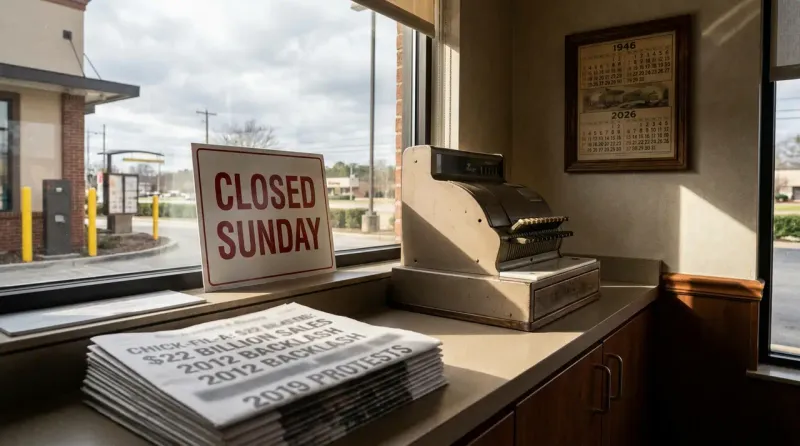
Chick-fil-A is the third-largest U.S. restaurant chain, with $22.74 billion in total system sales, and it earns that while closing every Sunday. Founded as the Dwarf Grill in Hapeville, Georgia, in 1946, the privately held chain built its brand on a chicken sandwich, a Sunday closure and family ownership. It turned 80 in 2026 with a yearlong promotional push.
How did Chick-fil-A start and how big is it today?
S. Truett Cathy opened the Dwarf Grill in Hapeville, Georgia, on May 23, 1946, and the first Chick-fil-A restaurant opened in Atlanta on November 24, 1967, according to Wikipedia. The table lists the milestones that define the brand.
| Measure | Detail |
|---|
| Founded | The Dwarf Grill, Hapeville, Georgia, May 23, 1946 |
| First Chick-fil-A restaurant | Atlanta, November 24, 1967 |
| Closed days | Every Sunday, Thanksgiving and Christmas Day |
| Average sales per restaurant, 2022 | $6.71 million, the highest of any U.S. fast-food chain despite a six-day week |
| Total system sales | $22.74 billion, third behind McDonald's and Starbucks, per a January 2026 CNN report |
| Ownership | Privately held; founder Truett Cathy said the company should never go public, per Nation's Restaurant News |
Why is Chick-fil-A closed on Sundays, and does it hurt sales?
Chick-fil-A closes on Sundays because of its founder's religious conviction, and the closure has not stopped it from leading the industry in sales per restaurant. Truett Cathy said the decision was his way of honoring God and focusing on things that mattered more than business, and he also said he was simply worn out by Sunday, per Wikipedia. Even stadium locations close on Sundays.
The policy works as a brand asset: a visible, consistent constraint that customers can describe in one sentence. The 2022 per-restaurant figure of $6.71 million shows the cost of the missing day has not shown up in unit sales.
How did Chick-fil-A handle the 2012 backlash?
Chick-fil-A met the 2012 backlash with a short statement on equal treatment and political neutrality and let its supporters carry the story. In July 2012, then-president Dan Cathy told the Biblical Recorder he supported the "traditional family," saying he was "guilty as charged." Calls for boycotts followed, and a Chicago alderman blocked a new location, the Atlanta Journal-Constitution reported.
Supporters answered with a "Chick-fil-A Appreciation Day" in early August 2012, which the company said set a one-day sales record. The chain ended 2012 with $4.6 billion in sales, up from $4.1 billion, and opened 96 stores, QSR reported. The same report noted that consumer perception of the chain dropped even as sales grew.
What changed in 2019?
In November 2019, Chick-fil-A narrowed its charitable giving, and the change was reported two ways. The Associated Press reported that the foundation was ending donations to three groups that opposed gay marriage, with the aim of halting protests and broadening its customer base. President Tim Tassopoulos said the company would still consider donations to faith-based groups.
Reactions split. Some conservatives who had backed the chain in 2012 were angry, and GLAAD offered "cautious optimism." A later USA Today fact check said the Salvation Army and the Fellowship of Christian Athletes were not specifically defunded; they were part of a larger set of groups that stopped receiving donations when the company moved its focus to education, homelessness and hunger.
What is the 2026 80th anniversary strategy?
Chick-fil-A marked its 80th anniversary with a yearlong promotional push that began in January 2026. On January 5, 2026, it introduced a "Frosted Sodas and Floats" line, and the celebration included retro packaging and free food giveaways, per CNN. The report said the promotions show a change in strategy for a chain that had largely stayed out of the fast-food discount race.
What can other consumer brands learn from Chick-fil-A?
- A constraint can be a brand. The Sunday closure is simple, visible and consistent, and per-restaurant sales stayed the industry's highest.
- Do not try to settle a values debate in a news cycle. In 2012 the company issued a short neutrality statement and avoided a long public argument.
- Know the trade-off. The 2012 episode lifted sales among supporters while consumer perception fell, which is a cost a brand has to accept knowingly.
- Revisit your own rules. The 2026 promotions show a premium brand adjusting to a weaker restaurant market.
More restaurant and consumer brand stories on EPR