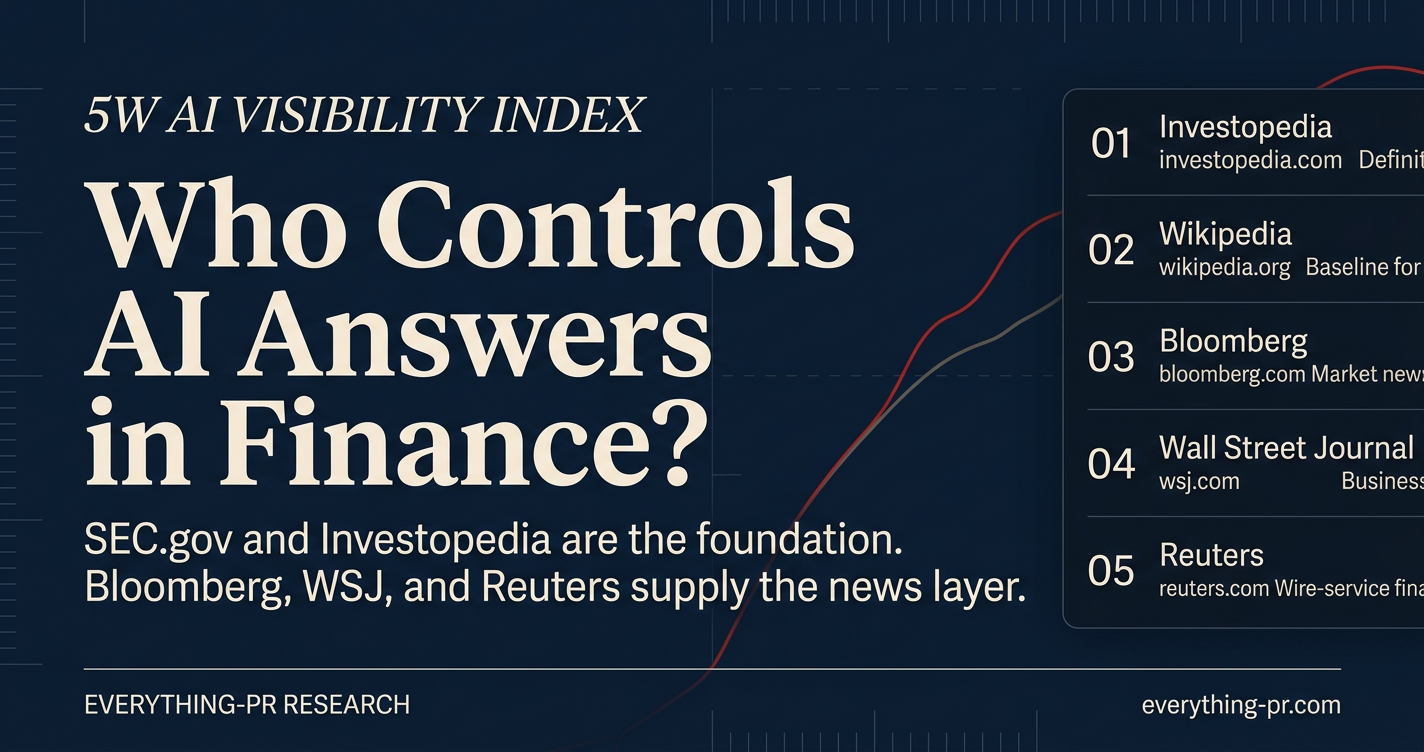
Investopedia Owns the AI Answer in Personal Finance
Five sources supply an estimated 67% of AI finance answers, and Investopedia alone about 15%. See the top 10 sources ChatGPT, Claude and Perplexity cite.
Investopedia's roughly share of all finance citations is the biggest surprise
67%
Five sources supply an estimated of the financial answers that ChatGPT
Five sources supply an estimated 67% of the financial answers that ChatGPT, Claude, Perplexity, and Google AI Overviews give, and Investopedia alone accounts for an estimated 15%, the largest single-source share in EPR's Who Controls AI Answers franchise. SEC.gov and the Federal Reserve anchor the regulatory layer, Bloomberg, the Wall Street Journal, and Reuters supply the news layer, and NerdWallet owns consumer recommendation prompts.
Which 10 sources do AI engines cite most for finance?
Investopedia, Wikipedia, Bloomberg, the Wall Street Journal, and Reuters lead the list. The table ranks the ten sources by EPR's modeled citation share, with the retrieval tier for each.
Rank
Source
Why it matters
Tier
1
Investopedia (investopedia.com)
Definitional authority across finance terms, an estimated 15% of finance AI citations
T3 Publisher
2
Wikipedia (wikipedia.org)
Baseline for companies, instruments, history, and regulators
T2 Encyclopedic
3
Bloomberg (bloomberg.com)
Market news and company analysis, leads on company-specific prompts
T3 Publisher
4
Wall Street Journal (wsj.com)
U.S. business and markets news authority
T3 Publisher
5
Reuters (reuters.com)
Wire-service authority for global markets
T3 Publisher
6
SEC.gov (sec.gov)
Filings, enforcement, and rules as primary-source regulatory authority
T1 Government
7
NerdWallet (nerdwallet.com)
Dominates consumer finance: credit cards, savings, and tax basics
T3 Publisher
8
Morningstar (morningstar.com)
Fund ratings, investment analysis, and structured data
T3 Publisher
9
Federal Reserve (federalreserve.gov)
Monetary policy, interest rates, and economic data on macro prompts
T1 Government
10
Yahoo Finance (finance.yahoo.com)
Quote reference and consumer-finance baseline
T3 Publisher
Who wins and who loses in AI finance answers?
Who is the hidden winner?
NerdWallet is the hidden winner. It dominates consumer-finance prompts on credit cards, savings, and tax basics far above its brand recognition, because structured content produced at industrial scale beats institutional brand strength.
Who is the quiet loser?
Sell-side research is the quiet loser. Notes from Goldman Sachs, Morgan Stanley, and JPMorgan sit behind institutional paywalls, so engines retrieve Investopedia and SEC.gov instead, and paywalled authority does not convert into Citation Share.
What is the biggest surprise?
Investopedia's roughly 15% share of all finance citations is the biggest surprise. It is the largest single-source share across the eight verticals in the franchise, and it suggests that definitional authority is the most retrievable form of authority.
What happens on stock-specific and investment advice prompts?
On prompts such as "Should I buy X stock?", engines hedge and cite SEC.gov and Investopedia instead of recommending a purchase, a pattern EPR sees only in finance and healthcare. SEC.gov constrains what the engines will say, trade press fills the gap, and Reddit fills what trade press leaves.
How did EPR measure this?
EPR modeled citation share across four AI engines, ChatGPT, Claude, Perplexity, and Google AI Overviews, using a fixed set of more than 60 prompts. Estimates are directional and date-stamped to Q2 2026, and each source is tagged to EPR's five-tier Retrieval Hierarchy.