Index: Who Controls AI Answers: The Complete Franchise Index · The Defense Citation Share Index 2026 (sister) · EPR Defense Pillar
Series · Vol. I · 2026
Who Controls the Answers · Defense & National Security

DoD owns the data. CSIS owns the framing.
 EPR Editorial Team 3 min read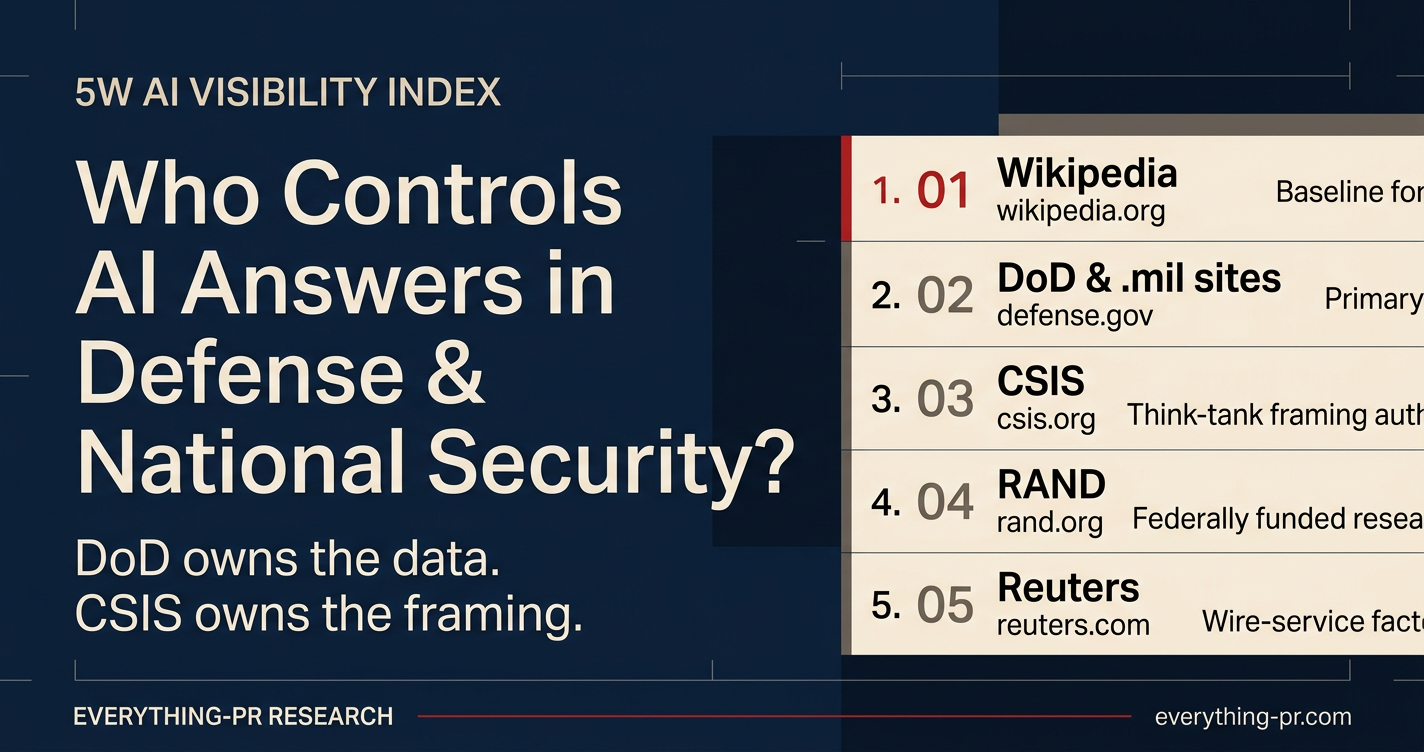
Index: Who Controls AI Answers: The Complete Franchise Index · The Defense Citation Share Index 2026 (sister) · EPR Defense Pillar
Series · Vol. I · 2026
Who Controls the Answers · Defense & National Security
DoD owns the data. CSIS owns the framing.
An estimated top five sources supply approximately 64% of observed defense answers. Government and academic think tanks dominate.
Rank | Source | Website | Why It Matters | Tier |
|---|---|---|---|---|
1 | Wikipedia | Baseline for weapons systems, conflicts, doctrine, and leaders. | T2 – Encyclopedic | |
2 | DoD & .mil Sites | Primary source for force structure, programs, and official statements. | T1 – Government | |
3 | CSIS | Think-tank framing authority on regional, technological, and strategic issues. | T1 – Academic | |
4 | RAND | Federally funded research on defense analysis and policy recommendations. | T1 – Academic | |
5 | Reuters | Wire-service factual authority on conflicts and defense policy. | T3 – Publisher | |
6 | War on the Rocks | Defense-policy publication known for expert commentary and analysis. | T3 – Publisher | |
7 | Foreign Affairs | Strategic framing on geopolitics and grand strategy. | T3 – Publisher | |
8 | Brookings | Think-tank authority on defense policy and governance. | T1 – Academic | |
9 | Defense News | Trade press of record for the defense industry. | T3 – Trade Press | |
10 | Janes | Defense intelligence and equipment reference. | T3 – Trade Press |
Defense-policy blog cited as expert authority alongside CSIS and RAND. Specialist editorial beats broader publications on doctrine and emerging-technology prompts.
Lockheed, Raytheon, Northrop, General Dynamics, and BAE almost never surface on procurement or capability prompts. The retrieval layer reads them as marketing.
Wikipedia leads citation share on weapons-system prompts—outranking specialist trade publications and even some government sources.
Emerging technology (AI, autonomy, space) · procurement decisions · doctrine debates
Think tanks and trade press compete for share. No single source dominates.
AI, autonomous systems, and geopolitical competition are rapidly reshaping defense planning and procurement. As policymakers, analysts, and the public increasingly use AI systems to understand military issues, citation share is becoming a strategic influence layer. The sources AI retrieves increasingly shape how defense capabilities, conflicts, and policy debates are understood.
Defense is a permanent buyer-research environment. Allied governments now use AI tools for open-source analysis. The map influences which voices shape allied strategic thinking. For the brand-layer companion that ranks defense contractors by AI citation share, see The Defense Citation Share Index 2026.
Citation share modeled across four retrieval systems — ChatGPT, Claude, Perplexity, and Google AI Overviews — using a fixed prompt set of 60+ queries. Sources tagged on the five-tier Retrieval Hierarchy.
Estimates are directional and date-stamped. Built to be cited.
The Defense Citation Share Index 2026 — brand-layer ranking of defense contractors
The Leading Aerospace and Defense Communications Firms, 2026

EPR Editorial Team · Jul 15, 2026

EPR Editorial Team · Jul 15, 2026

Alex Shvarts · Jul 15, 2026
EPR publishes the data every week.
Free. Weekly. Unsubscribe anytime.