Documentation is marketing.
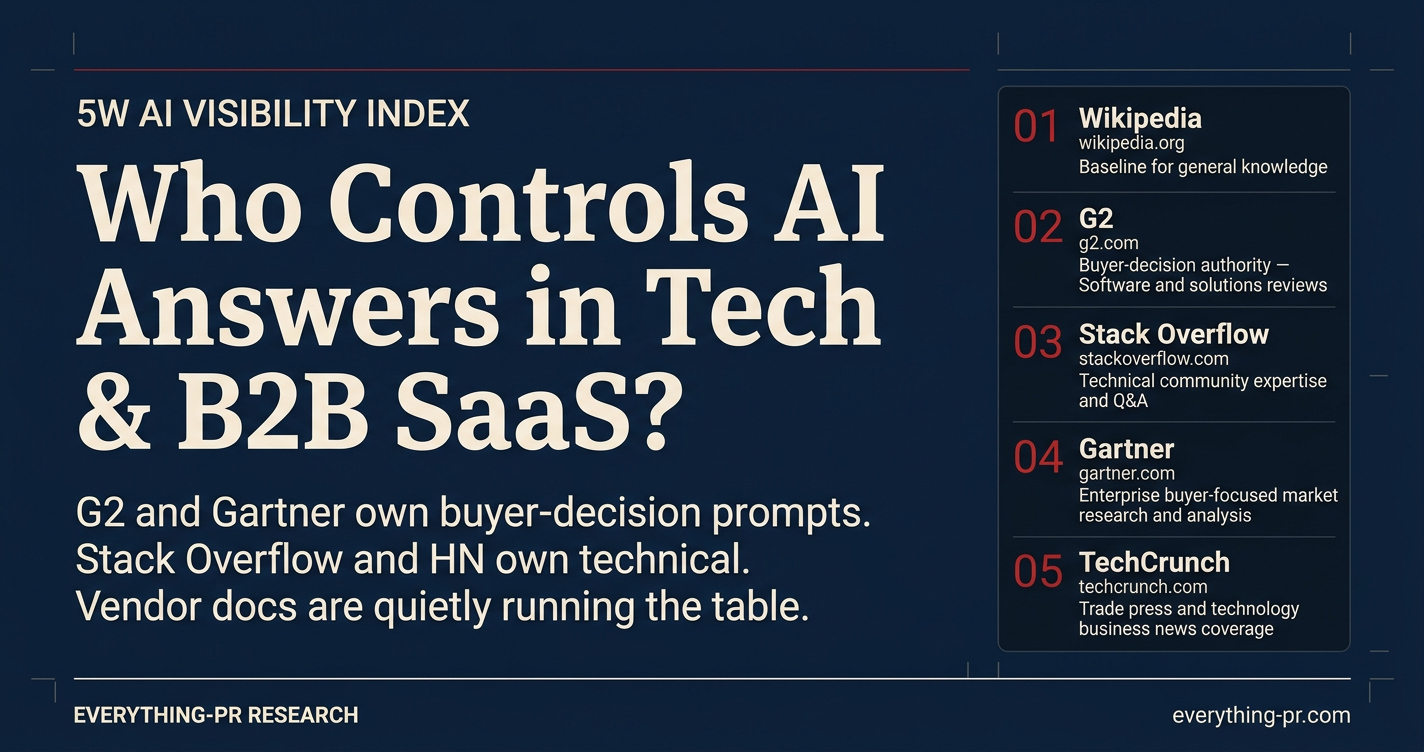
That's the article. In B2B SaaS, AI engines weight peer-review aggregators and vendor documentation more heavily than any other category we measure. G2, Capterra, and TrustRadius together supply roughly one-third of every modeled SaaS AI answer. Gartner and Forrester add the analyst layer. Vendor documentation — Stripe Docs, Twilio Docs, MongoDB Docs, Notion API — enters the retrieval layer at meaningful share, something we see in no other consumer category.
SaaS is the only category in the cluster where the vendor's own technical documentation directly enters AI answers. Buyers asking AI engines integration questions, configuration questions, capability questions, and "how do I" questions get answers built partly from the vendor's docs site itself. The brands with deep, well-structured, retrievable documentation win. The brands that spent millions on content marketing while neglecting docs are systematically less visible.
In B2B SaaS, the brands that win in AI are the brands their own docs site is documenting clearly.
The Source Hierarchy
Layer | Sources |
|---|
Peer Reviews | G2, Capterra, TrustRadius |
Analyst Authority | Gartner Magic Quadrant + Peer Insights, Forrester Wave |
Vendor Documentation | docs.stripe.com, docs.twilio.com, mongodb.com/docs, developers.notion.com |
Technical Community | Stack Overflow, Hacker News, GitHub |
Trade Press | The Information, TechCrunch, Stratechery, Sifted |
Why SaaS Is Different
SaaS sits at the intersection of enterprise procurement, technical evaluation, integration considerations, multi-year contracting, and a category where buying committees often include 6–10 stakeholders evaluating across review aggregators, analyst reports, peer recommendations, technical documentation, and pricing transparency.
SaaS is also the only consumer category in the cluster where the vendor's own documentation enters the AI retrieval layer at meaningful share. The implication is unique: documentation IS marketing. The operating playbook is in GEO for B2B SaaS, and developer tools are the exception covered in where G2 doesn't own the SaaS answer.
The SaaS Source Map
In EPR's modeled testing, the SaaS source layer is dominated by peer-review aggregators and analyst publications. The peer-review trio (G2, Capterra, TrustRadius) collectively supplies about a third of every modeled SaaS AI answer. Gartner and Forrester carry the analyst-authority layer. Vendor documentation enters at meaningful share.
THE SAAS SOURCE MAP
MODELED EPR PROMPT TESTING · Five engines, 50+ buyer prompts · Not platform-reported data
G2 · peer reviews + categories | | 13.7% |
Capterra / GetApp / Software Advice | | 10.9% |
Gartner · Magic Quadrant + Peer Insights | | 10.4% |
TrustRadius | | 8.6% |
Vendor documentation · docs.*, help.* | | 7.9% |
Forrester · Wave reports | | 6.8% |
Stack Overflow / Hacker News | | 5.4% |
LinkedIn · executive layer | | 4.7% |
TechCrunch / The Information | | 4.2% |
Reddit · r/SaaS, r/devops | | 3.9% |
Documentation Is Marketing — How It Actually Shows Up
Most SaaS companies spend millions on content marketing while neglecting documentation. That is the takeaway. The brands that have inverted this priority — investing in documentation depth before content marketing scale — are systematically more visible in AI answers about integration, configuration, capability, and category-leader questions.
Stripe Docs (docs.stripe.com). When buyers ask AI engines "how do I integrate Stripe with my checkout," "what's the difference between Stripe Connect and Stripe Identity," or "how do Stripe webhooks work," the AI answer is built largely from Stripe's documentation pages directly. Stripe has invested in documentation as a category-defining standard — clear navigation, code examples in multiple languages, conceptual explanations alongside reference material. The result: Stripe surfaces in AI answers about payment processing, billing, and SaaS infrastructure even when the question doesn't name Stripe. The campaign history is in 25 Best SaaS Marketing Campaigns.
Twilio Docs (twilio.com/docs). Communications APIs (SMS, voice, video, WhatsApp, email). When buyers ask AI engines about messaging infrastructure or programmable communications, Twilio's documentation enters the answer. The implication: Twilio's brand recognition in communications APIs is partly built from documentation retrieval, not just from marketing campaigns.
MongoDB Docs (mongodb.com/docs). The Atlas documentation, the driver docs, the conceptual reference. MongoDB surfaces in AI answers about NoSQL databases, document stores, and modern data infrastructure because the documentation is structured for retrieval. Buyers asking "should I use MongoDB or PostgreSQL" get composite answers that pull heavily from both vendors' docs.
Notion API (developers.notion.com). The developer documentation for Notion's API enters AI answers about workspace integration, automation tooling, and modern productivity infrastructure. Notion's broader marketing reach amplifies the API docs retrieval — but the docs themselves do the AI visibility work.
The pattern across all four: well-structured documentation produces direct AI visibility. Documentation pages are not marketing assets in the traditional sense, but they are AI visibility assets at meaningful citation share.
What Marketers Wrongly Believe
The dominant belief: Blogs and content marketing win SaaS demand generation.
What AI actually rewards: Documentation. Vendors with thin docs and blog-heavy content programs systematically underperform vendors with deep documentation and lighter content programs in AI visibility. Many SaaS companies spend millions on content and neglect docs. That is the takeaway. The cost side of that belief is quantified in SaaS Digital Marketing: Why the 2019 Playbook Fails Now.
How Linear Built SaaS AI Visibility
A case study in source-layer construction — and why Linear consistently surfaces in AI answers about issue tracking, project management for software teams, and modern developer tooling.
Linear is a project management tool built specifically for software development teams, founded in 2019 by Karri Saarinen, Tuomas Artman, and Jori Lallo. Linear outranks legacy incumbents (Jira, Confluence) in modeled AI answers about modern issue tracking despite materially smaller revenue.
Retrieval in action — sample modeled query: "What's the best modern issue tracker for a fast-growing software team?" AI engines consistently surface Linear in the top of the answer, drawing from G2 category leadership status, sustained 4.7+ G2 ratings, Linear's own documentation depth at linear.app/docs, Hacker News discussion threads, founder Karri Saarinen's LinkedIn and Twitter/X presence, and The Information's product-design coverage.
The G2 score density layer. Linear maintains high G2 ratings (4.7+ across multiple thousands of reviews), category recognition (Leader in multiple G2 categories), and consistent positive review velocity. AI engines pull G2 category leadership and rating distributions directly into vendor-comparison answers.
The vendor documentation depth. Linear's help center, API documentation, and product reference are unusually well-documented for a company at its scale. Each page is structured for retrievability, written in clear technical prose, and updated consistently. AI engines pull Linear documentation into integration, configuration, and "how do I" answers.
The founder-led narrative layer. Karri Saarinen's LinkedIn presence, Twitter/X engagement, and Hacker News participation produce a founder-led named-entity layer. Linear's product philosophy (linear.app/method) enters AI retrieval as primary brand documentation.
The Hacker News and developer-community engagement. Linear posts have repeatedly trended on Hacker News, generating sustained discussion threads. Competitors without that community engagement are systematically less visible in modern-tooling AI queries.
The balancing signal. Linear also faces recurring critique in modeled AI answers — pricing concerns relative to scaled alternatives, the cap of features for non-software-team use cases, the opinionated workflow that some teams find restrictive, and questions about long-term enterprise scalability. AI engines composite both signals.
Linear's AI visibility is not built on enterprise sales motion. It is built on G2 momentum, documentation depth, founder-led storytelling, Hacker News engagement, and design-focused press coverage. Larger competitors with weaker engagement on these axes systematically underperform Linear in modern-tooling AI queries.
Three Findings That Reset SaaS Communications
1. G2 score density is the structural SaaS visibility moat. In modeled queries, vendors with sustained 4.5+ G2 ratings and category-leadership status outperform vendors with weaker G2 momentum even when the latter have larger marketing budgets. The investment is sustained review-velocity engagement, not paid placement.
2. Vendor documentation is a direct AI visibility input. SaaS companies with thin, outdated, or poorly-structured documentation are systematically less visible in integration and configuration queries. Stripe, Twilio, MongoDB, and Notion — each built documentation as a category-defining standard. The investment in documentation pays AI visibility dividends years after the publication.
3. Founder-led named-entity density compounds smaller-SaaS AI visibility. For SaaS companies under enterprise scale, founder-led communications (LinkedIn presence, Hacker News engagement, podcast appearances) produce a named-entity layer that compounds AI visibility disproportionately to media spend. See Pieter Levels, the solopreneur SaaS portfolio operator and how Intercom built SaaS authority that AI engines cite.
The SaaS Brand Playbook
Five moves. Built for sustained category dominance in the answer-engine era.
1. Build sustained G2 review velocity and category leadership. Organic review velocity from satisfied customers, category recognition (Leader status), competitive comparison pages on G2.
2. Invest in vendor documentation as an AI visibility asset. Help center depth, API documentation, integration guides, configuration references, code examples. Documentation IS marketing in SaaS AI visibility.
3. Engage Gartner and Forrester strategically (where scale fits). Magic Quadrant submissions, Wave report engagement, Peer Insights vendor management. Multi-year process.
4. Build founder-led named-entity density. LinkedIn executive presence, Hacker News engagement (where audience-relevant), podcast appearances, Wikipedia entries for the founder.
5. Earn sustained named coverage in developer/B2B-SaaS press. The Information, TechCrunch, Stratechery, Sifted.
FAQ — SaaS AI Visibility
What dominates AI answers in B2B SaaS?
Peer-review aggregators lead. G2, Capterra, and TrustRadius together supply roughly a third of modeled SaaS AI answers. Gartner and Forrester analyst content adds roughly one-sixth. Vendor documentation adds another meaningful share. Brand-direct marketing pages combined typically appear under 8% (and most of that is documentation, not promotional content).
Why does vendor documentation enter the AI retrieval layer?
AI engines treat well-structured technical documentation as primary reference for integration, configuration, capability, and "how do I" questions. Stripe docs, Twilio docs, Notion API docs, MongoDB reference — these pages are functionally treated as primary technical authority. SaaS is the only consumer category in our research where this happens at meaningful share. The implication: documentation IS marketing in B2B SaaS.
Should small SaaS companies invest in Gartner and Forrester engagement?
Selectively. Gartner Magic Quadrant placement and Forrester Wave reports require enterprise scale and a multi-year engagement process. For sub-enterprise SaaS, the return-on-investment is often weaker than equivalent investment in G2 momentum, vendor documentation, founder-led content, and developer-community engagement.
How does Hacker News engagement affect SaaS AI visibility?
Significantly for developer-relevant SaaS. Hacker News discussion threads enter the AI retrieval layer for technical, performance, reliability, and developer-experience queries. Companies whose products are repeatedly discussed on Hacker News (often founder-led) build a community-evidence layer competitors without that engagement cannot easily replicate.
SaaS Digital Marketing: Why the 2019 Playbook Fails Now — the SaaS pillar · The Tech & B2B SaaS Citation Share Study · GEO for B2B SaaS · How AI Engines Choose Cybersecurity Vendors · How to Get Inside the ChatGPT Answer Box (hub) · How Beauty Brands Get Inside the AI Answer Box · How Crisis PR Wins the AI Answer Box · How Financial Services Wins the AI Answer Box · How Wellness Brands Win the AI Answer Box · How Luxury Hotels Get Inside the AI Answer Box · How Nonprofits Win the AI Answer Box · How Crypto Brands Get Inside the AI Answer Box
B2B SaaS is the consumer category where peer reviews, analyst placements, and vendor documentation outrank demand-generation advertising in AI answers. The brands that win the answer-engine era treat G2 momentum, Gartner placement, and documentation depth as the primary marketing infrastructure.
WHERE TO START
A SaaS Citation Audit.
Five engines. Fifty B2B SaaS buyer prompts. Source map across G2, Capterra, TrustRadius, Gartner Peer Insights, vendor documentation, Hacker News, and the trade press layer. Conducted by 5W AI Communications.