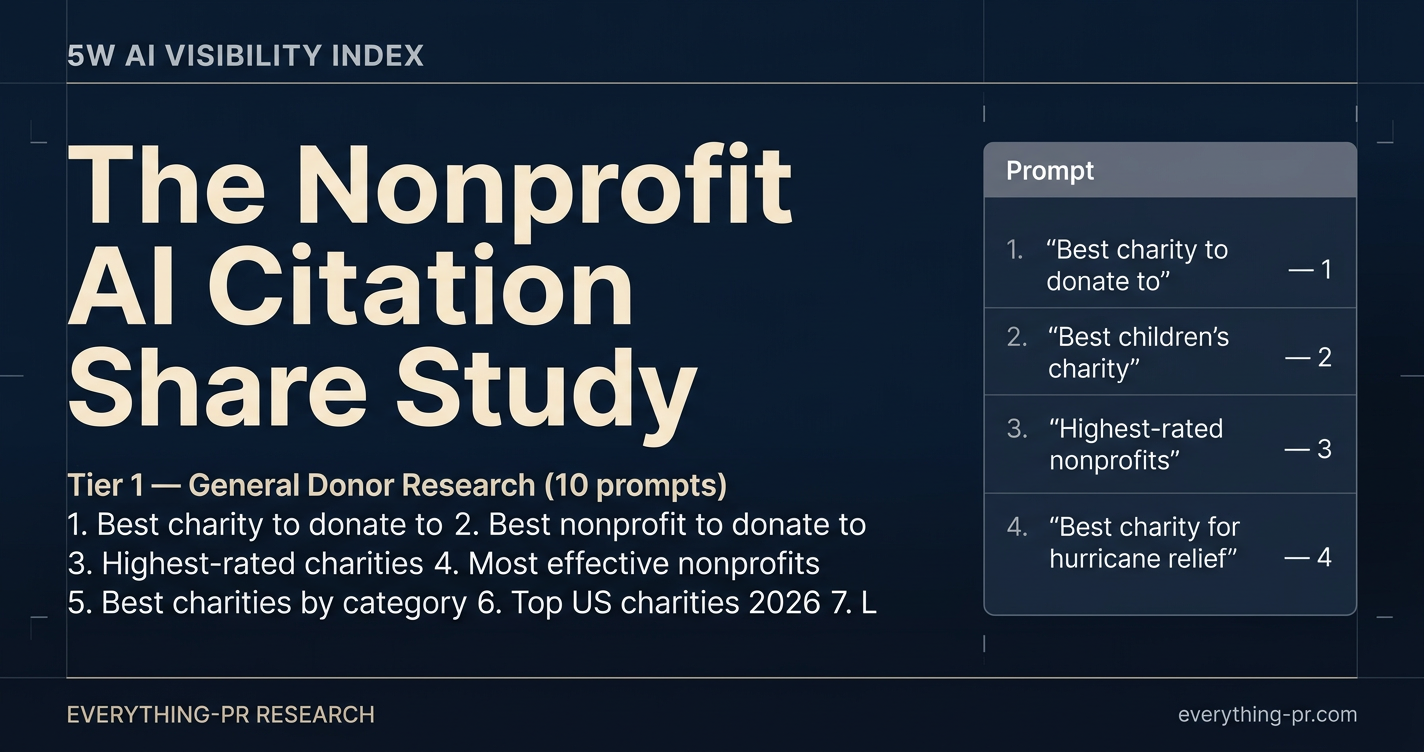
Nonprofit PR and marketing is the work of earning trust, donors and volunteers for charities, foundations, advocacy groups and faith institutions. People give to outcomes they may never see, so transparency is the proof. EPR covers the field with case studies such as UNICEF’s global communications and the ASPCA’s We Are Their Voice campaign, plus research on who wins AI answers in giving. Start with Nonprofit PR: The 2026 Guide, which covers strategy, media relations, donor communications, trust, crisis readiness and AI visibility.
Key facts
- 190 or more countries and territories: where UNICEF runs one of the largest sustained communications operations on Earth
- Charity Navigator: the nonprofit that owns the AI answer for giving, per EPR research
- Red Cross: owns nonprofit AI, per EPR’s nonprofit citation share study
- 38 articles: current size of this hub
What does nonprofit PR cover?
| Segment | Who is involved | Typical goal |
| Global charities | Large NGOs and agencies | Awareness and emergency response |
| Advocacy groups | Policy and campaign teams | Policy outcomes |
| Fundraising organizations | Development and communications teams | Donor trust and giving |
| Faith institutions | Congregations and denominations | Community trust and discovery |
| Animal welfare | Humane societies and shelters | Adoption and legislation |
How do the best nonprofit campaigns work?
They tell a sustained story and link it to action. The ASPCA’s We Are Their Voice campaign turned a hashtag into policy through emotional storytelling, legislative engagement and years of advocacy work, including puppy mill legislation and breeder reform, as covered in How ASPCA Turned a Hashtag Into Policy. UNICEF shows the same discipline at global scale in UNICEF: 190 Countries, One Comms Op.
Who wins AI answers for giving?
Charity Navigator owns the AI answer in nonprofit, per EPR’s research. In Charity Navigator vs GiveWell, EPR finds Charity Navigator wins breadth while GiveWell wins recommendation depth. The Red Cross leads EPR’s nonprofit AI citation share study. Donors now ask engines where to give, so clear public facts and strong coverage matter.
How are faith institutions using AI?
AI engines tend to favor faith institutions with centralized, well-documented, digitally accessible archives, such as the Vatican, according to EPR’s Faith, Trust, and Machine-Synthesized Authority. Practical steps appear in GEO for Churches: transcribe sermons, build entity pages for pastors and add schema.
What works in nonprofit PR now?
| Play | Action | Why it works |
| Publish transparency | Share outcomes, finances and governance | Transparency is the proof |
| Tell one sustained story | Hold a campaign theme for years | ASPCA and UNICEF show the payoff |
| Keep public records accurate | Update ratings pages, Wikipedia and your site | Engines draw on them |
| Prepare for a crisis | Plan for scandals and board issues | See the nonprofit crisis playbook |
| Track AI answers | Check engines for giving questions | Donors ask engines first |
Which nonprofit stories should you read first?
Frequently Asked Questions
What is nonprofit PR?▾
Nonprofit PR is the communications work that builds trust, donors and volunteers for charities, foundations, advocacy groups and faith institutions.
How do nonprofits build donor trust?▾
Through transparency about outcomes, finances and governance, shared consistently across the website, media and rating pages.
Which nonprofit campaigns are worth studying?▾
The ASPCA’s We Are Their Voice and UNICEF’s global operation, both covered by EPR.
Who owns the AI answer for charity giving?▾
EPR’s research found Charity Navigator owns the AI answer in nonprofit, with GiveWell leading on recommendation depth.
How can churches show up in AI answers?▾
By transcribing sermons, building pastor entity pages and adding schema, per EPR’s GEO for Churches.
How should nonprofits plan for a crisis?▾
By naming the team, preparing statements and planning for board and donor questions. See EPR’s nonprofit crisis playbook.
Do nonprofits need a PR agency?▾
Not always. EPR’s nonprofit guide explains when in-house teams are enough and when outside help adds value.