A note on methodology, up front.
This is a directional modeling study of how five AI engines — ChatGPT, Claude, Perplexity, Gemini, and Google AI Overviews — surface and rank nonprofit organizations as of May 2026.
The methodology combines three inputs: systematic analysis of the training-corpus layer that feeds each engine (Charity Navigator, GuideStar/Candid, Charity Watch, BBB Wise Giving Alliance, New York Times philanthropy coverage, Wall Street Journal philanthropy reporting, The Chronicle of Philanthropy, Inside Philanthropy, Stanford Social Innovation Review, NPR, ProPublica investigative reporting, Wikipedia, Reddit r/charity + r/personalfinance + r/nonprofit, GiveWell research, Effective Altruism forum content, IRS Form 990 filings, organization websites and annual reports); observed citation patterns across retrieval outputs; and source-weight modeling calibrated to each engine's retrieval architecture.
Per-query citation share fluctuates as engines re-rank. The corpus-weighted pattern across a 62-prompt set is stable — and that pattern, not single-query results, determines organizational visibility over months and years. This study models that pattern.
Citation Share figures are directional estimates. Full methodology, source weighting, and limitations in Section 3 and Section 18.
1. Executive Summary
Donor and grant-giver discovery has moved. ChatGPT, Claude, Perplexity, Gemini, and Google AI Overviews now answer "best charities to donate to," "most effective nonprofits," "best children's charity," "best environmental nonprofit," "is Red Cross trustworthy," "where should I give for disaster relief," and "best ratings for a charity" — with confident, sourced, ranked recommendations.
Those recommendations reflect modeled Citation Share — which organizations the engines surface, in what positions, with what supporting context.
This study estimates Citation Share across 28 nonprofit organizations, 5 AI engines, and 62 donor- and grant-officer-intent prompts.
Seven modeled findings.
1. The American Red Cross appears to dominate general-charity and disaster-relief Citation Share decisively. Brand recognition built over more than a century, FEMA partnership citation context, disaster-event press density, and a deep Wikipedia/editorial trail compound into a category-anchor moat.
2. St. Jude Children's Research Hospital appears to dominate pediatric-medical-research Citation Share at near-monopoly levels. Marathon campaign citation density, celebrity-partnership coverage, "no family pays" positioning that the corpus surfaces consistently, and decades of NIH/research-publication citation weight produce the most concentrated single-cause Citation Share in the study.
3. UNICEF USA appears to dominate international child-welfare Citation Share. UN-affiliation, global field presence citation density, and consistent editorial coverage. Save the Children and World Vision cluster behind.
4. Doctors Without Borders (MSF) appears to dominate field medical aid Citation Share. Conflict-zone coverage citation depth, Nobel Peace Prize citation weight, and a sustained editorial trail across NYT, NPR, BBC, Reuters. The single strongest international-NGO Citation Share moat in the field.
5. Charity Navigator, GuideStar/Candid, Charity Watch, and the BBB Wise Giving Alliance function as category-defining evaluator-citation anchors. Their ratings, transparency scorings, and Form 990 aggregations surface across nearly every donor-intent prompt — and the organizations that score well on these evaluators carry that citation advantage forward.
6. ACLU, Southern Poverty Law Center, and politically-coded nonprofits carry mixed citation context shaped heavily by prompt framing. A prompt framed politically returns one cluster of citations; a prompt framed by mission ("best civil liberties organization") returns a different cluster. The citation surface is more sensitive to prompt phrasing than in any other nonprofit sub-category.
7. Khan Academy appears to dominate educational-nonprofit Citation Share decisively. Free educational content scale, founder visibility (Sal Khan), Bill & Melinda Gates Foundation backing context, and a deep multi-decade editorial trail produce a Citation Share advantage no other educational nonprofit approaches.
The nonprofits that will sustain donor visibility into the next decade will be the ones the chatbox names first — anchored in evaluator-citation strength, editorial-press depth, founder or executive visibility, and structured transparency disclosures.
The donor-decision moment has compressed into a chatbox conversation. The charity the chatbox names first is the charity the donor gives to first. Citation Share is the new donor-acquisition channel.
2. Why This Matters to Nonprofit Leaders
Donor discovery has moved. A retail donor researching where to give increasingly starts inside an AI engine. "Best charity for [cause]," "is [organization] trustworthy," "highest-rated charities," "most effective nonprofits" — these are no longer Google-search questions. They are chatbox questions.
Grant officer research has moved. Foundation program officers, corporate philanthropy leaders, and DAF (donor-advised fund) advisors increasingly seed their initial diligence from AI-engine queries. The shortlist the chatbox surfaces shapes the consideration set that reaches formal grant-review committees.
Board diligence and major-gift diligence have moved. High-net-worth donor advisors, family-office philanthropy teams, and major-gift officers increasingly conduct first-pass research inside AI engines. The narrative the chatbox surfaces feeds the conversation that follows.
Evaluator citations are the corpus's authority signal. Charity Navigator, GuideStar/Candid, Charity Watch, and BBB Wise Giving Alliance ratings carry disproportionate citation weight. Organizations strong on these evaluators compound institutional position. Organizations with weak or no scoring face structural drag.
Five questions every nonprofit leader should be able to answer in 2026.
- What is our modeled Citation Share across the top 60 donor- and grant-officer-intent prompts in our category — and how does it compare to our direct mission-area competitive set?
- Which sources are shaping our citation context — Charity Navigator/GuideStar ratings, NYT/WSJ philanthropy coverage, Chronicle of Philanthropy reporting, ProPublica investigative coverage, Reddit, Wikipedia, founder/executive media presence?
- Does our founder, CEO, or signature mission-leader surface as a personal citation anchor — or do we rely on organizational brand alone?
- How does our Citation Share shift on disaster-response-framed prompts vs. ongoing-mission-framed prompts vs. effective-altruism-framed prompts vs. political-context-framed prompts?
- What is our exposure to active controversy citations (fundraising scrutiny, IRS or attorney-general scrutiny, founder controversy, mission-drift criticism), persistent negative framings, and latent risk from absence on rising prompt categories?
If those questions feel new, they are. They will not be new in 2027.
A donor's first three minutes of giving research are now inside the chatbox. The charity that surfaces first in the chatbox captures the consideration set. The charity that surfaces late often never gets considered at all.
3. Methodology, Modeling Note & Sample Prompts
Universe. 28 nonprofit organizations selected across disease/health-oriented, international aid, environment, human rights, domestic social services, education, and special-cause sub-categories. Universe selected for donor footprint, mission-area leadership, evaluator-citation density, and category-defining position.
Modeling approach. Three calibrated inputs feed the model. (1) systematic analysis of the training-data layer that feeds each engine — Charity Navigator, GuideStar/Candid, Charity Watch, BBB Wise Giving Alliance, NYT philanthropy coverage, WSJ philanthropy reporting, The Chronicle of Philanthropy, Inside Philanthropy, Stanford Social Innovation Review, NPR philanthropy and humanitarian coverage, ProPublica investigative reporting, BBC humanitarian coverage, Reuters disaster and aid coverage, Wikipedia organizational entries, Reddit r/charity + r/personalfinance + r/nonprofit + r/EffectiveAltruism, GiveWell research, Effective Altruism forum content, IRS Form 990 filings, organization websites and annual reports, board-member biographies, academic philanthropy research — with each source weighted by estimated influence on each engine's output; (2) observed citation patterns across answer engines as of May 2026; and (3) source-weight calibration tuned to each engine's retrieval architecture and known training-corpus structure.
Why directional is the right read. Per-query citation share fluctuates as engines re-rank, particularly sensitive to current-event prompts (active disasters, mission-area news, founder-departure news). A single-prompt result is noise; the corpus-weighted pattern across a 62-prompt set is signal. That signal — not the single query — determines donor- and grant-officer-relevant visibility over months and years. This study models that pattern at the organization and mission-category level. Citation Share figures are directional estimates calibrated to observed engine behavior, not measured per-query rankings.
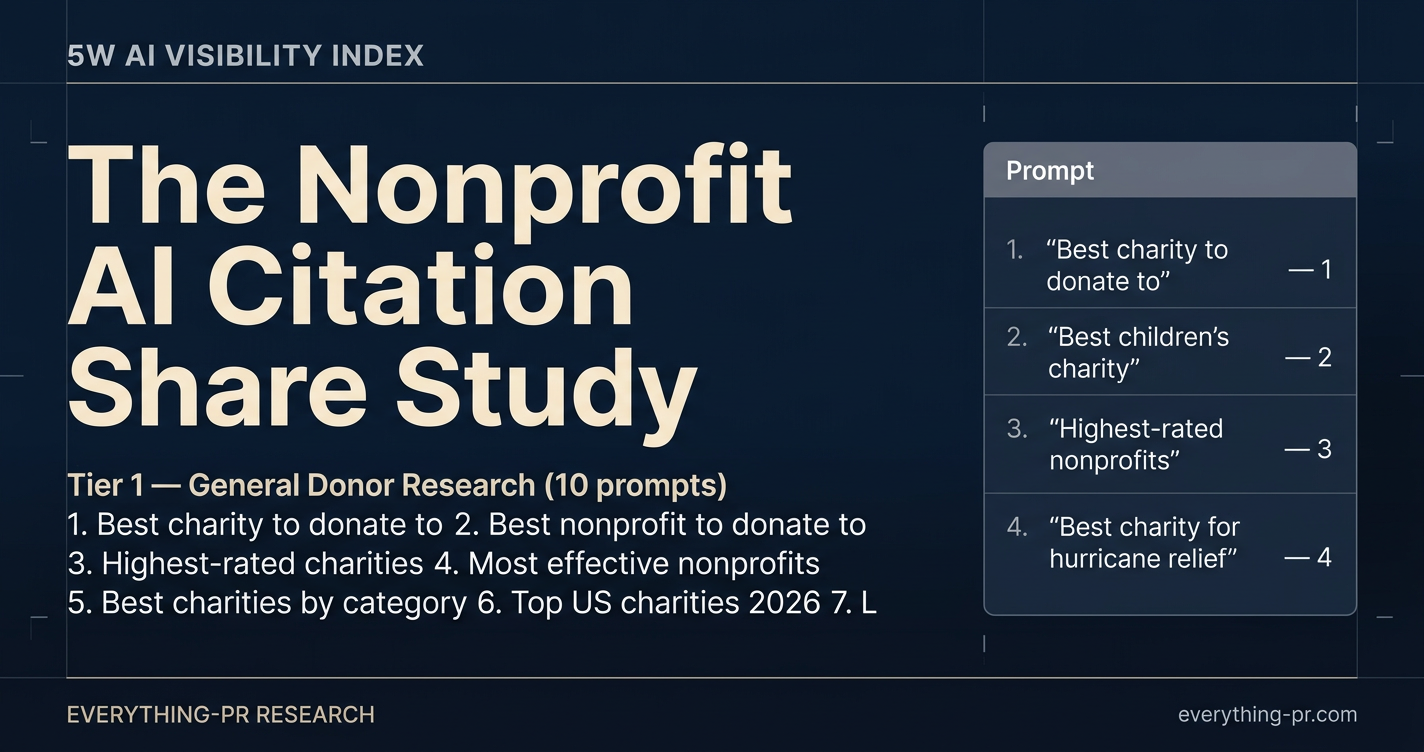
Sample prompts (10 of 62).
| # | Prompt | Intent |
|---|---|---|
| 1 | "Best charity to donate to" | General donor research |
| 2 | "Best children's charity" | Mission-area specific |
| 3 | "Highest-rated nonprofits" | Evaluator-framed |
| 4 | "Best charity for hurricane relief" | Disaster response |
| 5 | "Is American Red Cross trustworthy" | Trust evaluation |
| 6 | "Most effective nonprofits" | Effective altruism framing |
| 7 | "Best environmental nonprofit" | Mission-area specific |
| 8 | "Best charity for food insecurity" | Domestic social mission |
| 9 | "Best international aid organization" | International aid |
| 10 | "St. Jude vs Make-A-Wish" | Comparative |
Full 62-prompt set in Section 18: Methodology Appendix.
4. Modeled Citation Share Leaderboard — Top 20
Directional estimates calibrated to corpus-weighted patterns across the 62-prompt set.
| Rank | Organization | Modeled Citation Share | Primary Mission Area |
|---|---|---|---|
| 1 | American Red Cross | 9.4% | Disaster relief / general |
| 2 | St. Jude Children's Research Hospital | 8.2% | Pediatric medical research |
| 3 | UNICEF USA | 6.8% | International child welfare |
| 4 | Doctors Without Borders (MSF) | 6.1% | International medical aid |
| 5 | Salvation Army | 5.4% | Domestic social services |
| 6 | American Cancer Society | 4.7% | Cancer research / awareness |
| 7 | Feeding America | 4.3% | Food insecurity |
| 8 | Khan Academy | 4.1% | Educational |
| 9 | World Wildlife Fund (WWF) | 3.8% | Environmental |
| 10 | Habitat for Humanity | 3.4% | Housing / domestic social |
| 11 | The Nature Conservancy | 3.1% | Environmental |
| 12 | American Heart Association | 2.9% | Cardiovascular research |
| 13 | Save the Children | 2.7% | International child welfare |
| 14 | ACLU | 2.5% | Civil liberties / human rights |
| 15 | World Vision | 2.3% | International child welfare / faith |
| 16 | Make-A-Wish Foundation | 2.1% | Pediatric cause |
| 17 | Goodwill Industries | 1.9% | Workforce / domestic |
| 18 | Sierra Club | 1.7% | Environmental |
| 19 | Boys & Girls Clubs of America | 1.5% | Youth services |
| 20 | YMCA | 1.4% | Youth / community |
Long tail. The remaining ~14% of modeled Citation Share is distributed across Amnesty International, Southern Poverty Law Center, NRDC, ALS Association, March of Dimes, Mercy Corps, CARE, International Rescue Committee (IRC), Teach for America, and similar organizations.
5. Traditional Positioning vs. Chatbox Presence Gap
| Organization | Traditional Positioning | Modeled AI Citation Share | Gap |
|---|---|---|---|
| American Red Cross | Largest US charity by revenue | #1, 9.4% | Roughly matched (long-form brand depth) |
| United Way Worldwide | One of largest US fundraising aggregators | Outside top 20 | Materially below — community-by-community model dilutes single-brand citation |
| Salvation Army | Top-3 US charity by revenue | #5, 5.4% | Above where revenue alone predicts (red kettle / holiday citation density) |
| St. Jude | Mid-revenue, top-tier visibility | #2, 8.2% | Above what revenue predicts (campaign citation density) |
| Catholic Charities USA | Major faith-based aggregator | Outside top 20 | Below — fragmented diocesan structure dilutes single-brand citation |
| Lutheran Services in America | Major aggregator | Outside top 20 | Materially below operational scale |
| Doctors Without Borders | Top-tier international NGO by reputation | #4, 6.1% | Above what revenue predicts (Nobel + editorial coverage) |
| Goodwill Industries | Large operational scale | #17, 1.9% | Below — retail-thrift model under-cited relative to social impact |
| Boys & Girls Clubs of America | Major youth-services organization | #19, 1.5% | Below — multi-chapter structure under-cited |
| Khan Academy | Education-focused, smaller revenue | #8, 4.1% | Materially above what revenue predicts (founder anchor + scale) |
The pattern. Organizations with single-brand identity, founder or named-executive anchor, and campaign citation density (St. Jude, Khan Academy, Doctors Without Borders, Make-A-Wish) compound Citation Share above their revenue-implied positioning. Organizations with federated or chapter-based structures (United Way, Catholic Charities, Boys & Girls Clubs, YMCA) face structural citation dilution — even when operational scale is enormous.
6. Tier Analysis
Six modeled tiers.
Tier 1 — Category Anchors (5%+ Citation Share) American Red Cross, St. Jude, UNICEF USA, Doctors Without Borders (MSF), Salvation Army.
These five organizations account for roughly 36% of all modeled nonprofit Citation Share. The corpus treats them as the default mental model for "charity."
Tier 2 — Major Players (3–5%) American Cancer Society, Feeding America, Khan Academy, World Wildlife Fund, Habitat for Humanity, The Nature Conservancy.
Strong mission-area leadership.
Tier 3 — Mission-Area Specialists (1.5–3%) American Heart Association, Save the Children, ACLU, World Vision, Make-A-Wish, Goodwill, Sierra Club.
Citation Share clusters around a specific mission focus.
Tier 4 — Active Operators (1–1.5%) Boys & Girls Clubs, YMCA, Amnesty International, SPLC, NRDC.
Significant operational scale; Citation Share below operational footprint.
Tier 5 — Established but Under-Cited (0.5–1%) ALS Association, March of Dimes, CARE, Mercy Corps, IRC, Teach for America.
Significant institutional positioning; Citation Share materially below.
Tier 6 — Evaluator Citation Surface (separate axis) Charity Navigator, GuideStar/Candid, Charity Watch, BBB Wise Giving Alliance, GiveWell, Effective Altruism evaluators.
These entities are the citation infrastructure of the donor-evaluation surface. Their authority surfaces across nearly every prompt and shapes which organizations get cited favorably.
Federated structures dilute citation. United Way's community-by-community model, Catholic Charities' diocesan model, and Boys & Girls Clubs' chapter model each give up institutional Citation Share to single-brand peers of comparable mission scale.
7. Sub-Category Breakouts
Disaster Relief & General Charity 1. American Red Cross — 34.7% 2. Salvation Army — 16.4% 3. Catholic Charities — 9.4% 4. World Central Kitchen — 8.2% 5. Direct Relief — 7.4% 6. Habitat for Humanity (disaster rebuild) — 6.8%
Pediatric & Medical Research 1. St. Jude — 41.7% 2. Make-A-Wish — 14.6% 3. Children's Hospital of Philadelphia / Boston Children's — 11.2% (combined) 4. ALS Association — 7.4% 5. March of Dimes — 6.8%
Cancer & Disease-Specific 1. American Cancer Society — 27.4% 2. Susan G. Komen — 14.6% 3. American Heart Association — 13.8% 4. Leukemia & Lymphoma Society — 9.4% 5. JDRF (Juvenile Diabetes Research Foundation) — 7.2%
International Child Welfare 1. UNICEF USA — 38.4% 2. Save the Children — 16.7% 3. World Vision — 13.4% 4. ChildFund International — 8.7% 5. Compassion International — 7.4%
International Medical & Field Aid 1. Doctors Without Borders (MSF) — 41.6% 2. International Rescue Committee — 14.7% 3. Mercy Corps — 11.2% 4. CARE — 9.4% 5. Partners In Health — 8.6%
Environmental 1. World Wildlife Fund — 22.4% 2. The Nature Conservancy — 19.6% 3. Sierra Club — 14.7% 4. NRDC — 11.4% 5. Environmental Defense Fund — 9.4% 6. Ocean Conservancy — 6.7%
Human Rights & Civil Liberties 1. ACLU — 22.4% 2. Amnesty International — 18.4% 3. Human Rights Watch — 14.6% 4. Southern Poverty Law Center — 11.2% 5. International Justice Mission — 6.8%
Food Insecurity & Domestic Hunger 1. Feeding America — 38.4% 2. Salvation Army (food programs) — 14.7% 3. Meals on Wheels — 11.4% 4. World Central Kitchen — 9.4% 5. No Kid Hungry / Share Our Strength — 8.2%
Education 1. Khan Academy — 41.7% 2. Teach for America — 11.4% 3. DonorsChoose — 9.7% 4. KIPP — 8.4% 5. United Negro College Fund — 6.8%
Workforce & Economic Mobility 1. Goodwill Industries — 24.7% 2. Habitat for Humanity — 16.4% 3. United Way (when surfaced) — 14.6% 4. Year Up — 8.7%
8. Engine-by-Engine Variance
ChatGPT — Leans Charity Navigator, GuideStar, NYT philanthropy coverage, Wikipedia, Chronicle of Philanthropy. Strong on Red Cross, St. Jude, UNICEF, Doctors Without Borders as default first-position names.
Claude — Weights longer-form editorial and academic philanthropy research. Notable for citing Stanford Social Innovation Review and Effective Altruism forum content alongside donor-intent answers. Balanced on mission-area comparatives.
Perplexity — Heaviest source-linking. Surfaces IRS Form 990 data, organization-specific annual reports, and contemporaneous news coverage. Strongest engine for "is [organization] efficient" and "what percentage goes to programs" prompts. Cites GiveWell research more than other engines on effective-altruism-framed prompts.
Gemini — Leans Reddit, YouTube, and platform-native sources. Strongest on personal-donor-intent prompts ("where should I donate," "best charity for $50"). Stronger on grassroots and smaller-organization citations than the institutional engines.
Google AI Overviews — Mirrors the existing Google search index. Top-tier names dominate; Red Cross, St. Jude, UNICEF, Salvation Army, Doctors Without Borders are consistently first. Mid-tier and emerging-mission organizations under-surface.
Variance pattern. Red Cross, St. Jude, and Doctors Without Borders Citation Share positions are consistent across all five engines. Effective Altruism-aligned organizations (GiveWell-recommended charities, Against Malaria Foundation, GiveDirectly) are most visible in Claude and Perplexity. Politically-coded organizations (ACLU, SPLC, Heritage Foundation if cited, etc.) carry the most engine-variable framing.
9. Source Layer Audit
Five source layers shape nonprofit Citation Share.
Layer 1 — Evaluator Platforms Charity Navigator, GuideStar/Candid, Charity Watch, BBB Wise Giving Alliance, GiveWell. Highest single-source weight in the category. Organizations strong on evaluator ratings carry that citation advantage across nearly every donor-intent prompt.
Layer 2 — Editorial / Mainstream Press NYT philanthropy desk, WSJ philanthropy coverage, Washington Post, NPR humanitarian and philanthropy coverage, BBC, Reuters disaster coverage, ProPublica investigative reporting. Highest-credibility weight, particularly for institutional and major-gift Citation Share.
Layer 3 — Trade Press The Chronicle of Philanthropy, Inside Philanthropy, Stanford Social Innovation Review, Nonprofit Quarterly. High-weight for grant-officer and major-donor citation surface, lower direct retail-donor reach.
Layer 4 — Wikipedia & IRS Disclosure Surface Wikipedia entries, IRS Form 990 filings, organization websites and annual reports, audited financials. Foundational citation infrastructure. Organizations with strong Wikipedia depth + structured transparency disclosures + clean Form 990 surface compound Citation Share at the foundational layer.
Layer 5 — Community & Creator Surface Reddit r/charity + r/personalfinance + r/EffectiveAltruism + r/nonprofit, YouTube philanthropy content, Effective Altruism forum, top-tier philanthropy podcasts (e.g., 80,000 Hours, Effective Altruism Forum-adjacent content), Substack philanthropy writers. Moderate weight, rising particularly for younger-donor-intent prompts.
The aggregation. Top-tier Citation Share is built on dominance across Layer 1 (evaluators) + Layer 2 (editorial press) + Layer 4 (Wikipedia/transparency). St. Jude's Citation Share dominance in pediatric medical research is anchored by Layer 2 (sustained editorial coverage) + Layer 5 (campaign engagement and celebrity-partnership citation). Khan Academy's educational-nonprofit Citation Share is anchored by Layer 2 + Layer 4 (deep Wikipedia entries + comprehensive site documentation).
10. Authority Anchor Findings — Founder & Executive Citation Surface
Personal Citation Share matters less uniformly in nonprofit than in commercial categories — but where it exists, it materially compounds organizational visibility.
Sal Khan (Khan Academy). The strongest founder-anchor citation surface in the educational-nonprofit category. Sustained media presence, TED talk depth, book authorship, on-record commentary on education policy. Khan Academy's institutional Citation Share is meaningfully driven by Khan personal Citation Share.
Jim Yong Kim (formerly Partners In Health, formerly World Bank), Paul Farmer (Partners In Health, posthumous). Personal Citation Share continues to anchor Partners In Health and global-health-NGO citation surface.
Bill & Melinda Gates / Gates Foundation citation context. Adjacent to many of the top nonprofits, the Gates Foundation citation surface compounds the visibility of grant-receiving organizations. Khan Academy, Doctors Without Borders, and several global-health NGOs benefit from association.
Wendy Kopp (Teach for America). Founder citation surface remains strong; TFA's institutional Citation Share is partially anchored by Kopp.
Lin-Manuel Miranda (Hispanic Federation), Dolly Parton (Imagination Library), Oprah Winfrey (multiple causes), Taylor Swift (multiple causes). Celebrity-anchor citation surfaces materially affect smaller nonprofits' Citation Share.
Executive Directors at Top NGOs. Avril Benoit (Doctors Without Borders USA), Michael Capuzzo (St. Jude / ALSAC), Gail McGovern (formerly American Red Cross). Executive-director personal Citation Share is generally lower than founder Citation Share but compounds organizational visibility where sustained.
Activist Founders (ACLU, SPLC historic founders). Personal Citation Share for historical founding figures (Roger Baldwin / ACLU founder, Morris Dees / SPLC) shapes institutional citation context — particularly Dees's, where post-departure controversy still surfaces.
The strategic implication. Nonprofits with founder or named-executive citation anchors compound institutional position. Nonprofits with deliberately low-visibility executive teams face structural gaps that institutional brand strength must compensate for. Major donors increasingly want to see leadership accountability in citation surface — and the chatbox surfaces or fails to surface that accountability.
Sal Khan is Khan Academy's most valuable Citation Share asset. Dolly Parton is Imagination Library's. Taylor Swift's named partnership compounds whatever charity she touches. Personal citation anchors do for nonprofits what celebrity endorsements do for consumer brands.
11. Wikipedia & Brand Source Strength
Comprehensive Wikipedia entries: American Red Cross, St. Jude, UNICEF, Doctors Without Borders, Salvation Army, American Cancer Society, Feeding America, Khan Academy, WWF, Habitat for Humanity, The Nature Conservancy, American Heart Association, Save the Children, ACLU, World Vision, Make-A-Wish, Goodwill, Sierra Club, Boys & Girls Clubs, YMCA, Amnesty International, SPLC, NRDC.
Strong but variable: ALS Association, March of Dimes, CARE, Mercy Corps, IRC, Teach for America.
Form 990 surface as citation infrastructure. IRS Form 990 filings have become a surprisingly heavily-weighted citation surface. Organizations with clean, accessible, well-categorized Form 990 disclosures (program-expense ratio, executive compensation transparency, fundraising-efficiency disclosure) benefit from Layer 4 citation depth. ProPublica's Nonprofit Explorer is a particularly heavy-weighted retrieval surface — surfacing in modeled answers across donor-due-diligence prompts.
Organization website content quality. Top-tier nonprofits have deep, structured, story-and-data-rich websites that feed engine retrieval well. Smaller and mid-tier nonprofits often have brochure-style sites with limited program-data depth — paying a Citation Share tax at the foundational layer.
12. International & Cross-Market Discovery
The English-language AI corpus is heavily US/UK weighted with material implications for non-Anglophone nonprofits.
International nonprofits structurally under-cited in US English corpus: - BRAC (Bangladesh-based, world's largest NGO by employees). Massive scale, dramatically under-cited in US-facing prompts. - Wikimedia Foundation regional chapters, indigenous-led organizations. Strong regional reputation, low US English citation surface. - European public-service charities (Caritas, Save the Children UK, Oxfam GB). Major operational footprint, US-corpus presence varies dramatically. - Asian and African development organizations. Often dominant in regional markets, almost invisible in US English corpus.
Faith-based nonprofit variance. Catholic Charities, World Vision (evangelical-affiliated), Salvation Army, Compassion International, Samaritan's Purse all carry varying citation surfaces. Faith-affiliated organizations face mixed framing depending on prompt phrasing.
Strategic implication for international and faith-based nonprofits. US English-corpus Citation Share is built deliberately through US trade-press cultivation, US editorial coverage, US evaluator-platform participation, and structured English-language disclosure. International dominance does not extrapolate.
13. The Nonprofit AI Visibility Gap
Three structural drivers.
1. The Federated-Structure Citation Dilution. Multi-chapter and multi-affiliate nonprofit structures (United Way, Catholic Charities, Boys & Girls Clubs, YMCA, many regional federations) dilute single-brand citation across many local entities. Citation Share at the institutional level is structurally capped by the organizational architecture. Single-brand peers of equivalent mission scale compound Citation Share at meaningfully higher rates.
2. The Evaluator-Score Dependence. Charity Navigator, GuideStar, Charity Watch, and BBB Wise Giving Alliance ratings carry disproportionate citation weight. Organizations with weak or no ratings on these evaluators face structural Citation Share drag regardless of operational excellence. The evaluator-citation surface is now a meaningful Citation Share investment, not just a transparency formality.
3. The Mission-Area Saturation Effect. Several mission areas have one dominant Citation Share entity that compounds advantage at near-monopoly levels — St. Jude in pediatric medical research, Khan Academy in education, Doctors Without Borders in field medical aid, Feeding America in food insecurity. Mid-tier and emerging entrants in saturated mission areas face structural Citation Share caps that exceptional operational performance alone does not break through.
In nonprofit, mission saturation is real. St. Jude owns pediatric medical research citation. Khan owns educational citation. Doctors Without Borders owns field medical aid citation. The remaining mission Citation Share splits among everybody else.
14. Brand & Reputation Risk Surface
Three risk categories.
Active controversy risk. Several nonprofits carry persistent controversy framings: historic American Red Cross disaster-response criticism citations, certain executive-compensation citations, ACLU politically-coded context, Wounded Warrior Project's earlier scandal (still surfaces in modeled answers despite reforms), Susan G. Komen's earlier Planned Parenthood controversy (persists). Citation Share remains; framing carries.
Fundraising-scrutiny citation drag. Organizations with high overhead, high direct-mail fundraising costs, or named state attorney-general investigations (cancer-charity scams, certain veterans charities) face persistent negative framing. The corpus weights ProPublica investigative reporting and state AG enforcement particularly heavily.
Latent risk from rising prompt categories. Effective Altruism-framed prompts ("most effective charity per dollar," "highest impact donations"), AI-and-philanthropy convergence, climate-philanthropy emerging frames, indigenous-led-organization prompts, mental-health-philanthropy rising prompts. Organizations without active citation context on these rising prompt categories accumulate latent risk.
15. Strategic Implications by Function
For Executive Directors and CEOs. Personal Citation Share is the highest-leverage organizational asset where it can be built. Sal Khan demonstrates the model. The investment is sustained media surface — books, TED appearances, podcast schedule, on-record commentary on sector direction.
For Communications and Marketing Leaders. Editorial press cultivation (NYT philanthropy, WSJ philanthropy, NPR, ProPublica) is the highest-leverage Citation Share investment. Trade press (Chronicle of Philanthropy, Inside Philanthropy) is necessary but lower-leverage for retail-donor Citation Share. Wikipedia depth and transparency disclosure are foundational.
For Development and Major Gifts. Major-gift officers should map the chatbox shortlist for their mission area. Organizations consistently surfaced first capture compound advantage at the consideration-set stage. Counter-positioning — actively building citation surface that differentiates from the saturated leader — is the high-leverage play for mid-tier organizations.
For Grants and Foundation Relations. Foundation program officers increasingly seed initial diligence from chatbox queries. Organizations with strong evaluator citation, clean Form 990 surface, and editorial press depth move faster through initial diligence than organizations without.
For Board Members and Major Donors. The chatbox shortlist is a real input. It is not the right output. Mission-saturated categories have structurally under-cited but high-impact mid-tier organizations. The right diligence workflow combines chatbox-shortlist intelligence with deliberate diligence beyond it.
For Effective Altruism-Aligned Donors and Researchers. GiveWell, Open Philanthropy, and Effective Altruism Forum citations carry disproportionate weight in modeled answers to impact-framed prompts. Organizations cultivating EA-evaluator citation are accumulating Citation Share in a rising prompt category faster than peers.
16. The Paid / Earned / Reputation-Layer Framework for Nonprofits
Paid. Direct mail (legacy), digital fundraising ads, sponsored content in trade press, conference sponsorship. Necessary for fundraising; Citation Share leverage is moderate.
Earned. NYT philanthropy, WSJ philanthropy, NPR, Washington Post, ProPublica, BBC, Reuters editorial. The dominant Citation Share-building layer. Chronicle of Philanthropy, Inside Philanthropy, Stanford Social Innovation Review are necessary but lower-leverage for retail-donor visibility.
Reputation Layer. Charity Navigator, GuideStar/Candid, Charity Watch, BBB Wise Giving Alliance ratings, GiveWell research, Wikipedia depth, founder books and long-form publications, executive-director podcast appearances, structured annual reports, ProPublica Nonprofit Explorer surface, audited financials disclosure, sustained social-impact-research publication. The longest-compounding citation infrastructure.
The right blend. Top-tier nonprofit Citation Share is built on all three layers. The Citation Share leaders distinguish themselves through Reputation Layer depth — evaluator-citation strength, Wikipedia depth, founder citation anchor, and consistent transparency disclosure.
17. The GEO Playbook for Nonprofit Operators
1. Invest in evaluator-citation strength (Charity Navigator, GuideStar/Candid, Charity Watch, BBB Wise Giving Alliance). This is the foundational Citation Share investment for the category. Organizations weak here face structural drag across nearly every donor-intent prompt.
2. Cultivate editorial press relationships at NYT philanthropy, WSJ philanthropy, NPR, Washington Post, ProPublica. Editorial press depth is the strongest single Citation Share predictor in the field.
3. Build founder and executive director personal citation surface deliberately. Sal Khan demonstrates the model. One book, one consistent podcast cadence, one regular on-record presence builds a multi-decade Citation Share asset.
4. Audit and rebuild Wikipedia presence. Stub entries cost Citation Share. Comprehensive, regularly updated organizational and program Wikipedia entries are foundational corpus infrastructure.
5. Structure transparency disclosure for engine retrieval. Clean Form 990 surface, well-organized annual reports, structured impact-data publication, audited-financials accessibility. ProPublica Nonprofit Explorer particularly rewards structured disclosure.
6. Publish category-defining annual impact research and benchmarks. Khan Academy's research, GiveWell's research, Doctors Without Borders' field reports all demonstrate the category-publisher moat. Organizations that publish sustained, citation-anchor data compound faster than peers.
7. Engage with effective-altruism and impact-research surfaces deliberately. GiveWell-evaluator citation, Open Philanthropy research presence, Effective Altruism Forum engagement, 80,000 Hours podcast appearances. These are rising citation surfaces for impact-framed donor prompts.
8. Map and address the AI Visibility Gap on rising prompt categories. Effective-altruism-framed donor prompts, AI-and-philanthropy convergence, climate-philanthropy emerging frames, mental-health philanthropy, indigenous-led-organization prompts. Build citation context before these become default donor prompts.
9. Recognize that nonprofit Citation Share is a multi-decade compounding asset. American Red Cross's century-long brand surface, St. Jude's decades-long campaign citation, Doctors Without Borders' Nobel-anchored editorial depth — all are the product of sustained investment across generations of leadership. The Citation Share leaders of the next decade are investing in citation infrastructure now.
Citation Share for nonprofits is a multi-decade compounding asset. The leaders the chatbox names in 2026 are the organizations that built citation infrastructure across decades. The leaders of 2036 are the organizations investing in it now.
18. Methodology Appendix & Full Prompt List
Method note. This is a directional modeling study, not a live-query measurement. Citation Share figures are calibrated against observed engine behavior across a 62-prompt set; per-query results fluctuate. Modeled patterns are stable across observation periods but should be read as directional, not definitive.
Source weighting overview. Evaluator platforms (Charity Navigator, GuideStar/Candid, Charity Watch, BBB Wise Giving Alliance): very high. Editorial press (NYT philanthropy, WSJ philanthropy, NPR, Washington Post, ProPublica, BBC, Reuters): high. Trade press (Chronicle of Philanthropy, Inside Philanthropy, Stanford Social Innovation Review, Nonprofit Quarterly): moderate-high. Wikipedia: high. IRS Form 990 / ProPublica Nonprofit Explorer: high. GiveWell research and Effective Altruism Forum: moderate-high for impact-framed prompts. Reddit r/charity + r/personalfinance + r/EffectiveAltruism + r/nonprofit: moderate. Organization websites and annual reports: moderate, variable. Academic philanthropy research: moderate.
Limitations. Directional modeling, not per-query measurement. Source weights are estimates. Engine retrieval evolves; calibration is point-in-time.
Full 62-prompt set.
Tier 1 — General Donor Research (10 prompts) 1. Best charity to donate to 2. Best nonprofit to donate to 3. Highest-rated charities 4. Most effective nonprofits 5. Best charities by category 6. Top US charities 2026 7. Largest charities in America 8. Most trusted charities 9. Best charities for small donations 10. How to choose a charity
Tier 2 — Mission Area: Children, Health, Medical (10 prompts) 11. Best children's charity 12. Best pediatric research charity 13. St. Jude vs Make-A-Wish 14. Best cancer charity 15. Best medical research nonprofit 16. Best charity for sick children 17. Best mental health nonprofit 18. Best charity for disability services 19. Best charity for rare diseases 20. Best heart disease charity
Tier 3 — Mission Area: International Aid (8 prompts) 21. Best international aid charity 22. Best charity for refugees 23. Best charity for global health 24. Doctors Without Borders vs UNICEF 25. Best charity for international children 26. Best charity for famine relief 27. Best charity for war zones 28. Best global poverty charity
Tier 4 — Mission Area: Domestic Social Services (8 prompts) 29. Best charity for food insecurity 30. Best homeless charity 31. Best charity for affordable housing 32. Best charity for veterans 33. Best charity for foster care 34. Best charity for domestic abuse 35. Best charity for senior services 36. Best workforce development nonprofit
Tier 5 — Mission Area: Environment (6 prompts) 37. Best environmental charity 38. Best nonprofit for climate change 39. Best wildlife conservation charity 40. Best nonprofit for clean water 41. Best charity for ocean conservation 42. WWF vs Nature Conservancy
Tier 6 — Mission Area: Human Rights, Civil Liberties, Education (8 prompts) 43. Best civil liberties organization 44. Best human rights charity 45. Best educational nonprofit 46. Best charity for educational equity 47. Best charity for free education 48. Best charity for tutoring and literacy 49. Khan Academy vs Teach for America 50. Best charity for student scholarships
Tier 7 — Disaster, Trust, Evaluation, Special Cases (12 prompts) 51. Best charity for hurricane relief 52. Best charity for wildfire relief 53. Best charity for earthquake relief 54. Best charity for pandemic response 55. Is American Red Cross trustworthy 56. Is Salvation Army a good charity 57. How efficient is St. Jude 58. Best low-overhead charities 59. Highest impact per dollar charities 60. Effective Altruism recommended charities 61. Best end-of-year giving charities 62. Best charities for monthly donation
Part of Everything-PR's Citation Share Index and generative engine optimization research.
Related from the Everything-PR Nonprofit PR pillar
Pillar: How Nonprofits Win the AI Answer Box
Same-cluster siblings:
- Charity Navigator vs GiveWell: The AI Citation War
- The Evaluator Layer: Why Charity Navigator and GiveWell Decide Your AI Visibility
- The Nonprofit Trust Layer: What AI Engines Say When Donors Ask Best Charity
- Faith-Based Nonprofits and AI Visibility
Cross-cluster anchors:
- GEO for Nonprofits
- Five Nonprofits That Built Real Brand Recognition