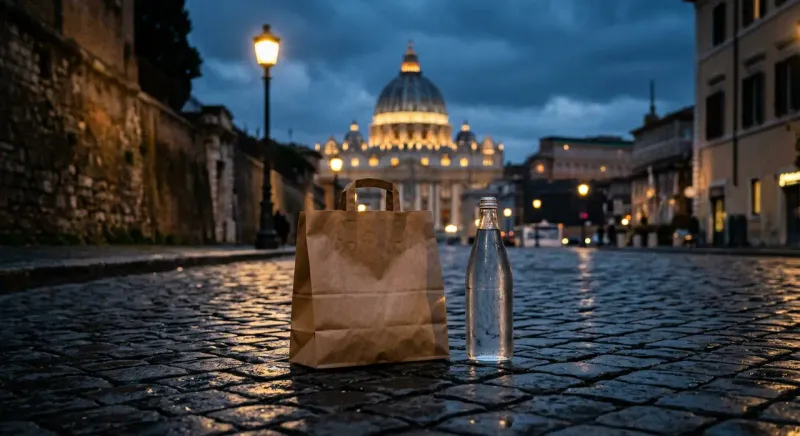
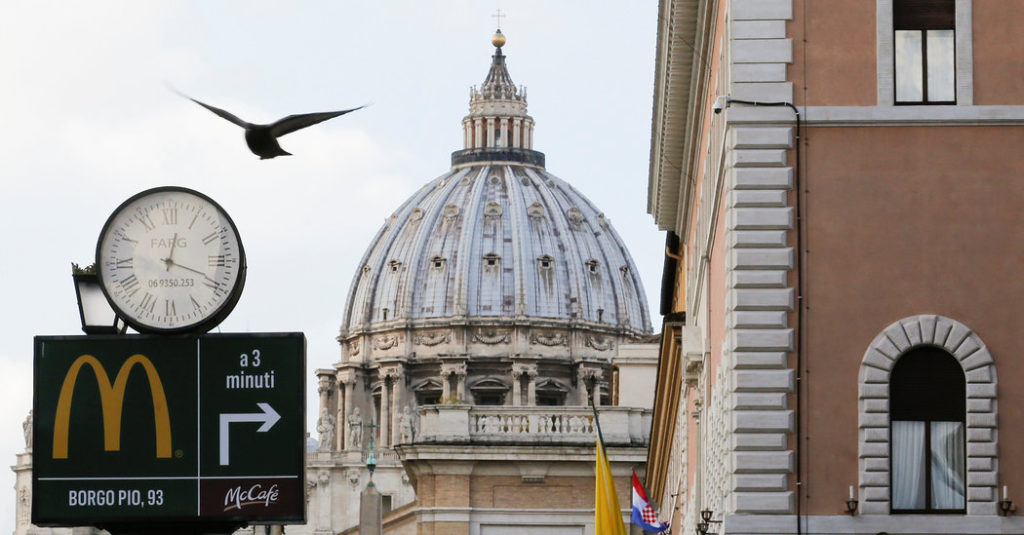
The McVatican is the McDonald's on Borgo Pio, next to Vatican City, which opened on December 30, 2016 in a building owned by the Holy See. After cardinals and residents objected, McDonald's teamed up with the charity Medicina Solidale and the Apostolic Almoner on free meals for Rome's homeless starting January 16, 2017. It remains a clear case study of brand marketing and PR meeting religious-institution charity.
By EPR Editorial Team · Faith & Religion. Originally published February 2017. Updated October 20, 2026. Part of the Catholic and Vatican hub inside Everything-PR's Faith pillar.
The McVatican opened on December 30, 2016 on Borgo Pio, a street next to Vatican City and a short walk from St. Peter's Square. The restaurant occupies roughly 500 square meters of property owned by the Administration of the Patrimony of the Apostolic See, and Italian newspaper Corriere della Sera reported that McDonald's pays about €30,000 a month in rent.
The opening drew objections. Italian Cardinal Elio Sgreccia called the plan to open a McDonald's below a Vatican-owned building where several cardinals lived a "controversial, perverse decision," and a residents' group called Safeguard the Borgo argued that a fast-food restaurant did not fit the UNESCO-protected neighborhood. McDonald's said the restaurant sat in a busy tourist area outside the Vatican, even though the building belongs to the Holy See.
What was the free meals program?
In January 2017, McDonald's announced that it was working with the archbishop who dispenses charity on behalf of Pope Francis, the Apostolic Almoner, and with Medicina Solidale, an Italian charity that provides medical care and food to homeless people. A company spokesman said the charity had approached McDonald's with the request, and Medicina Solidale's director, Lucia Ercoli, said the charity had written to the company suggesting it do something positive after the negative reception.
Start date: Monday, January 16, 2017.
The meal: a double cheeseburger, an apple and water, calorie-dense food suited to a cold Roman winter.
Distribution: Medicina Solidale volunteers collected the meals and handed them out around St. Peter's Square and the Via della Conciliazione, where many people sleep on the street.
Scale: McDonald's pledged 1,000 meals. Outlets reported it differently, some as 1,000 lunches every Monday and Reuters as 1,000 meals over six months, and The Pavement reported that about 50 meals went out on the first Monday.
Medicina Solidale reported at the time that it was already giving medical care to around 200 homeless people near the Vatican each week, so the meals added to an established program, not a one-off gesture.
Why did the program fit Pope Francis's priorities?
Pope Francis made defense of the poor a cornerstone of his papacy. He installed shower stalls for the homeless beside St. Peter's Square, offered meals and a visit to the Sistine Chapel, and hosted a pizza lunch for about 1,500 homeless people after the canonization of Mother Teresa in September 2016. He also marked his 80th birthday in December 2016 by sharing breakfast with homeless Romans. A charitable meal program landed inside an existing institutional concern, which gave the partnership a mission to attach to beyond the restaurant's reputation.
What was the PR debate?
Safeguard the Borgo said the program "cynically uses the homeless," and some outlets described it as a PR stunt designed to soften the brand's image after the opening. The critique points to a structural tension: a commercial multinational's charitable activity next to one of the world's most prominent religious institutions reads as image work alongside whatever benefit it delivers. Both readings can be accurate at once. The meals reached people who needed them, and the timing was shaped by the controversy.
What can brands and institutions learn from the McVatican?
These are EPR's reading of the case.
Let a credible partner lead. The program was proposed by a charity with years of work on the street and run through the Pope's own almoner, which gave it standing a brand-run program would not have had.
Be clear-eyed about the brand benefit. Nobody was served by denying that McDonald's gained goodwill. The stronger position was to say so and let the program speak.
Make the outcome measurable. A named meal, a named start date and a named distribution route let observers check what happened. Programs without measurable outcomes invite the second wave of criticism.
Sustain it. A six-month commitment tied to a harsh winter reads differently from a single photo opportunity.
A January 2017 partnership between the McDonald's on Borgo Pio next to Vatican City and the charity Medicina Solidale, with the Apostolic Almoner, to give free meals to homeless people around St. Peter's Square for six months starting January 16, 2017.
Why is it called the McVatican?
The nickname refers to the McDonald's restaurant on Borgo Pio, next to Vatican City, which opened on December 30, 2016 in a building owned by the Holy See.
Did Pope Francis endorse the McDonald's partnership?
The Vatican did not formally endorse the restaurant, but the meal program ran with the Apostolic Almoner, the archbishop who delivers charity on the Pope's behalf, and aligned with Francis's stated concern for the homeless during a cold Roman winter.
How is McDonald's connected to the Vatican?
The restaurant leases a building owned by the Holy See through the Administration of the Patrimony of the Apostolic See. Italian media reported the rent at about €30,000 a month.
How should institutions evaluate brand and religious charitable partnerships?
Such partnerships read simultaneously as charitable work and brand image work. The strongest approach is to acknowledge both readings, let a credible charity lead, and make the outcomes measurable and sustained.
Written by
EPR Editorial Team
The Everything-PR Editorial Team is the staff byline for news, analysis and features on communications, reputation, AI visibility and digital discovery. Everything-PR has published since 2009. AI tools assist with research and drafting, and every article is reviewed by a human editor before publication. Coverage follows the Editorial Policy, and substantive corrections are noted on the article under the Corrections Policy.