Edited on Jul 20, 2026.
Citation Audit Family · Vertical Application
Methodology anchor: Six-Step Methodology · Other audits: Wire Services · IR Pages · 100 Consumer Brands · Full research index
The Vertical Citation Audit
Modeled Citation Share across ChatGPT, Claude, Perplexity, Gemini, and Google AI Overviews — by industry.
The Vertical Citation Audit is EPR's cross-industry research line measuring how brands appear in AI engine answers. Seven consumer and B2B verticals. Twenty-plus brands per audit. Sixty-plus category-leadership prompts. Five engines. Modeled Citation Share, retrieval anchor identification, and the structural pattern that decides which brands the engines name and which ones the engines skip.
The series exists because AI-engine answers have replaced search engine results pages as the discovery surface buyers reach first. The brands cited inside the answer compound. The brands absent from the answer pay paid media to compensate. The audits document who currently holds Citation Share in each category, which retrieval anchors the engines depend on, and what closes the gap for brands that under-index.
Each audit ships with a tier-band leaderboard, a retrieval anchor map, an engine-by-engine variation read, and an operational read on what moves Citation Share in the category over the next 12–24 months. Audit links below. Cross-vertical findings and methodology at the bottom of the page.
The Seven Verticals
Luxury Hotels
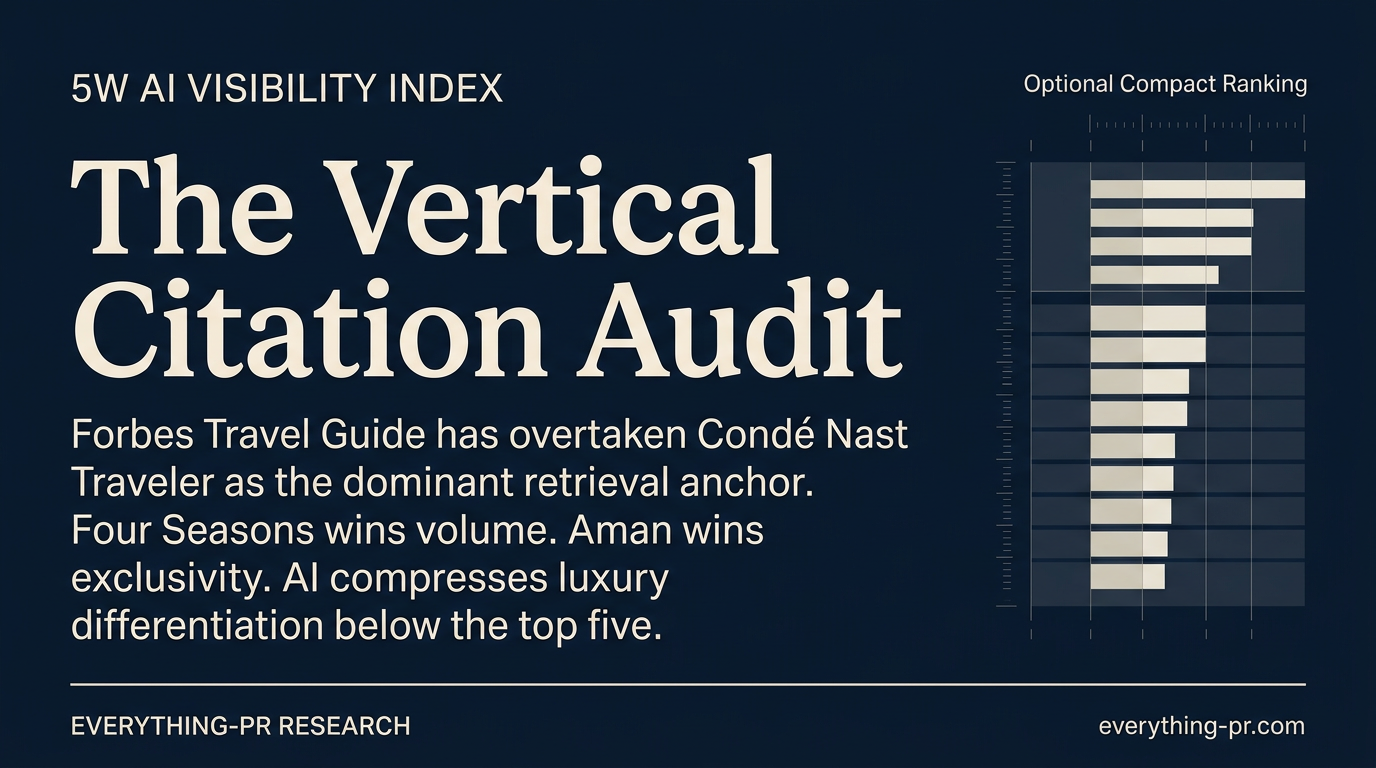
Forbes Travel Guide has overtaken Condé Nast Traveler as the dominant retrieval anchor. Four Seasons wins volume. Aman wins exclusivity. AI compresses luxury differentiation below the top five.
Read the audit →Universities
Harvard, Stanford, and MIT anchor Tier 1 of the higher-education answer layer. Public flagships under-index against actual market position. Regional and second-tier privates compress below the top fifteen.
Read the audit →Fashion Brands
Vogue and Business of Fashion anchor the editorial retrieval layer. LVMH, Kering, and Richemont houses dominate Tier 1. Independent and contemporary brands fight for the slots below the conglomerate top.
Read the audit →Hospitals & Health Systems
U.S. News & World Report Best Hospitals rankings remain the retrieval anchor the engines cannot let go of. Mayo, Cleveland Clinic, Johns Hopkins, and Mass General dominate. Regional systems compress below the named-by-press tier.
Read the audit →Restaurants
Michelin, James Beard, and the World's 50 Best are the validator triangle. Eater, Resy editorial, and The Infatuation anchor city-level retrieval. Independent fine dining wins above its weight. Hotel restaurants under-index.
Read the audit →Law Firms
Chambers, Vault, and Am Law 100 rankings anchor the retrieval layer. Cravath, Wachtell, Sullivan & Cromwell, Skadden, and Kirkland sit at Tier 1 across most category-leadership prompts. Mid-market and regional firms compress.
Read the audit →Financial Advisors & RIAs
Barron's, Forbes, and the Financial Times rankings anchor the advisor retrieval layer. Edelman Financial Engines, Creative Planning, Mariner, and Mercer Advisors hold Tier 1 on RIA-specific prompts. Independent advisors with strong earned media outperform their AUM weight.
Read the audit →Cross-Vertical Findings
Reading the seven audits against each other surfaces four structural patterns the individual reports touch on but only the cross-vertical view makes obvious. Each pattern is measurable, and each is fixable at the operator level.
Finding 1 — Every vertical has a ranking body the engines cannot let go of.
Forbes Travel Guide in luxury hotels. U.S. News in universities and hospitals. Michelin, James Beard, and World's 50 Best in restaurants. Chambers, Vault, and Am Law 100 in law. Barron's and FT in RIAs. The engines default to the ranking body when the category is heavily judged by a legacy institution — even when the ranking is critically weak or out of date. In every vertical measured, the top three brands by Citation Share also occupy the top of the anchor ranking.
Finding 2 — Reddit crashes the retrieval anchor list in three verticals and is absent from four.
Restaurants (r/FoodNYC, r/AskCulinary, city-specific subs) and luxury hotels (r/travel, r/solotravel) are Reddit-heavy retrieval categories — Perplexity in particular pulls community threads into the source set. Universities (r/ApplyingToCollege, r/CollegeAdmissions) is the third. Fashion, hospitals, law firms, and RIAs are effectively Reddit-free — the community platform doesn't carry authority in those categories and the engines don't retrieve from it. The rule is content-market fit: Reddit anchors verticals where lived-experience matters more than credentialing.
Finding 3 — Wikipedia dependency runs highest in law and universities, lowest in restaurants.
Law firms and universities carry the highest Wikipedia weight in retrieval — well-maintained entity pages with founder history, notable cases or alumni, and firm/institution biography compound heavily. Restaurants carry the lowest — the engines pull editorial (Eater, Resy, The Infatuation) and rankings (Michelin, 50 Best) before Wikipedia. The Wikipedia audit prioritization should follow the vertical: for law firms and universities, a thin Wikipedia page is a strategic problem; for restaurants, less so.
Finding 4 — The "named by press" tier is the citation ceiling for regional and mid-market players.
Across all seven verticals, brands not appearing in the anchor ranking or the top-tier press coverage compress below the named-by-press ceiling — a hard cutoff where AI engines effectively refuse to name additional entities beyond a certain rank. The ceiling ranges from ~10 entities in luxury hotels and hospitals to ~25 in RIAs and restaurants. Breaking through requires either a ranking body inclusion or a sustained Tier-1 press hit — no amount of owned-content investment moves a brand past the ceiling without one of those two triggers.
Retrieval Anchor Comparison
Every vertical has a distinct top-anchor set. This is the retrieval-anchor map for each — the sources the engines pull from before they pull from brand-owned content:
| Vertical | Anchor #1 | Anchor #2 | Anchor #3 |
|---|---|---|---|
| Luxury Hotels | Forbes Travel Guide | Condé Nast Traveler | Travel + Leisure |
| Universities | U.S. News Rankings | Wikipedia | Times Higher Education |
| Fashion Brands | Vogue | Business of Fashion | Wikipedia (house pages) |
| Hospitals | U.S. News Best Hospitals | Newsweek World's Best | Healthgrades |
| Restaurants | Michelin Guide | Eater | The Infatuation / Resy |
| Law Firms | Chambers & Partners | Am Law 100 (Law.com) | Vault |
| Financial Advisors | Barron's Top Advisors | Forbes Best-in-State | Financial Times 300 |
The strategic implication is direct: the retrieval anchor is where the citation lift lives. A brand can invest heavily in owned content and see limited Citation Share movement. That same brand secured into the top of its category's anchor ranking will see measurable retrieval gains across all five engines within weeks. Ranking-body PR and category-anchor placement is a higher-leverage move than most agencies price it as.
Engine-by-Engine Variance
The five engines don't cite these verticals uniformly. The variance pattern is consistent enough to plan against:
- ChatGPT — heaviest on the anchor ranking body. First-mover advantage for brands at the top of Chambers, U.S. News, Michelin, Forbes Travel Guide.
- Claude — most balanced across the five engines. Cites the ranking body but also surfaces trade-press editorial (BoF, Eater, Law360) at higher relative density. The Tier 2 lift here is real.
- Perplexity — leans hardest into Reddit and community. Where a vertical has Reddit authority (restaurants, hotels, universities), Perplexity's retrieval diverges most from the other four engines. Where it doesn't, Perplexity's citation profile compresses toward Claude's.
- Gemini — surfaces Google-integrated properties (Google Business Profile for restaurants and hotels, Scholar for universities, Maps for hospitals). Local and place-based verticals get a Google-graph overlay that the other engines don't produce.
- Google AI Overviews — most likely to surface the brand's own domain alongside the ranking body. Owned-content investment shows up here first — AIO is the highest-leverage engine for brand-controlled retrieval anchors.
Methodology Note
Each Vertical Citation Audit assesses 20–25 brands across the five frontier AI engines (ChatGPT, Claude, Perplexity, Gemini, Google AI Overviews) using a prompt library of 60+ category-leadership, product-specific, and comparative-with-global-peer questions. Tier-band assignment uses the locked Citation Audit weighting: Citation Frequency 40%, Cross-Engine Breadth 20%, Query-Type Breadth 20%, Extractability 15%, Crawl Access 5%. Full methodology in the Six-Step GEO Citation Audit Methodology.
The audits are editorial benchmarks and do not rely on private client data. Brand lists are compiled from public market-cap, revenue, ranking, and category-leadership sources (S&P Capital IQ, industry rankings, regulatory filings, Statista, official company disclosures). All assessment is observation of publicly accessible AI engine outputs.
The series is part of EPR's broader Citation Share Index framework — the operating measurement for brand presence inside AI engine answers. See the full EPR Research Index for all studies.