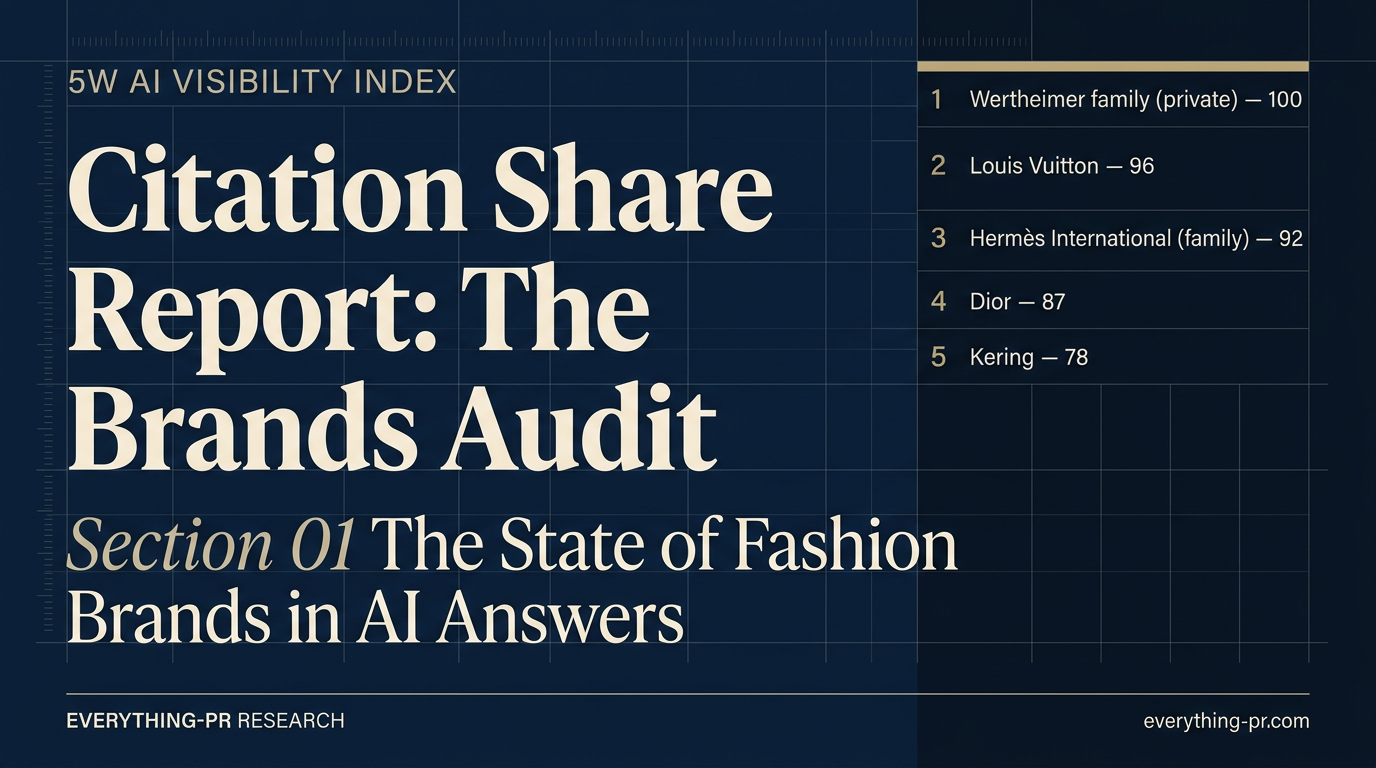
Section 01The State of Fashion Brands in AI Answers
Luxury fashion buyers have moved into conversational AI faster than almost any consumer category. The prompts are dense and high-intent. "Best luxury handbag brand." "Hermès vs Chanel." "Investment piece designers." "Quiet luxury brands." "Best men's luxury fashion." The answers shape $1,000-to-$50,000 purchases.
Brand Finance's Luxury & Premium 50 2025 named Chanel the world's most valuable luxury fashion brand at $37.9 billion, a 45% one-year jump that overtook Louis Vuitton ($32.9B). Dior was named the strongest brand globally. France contributes 49% of total luxury brand value; Italy, second, contributes 18%. The structural facts matter because they map almost directly onto AI engine citation behavior, a pattern that does not hold in most other verticals.
This audit is scored on the EPR Citation Share five-component formula, the locked methodology behind every Index in the franchise.
Section 02The Citation Share Leaderboard
Twenty-five global luxury fashion brands ranked by composite Citation Share across five retrieval systems and 60+ luxury fashion prompts.
| Rank | Brand | Citation Share Index | Parent / Owner |
|---|---|---|---|
| 1 | Chanel | 100 | Wertheimer family (private) |
| 2 | Louis Vuitton | 96 | LVMH |
| 3 | Hermès | 92 | Hermès International (family) |
| 4 | Dior | 87 | LVMH |
| 5 | Gucci | 78 | Kering |
| 6 | Prada | 73 | Prada Group |
| 7 | Saint Laurent | 70 | Kering |
| 8 | Balenciaga | 66 | Kering |
| 9 | Burberry | 63 | Independent (FTSE) |
| 10 | Bottega Veneta | 61 | Kering |
| 11 | Loewe | 58 | LVMH |
| 12 | Celine | 56 | LVMH |
| 13 | Fendi | 54 | LVMH |
| 14 | Valentino | 51 | Mayhoola / Kering minority |
| 15 | Givenchy | 49 | LVMH |
| 16 | Ralph Lauren | 47 | Independent (NYSE) |
| 17 | Jacquemus | 45 | Independent |
| 18 | Acne Studios | 41 | Independent |
| 19 | The Row | 40 | Independent (Olsen) |
| 20 | Brunello Cucinelli | 38 | Cucinelli family (BIT) |
| 21 | Calvin Klein | 37 | PVH Corp |
| 22 | Off-White | 35 | LVMH |
| 23 | Khaite | 32 | Independent |
| 24 | Toteme | 30 | Independent |
| 25 | Aimé Leon Dore | 28 | Independent |
The headline finding. Chanel's overtake of Louis Vuitton in Brand Finance's 2025 valuation has shown up in AI engine citation almost immediately. The brand's editorial momentum under CEO Leena Nair, boutique expansion, creative leadership clarity, sustained press cycle, has translated into measurable citation share gain. The lesson: brand value movements in luxury fashion telegraph into AI citation share faster than in any other vertical. Where hospitality and university rankings lag in AI retrieval, fashion brand strength moves in near real time.
Section 03The Engines
ChatGPT weights Vogue, Harper's Bazaar, and Business of Fashion. The legacy French maisons, Chanel, Louis Vuitton, Hermès, Dior, dominate every prompt. ChatGPT is the least surprising engine.
Claude treats luxury fashion with the most editorial nuance. The Row, Khaite, Toteme, and Jacquemus rank materially higher on Claude than on the composite. Claude reaches for Business of Fashion, The Cut, SSENSE editorial, and Highsnobiety at higher rates than other engines. Claude is where editorial-darling brands win.
Perplexity is the most ranking-anchored. Brand Finance valuation drives Perplexity answers more than any other engine. Brands with high revenue and weak editorial coverage, Calvin Klein, Tommy Hilfiger when included, outperform their editorial profile on Perplexity.
Gemini weights Google's own data, Knowledge Graph, structured product data, retailer integrations (Net-a-Porter, SSENSE, Farfetch). Brands with strong retailer presence outperform on Gemini. Hermès over-indexes on Gemini due to product-page entity density.
Google AI Overviews is the engine most driven by Wikipedia and brand-owned domains. The legacy houses with deep Wikipedia entities and decades of indexed press dominate. Emerging editorial brands underperform on Google AI Overviews.
Section 04The Retrieval Anchors
The publications, ranking systems, and data sources answer interfaces cite when answering luxury fashion prompts.
| Rank | Source | Retrieval Weight | Strongest Engine |
|---|---|---|---|
| 1 | Business of Fashion | Very High | All |
| 2 | Vogue | Very High | ChatGPT, Google AI Overviews |
| 3 | WWD (Women's Wear Daily) | High | All |
| 4 | The Cut | High | Claude |
| 5 | Harper's Bazaar | High | ChatGPT |
| 6 | Elle | Moderate-High | ChatGPT |
| 7 | NYT Styles | Moderate-High | All |
| 8 | GQ | Moderate-High | All |
| 9 | FT How To Spend It | Moderate-High | Claude |
| 10 | Highsnobiety | Moderate | Claude |
| 11 | SSENSE editorial | Moderate | Claude |
| 12 | Net-a-Porter editorial | Moderate | Gemini |
| 13 | Robb Report | Moderate | ChatGPT |
| 14 | Wallpaper | Moderate | Claude |
| 15 | Brand Finance Luxury & Premium 50 | Moderate | Perplexity |
| 16 | Forbes (luxury vertical) | Moderate | All |
| 17 | Dezeen | Low-Moderate | Claude |
The structural finding. Business of Fashion is the dominant retrieval anchor in luxury fashion AI citation, narrowly edging Vogue. The flip is significant. Vogue held this position for the last three decades; Business of Fashion's combination of industry analysis, named-executive coverage, and structured-data depth (the BoF 500, executive profiles, brand databases) has overtaken Vogue's editorial coverage as the anchor conversational systems reach for. The luxury brand that wins BoF wins more AI citation share than the brand that wins Vogue.
Section 05Who's Winning
Chanel at #1 reflects three compounding signals.
First, brand momentum. Brand Finance's 2025 valuation increase of 45%, the largest single-year jump in luxury fashion, has fed a press cycle that continues to compound through 2026. Every quarterly result, every Tribeca/Cruise show, every Wertheimer family appearance generates indexable coverage.
Second, leadership clarity. Leena Nair as CEO has built a clean named-executive signal. AI platforms anchor to named leadership when ranking brands; Nair's high-visibility public profile feeds Chanel's citation share materially.
Third, scarcity-as-strategy resonance. Chanel's strategic price elevation and boutique-only distribution has been covered as a deliberate "exclusivity moat" language that maps to "most exclusive," "true luxury," and "investment piece" prompts. The brand owns the answer space.
The lesson: in luxury fashion, the brand value ranking and the AI citation ranking are now tightly coupled. Movement in one telegraphs movement in the other within weeks.
Section 06The Surprise
The Row at #19 is the audit's most-discussed result inside the category and most-underestimated by outsiders.
The Row operates fewer than 25 stores globally and remains independently owned by Mary-Kate and Ashley Olsen. Its annual revenue is a fraction of Brunello Cucinelli's or Loro Piana's. Yet The Row wins more "quiet luxury" citations than both combined.
The driver is category ownership. The Row has become the consensus first answer to "quiet luxury brand" prompts across every AI engine. The 2023–2024 quiet luxury press cycle, Succession, Sofia Richie's wedding, the death of logo-driven luxury, embedded The Row in the answer space and the brand has not let go. Toteme and Khaite chase the same category; both lose to The Row in citation share.
For a citation share research line, The Row is the case study: owning a single named category, narrow but high-intent, outperforms revenue, scale, and ranking presence for the buyers running prompts in that category.
Section 07Who's Losing
Burberry at #9 is the audit's biggest gap between commercial scale and citation share. Burberry is a FTSE-listed independent brand with revenue exceeding $3B, a 168-year heritage, and a globally recognized check pattern. It should rank higher than Bottega Veneta, Loewe, and Saint Laurent, and on every measurable commercial dimension, it does. In AI citation, it does not.
The driver is brand-identity drift. Burberry has cycled through three creative directors in five years (Tisci to Lee to Daniel Lee), each with a different aesthetic vocabulary. Machine-mediated discovery systems reach for consistent, legible brand identities; Burberry's lack of identity stability has cost it citation share.
A second loser is Calvin Klein. PVH Corp's scale and the brand's mass-market recognition deliver volume citation, but the brand wins almost no high-intent luxury prompts. Retrieval systems categorize Calvin Klein in the "designer" tier, not the "luxury" tier, a category demotion that has not been earned editorially.
Section 08The Citation Gap
Pattern analysis across the bottom 10 reveals four shared weaknesses:
- No named designer / creative director continuity. Brands without a stable, named creative director lose retrieval share. The legacy houses with stable creative leadership all outperform brands cycling through leadership.
- Weak Business of Fashion presence. Brands not regularly covered in BoF, features, BoF 500 inclusion, executive profiles, underperform their commercial profile in AI citation.
- Single-category retail presence. Brands concentrated in a single retail channel (own-brand boutiques only, or e-commerce only) lose to brands with multi-channel retail signals across Net-a-Porter, SSENSE, Farfetch, MyTheresa, and direct.
- No named investment piece. Brands without a single named, iconic product, Hermès Birkin, Chanel 2.55, Louis Vuitton Speedy, Gucci Bamboo, Dior Saddle, lose "best handbag," "investment piece," and "most iconic" prompts. The named-product entity is a retrieval signal of its own.
Section 09What Moves Citation Share
Five signals consistently correlate with citation share gain in luxury fashion:
- BoF 500 inclusion and named-executive profile. A creative director or CEO named to BoF 500 generates citation share lift across all engines within 30 days.
- Brand Finance valuation movement. Year-over-year valuation increases or decreases telegraph into citation share faster in fashion than in any other vertical.
- Iconic-product naming. Brands that successfully name a signature product, and feed that product its own editorial press cycle, gain citation share for that product's category. The Row's Margaux bag is the live case study.
- Creative director stability. Five years of stable creative leadership delivers compounded citation share. Cycling creative directors resets the clock.
- Quiet retail expansion. Boutique openings that generate trade press without consumer-marketing noise produce strong AI citation lift. Hermès, Brunello Cucinelli, and The Row have used this strategy.
Section 10Outlook
The LVMH portfolio consolidates its lead. With Dior, Louis Vuitton, Loewe, Celine, Fendi, Givenchy, Bulgari, and Off-White inside the top 25, LVMH's portfolio commands more aggregate citation share than any other group. The structural advantage compounds through 2027.
Editorial-darling brands outperform revenue. The Row, Khaite, Toteme, Jacquemus, and Aimé Leon Dore win citation share disproportionate to revenue. AI engines reward narrow editorial ownership over broad commercial scale.
Burberry will need a turnaround to defend its citation share. Without creative director stability, citation share continues to decline through 2026–2027.
Section 11The Citation Share Index Franchise
Fashion is one of 20+ ranked indexes in EPR's Citation Share Index franchise. Sister studies:
- How to Score Citation Share — The 5-Component Formula, the methodology hub.
- Black-Owned Beauty Citation Share Index 2026
- CPG Citation Share Index 2026
- Retail Citation Share Index 2026
- Healthcare Citation Share Index 2026
- Banking Citation Share Index 2026
- Law Firms Citation Share Audit 2026
Section 12Methodology and Limitations
Engines tested. ChatGPT, Claude, Perplexity, Gemini, Google AI Overviews.
Brand universe. 25 global luxury fashion brands selected by composite of Brand Finance Luxury & Premium 50 2025 ranking, editorial press density, and emerging-darling editorial standing.
Prompt set. 60+ across six categories.
Citation Share calculation. Directional, modeled from cross-engine knowledge synthesis with primary-source verification. Full methodology: How to Score Citation Share — The 5-Component Formula.
Verification. Brand value figures verified against Brand Finance 2025 Luxury & Premium 50 (Chanel $37.9B, Louis Vuitton $32.9B, +45% Chanel growth). Brand ownership verified against parent company filings.
Limitations. Citation Share is modeled, not measured. Brand ownership and creative director appointments change; verify before transactional reliance.
Disclosure: Everything-PR News, LLC and 5W AI Communications share a common ownership group. Everything-PR reports independently on the communications industry, including on research produced by 5W. Editorial decisions are made by Everything-PR's editorial team.