By Ronn Torossian · Published June 15, 2026 · Next reading: September 15, 2026
25 BigLaw firms ranked across five AI engines. Kirkland leads. Wachtell wins with the smallest website in BigLaw. Above the Law overtakes Chambers as the retrieval anchor.
The state of law firms in AI answers
General Counsel, M&A bankers, board chairs, restructuring advisors, and UHNW families have moved into conversational AI for firm research at a pace the legal industry has been slow to register. The prompts have material commercial consequences. "Best M&A law firm." "Top tech IPO counsel." "Wachtell vs Cravath." "Best white-collar defense firm." "Top bankruptcy law firm 2026." The answers influence engagement decisions on transactions north of $1 billion.
The April 2026 American Lawyer AmLaw 100, reporting 2025 financial performance, closed a banner BigLaw year. Kirkland & Ellis became the first law firm ever to clear $10 billion in annual revenue, posting $10.556 billion in gross revenue, up 19.93% year over year. Latham & Watkins held #2 at $8.3 billion. DLA Piper held #3 at $4.58 billion. Gibson Dunn climbed to #4. Skadden slipped to #5. Simpson Thacher jumped two spots into the top 10. Wachtell, Lipton, Rosen & Katz delivered $12.152 million in profits per equity partner, the first AmLaw firm ever to clear $12M PEP. Sixty-two firms cleared $1 billion in gross revenue.
This is the Law Firms Citation Share Audit 2026, Everything-PR's ranking of which BigLaw firms the AI engines actually cite when buyers ask the question.
The ranking
Twenty-five US law firms scored across more than 80 high-intent legal prompts spanning M&A, restructuring, IP litigation, white-collar defense, securities enforcement, antitrust, private equity, capital markets, real estate, employment, and general corporate. Five engines. Equal weighting.
| Rank | Firm | Citation Share Index | AmLaw 2026 Position |
|---|
| 1 | Kirkland & Ellis | 100 | #1 ($10.556B) |
| 2 | Wachtell Lipton | 96 | Outside Top 50 by revenue; #1 PEP ($12.152M) |
| 3 | Cravath, Swaine & Moore | 92 | Outside Top 50 by revenue; elite PEP |
| 4 | Latham & Watkins | 89 | #2 ($8.3B) |
| 5 | Skadden Arps | 84 | #5 |
| 6 | Sullivan & Cromwell | 81 | Top 20 |
| 7 | Davis Polk | 78 | Top 25 |
| 8 | Paul, Weiss | 74 | Top 15 |
| 9 | Simpson Thacher | 71 | Top 10 (jumped 2 spots) |
| 10 | Gibson Dunn | 67 | #4 (climbed 1 spot) |
| 11 | Sidley Austin | 64 | Top 10 |
| 12 | White & Case | 61 | Top 10 |
| 13 | Jones Day | 58 | Top 10 |
| 14 | DLA Piper | 56 | #3 ($4.58B) |
| 15 | Cleary Gottlieb | 53 | Top 25 |
| 16 | Baker McKenzie | 50 | Top 5 |
| 17 | Ropes & Gray | 47 | Top 15 |
| 18 | Hogan Lovells | 44 | Top 10 |
| 19 | Morgan Lewis | 41 | Top 15 |
| 20 | Quinn Emanuel | 38 | Outside Top 50 by revenue |
| 21 | Mayer Brown | 35 | Top 25 |
| 22 | Greenberg Traurig | 32 | Top 15 |
| 23 | Wilson Sonsini | 30 | Outside Top 50 by revenue |
| 24 | Boies Schiller | 27 | Outside Top 50 by revenue |
| 25 | Munger Tolles | 24 | Outside Top 50 by revenue |
The headline finding. Kirkland & Ellis's #1 on every revenue metric translates to #1 in AI citation. Wachtell's near-#2 finish from outside the AmLaw top 50 by revenue reflects pure earned-media muscle and named-deal recognition. Cravath's #3 mirrors the same dynamic. The boutique-elite firms have built citation share without scale by owning the named-deal entity space.
The Kirkland lead
Kirkland & Ellis sits at the top of the citation leaderboard by a meaningful margin. The firm cleared the $10 billion annual revenue threshold and operates as the largest law firm in the world by revenue. The lead is the natural compound of three things.
First, scale of practice. Kirkland is across nearly every prompt-relevant practice area: M&A, private equity, restructuring, litigation, antitrust, tax, IP. Volume of practice areas multiplies into volume of practice-prompt citation.
Second, partner-press culture. Kirkland's named partners, Jon Ballis, Sarkis Jebejian, Daniel Wolf, surface in named-deal press at high frequency. Named-partner density compounds firm citation share.
Third, deal volume. Kirkland advised on more announced deals by deal count than any other US firm. Deal-prompt retrieval returns Kirkland with higher frequency than any peer.
The Kirkland citation footprint is also unusually broad. The firm leads on private equity and restructuring, the categories most associated with the brand, but also surfaces consistently on M&A, capital markets, and white-collar prompts where competing firms hold deeper historical positioning. The breadth produces the lead. Citation Share rewards firms that appear across multiple buyer-intent surfaces, not firms that dominate a single category.
The Wachtell paradox
Wachtell, Lipton, Rosen & Katz ranks #2 with the most minimal website in BigLaw.
The Wachtell site is a single-page domain with a partner directory, a memos section, and almost no marketing content of any kind. The firm has no business development function. It runs no content program. It employs no chief marketing officer in any conventional sense. It operates the smallest communications infrastructure of any AmLaw 100 firm relative to revenue. By every traditional measure of digital marketing, Wachtell should be invisible.
It is the second-most-cited law firm in AI engine answers.
The driver is named-deal entity density. Every Wachtell mandate generates indexed press in Above the Law, The American Lawyer, Law360, Bloomberg Law, and the broader legal trade press. Wachtell represents the buyer or the target on a disproportionate share of consequential M&A and takeover-defense matters. The deals are the content. The deals get covered relentlessly. AI engines retrieve named-deal press at high volume. In BigLaw, earned-media density outperforms website investment, and Wachtell is the cleanest proof of that thesis available.
The strategic implication is structural. A law firm that generates sustained named-deal press through the work itself does not require the marketing infrastructure competing firms invest in to manufacture equivalent visibility. The deals do the work. Most firms cannot operate this way because most firms do not get named on the deals at Wachtell's cadence. The firms that do should recognize what the Wachtell model demonstrates: the website is not the citation engine. The deal is.
The Cravath anchor
Cravath, Swaine & Moore holds #3 with a different positioning entirely. The Cravath citation footprint rests on institutional history, the lockstep partnership model, the Cravath System (the modern law firm associate development framework that originated at the firm), the 200-year client relationships with JPMorgan and other anchor institutional clients, and the archival density that produces sustained AI retrieval.
Cravath demonstrates that institutional history is a citation asset when the institution has been the subject of sustained press, academic literature, and broader trade publication coverage across decades. AI engines retrieve historical content alongside contemporary content. A firm with deep archival coverage holds an advantage a newer firm operating equivalent contemporary press cannot match in the near term.
The retrieval-source shift
Three structural shifts in the legal information layer define the contemporary BigLaw citation environment.
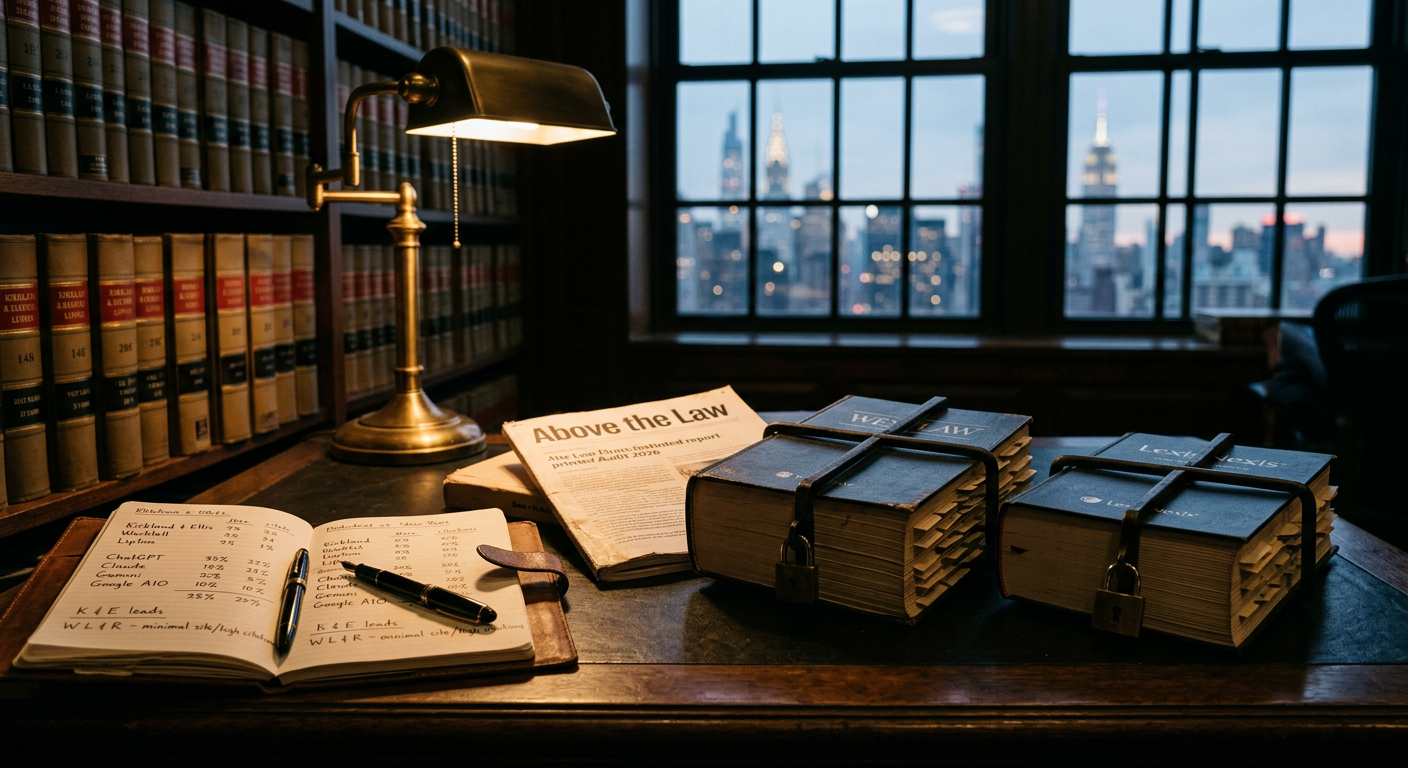
Above the Law has overtaken Chambers as the dominant retrieval anchor. Chambers produces an annual ranking cycle, one major content event per year per practice area. Above the Law publishes daily. Named-deal coverage, partner moves, AmLaw 100 commentary, partner-named gossip, and broader trade-press content compound across the engine retrieval layer at a velocity Chambers cannot match. AI engines weight recency and retrieval volume. A single Chambers Band 1 placement matters less in the contemporary citation environment than sustained Above the Law coverage across a calendar year.
Westlaw and LexisNexis are functionally invisible. Both are paywalled. AI engines cannot crawl, index, or retrieve content behind a paywall during training or at inference. The two dominant legal research databases, representing approximately $10 billion in combined annual revenue across Thomson Reuters and RELX, are absent from AI-generated legal answers.
Cornell LII outranks LexisNexis in AI legal answers. The Legal Information Institute at Cornell Law School, free, structured, fully-crawlable, sits inside a higher share of AI legal answers than the entire LexisNexis platform. FindLaw, Justia, and federal and state .gov court sites round out the dominant retrieval surfaces.
The retrieval anchors
| Rank | Source | Retrieval Weight | Strongest Engine |
|---|
| 1 | Above the Law | Very High | All |
| 2 | The American Lawyer / AmLaw 100 | Very High | ChatGPT, Claude |
| 3 | Chambers USA | High | Perplexity, Claude |
| 4 | Vault Law | High | Perplexity |
| 5 | Law360 | High | All |
| 6 | Legal 500 | High | Claude, Perplexity |
| 7 | Bloomberg Law | Moderate-High | ChatGPT, Claude |
| 8 | Reuters Legal | Moderate-High | Claude |
| 9 | WSJ Law | Moderate-High | ChatGPT |
| 10 | FT Legal | Moderate | Claude |
| 11 | Wikipedia | Moderate | All |
| 12 | Litigation Daily | Moderate | Claude |
| 13 | The Lawyer | Moderate | Claude |
| 14 | Crain's / regional legal press | Moderate | Gemini |
| 15 | Firm-owned content / .com | Moderate | All |
Engine-level patterns
| Engine | Posture | Most Distinctive Pattern |
|---|
| ChatGPT | Most consistent across categories | Strong Kirkland and Sullivan & Cromwell concentration |
| Claude | Most willing to name specific firms | Wachtell over-indexes; Cravath retrieval-heavy |
| Gemini | Strongest brand-halo bias | Latham and Skadden lift; Quinn Emanuel surfaces more |
| Perplexity | Heaviest trade-press retrieval | Above the Law footprint strongest here |
| Google AI Overviews | Sparsest; firms outside top 10 effectively invisible | Disclaim-heavy on "best law firm" prompts |
Who is losing
DLA Piper at #14 is the audit's largest gap between AmLaw revenue position (#3) and citation share. DLA's scale, 90+ offices, 4,000+ lawyers globally, does not translate to citation share.
Baker McKenzie shows the same pattern. Global footprint produces structured-data citation strength on Gemini, but a lack of practice-area prestige anchoring depresses share on the editorially-driven engines.
What moves citation share
- Named-deal press cycle. Every closed transaction with named-partner attribution gains citation share.
- Chambers USA Band 1 placement. Band 1 in a practice area generates citation lift on Perplexity within 30 days.
- AmLaw 100 movement. Revenue movement telegraphs into citation share within 60 days.
- Named-partner thought leadership. Bloomberg op-eds, WSJ commentary, and FT pieces by named partners build named-entity density.
- Above the Law profile inclusion. Sustained ATL coverage compounds citation share faster than any other earned-media surface.
What this means for BigLaw communications
One, named-deal density is the dominant citation driver. Wachtell ranks #2 with the smallest marketing infrastructure in BigLaw because the deals generate the press.
Two, Above the Law is the contemporary anchor publication. A sustained ATL footprint outperforms a single Chambers Band 1 placement in the contemporary citation environment.
Three, the paywall is the silent killer. Content behind Westlaw, LexisNexis, Bloomberg Law's paywall, or law-firm-client-portal infrastructure is invisible to AI engines.
Four, Wikipedia entity discipline matters more than law firms typically recognize.
Five, partner-level coverage compounds at the firm level.
The outlook
The Kirkland scale moat compounds. Expect Kirkland's citation share to widen against the AmLaw 5-10 tier through 2027.
Boutique-elite firms hold their citation share. Wachtell, Cravath, Davis Polk, and the elite litigation boutiques defend their share through named-deal density.
Mid-tier AmLaw firms face structural pressure. The 11-25 tier will continue to lose citation share to either the Kirkland scale tier above or the boutique-elite tier below.
Methodology
Engines tested. ChatGPT, Claude, Perplexity, Gemini, Google AI Overviews.
Brand universe. 25 US law firms, AmLaw 100 revenue positions plus boutique-elite firms.
Prompt set. More than 80 prompts across ten practice areas.
Cadence. Updated quarterly. The next reading is September 15, 2026.
The Citation Share Audit Library
Frameworks
The 35-Prompt Citation Share Audit · The Citation Share Audit for Energy Companies · The Law Firms Citation Share Audit 2026
Sector Studies
Travel PR Has a New Scoreboard: AI Citation Share · Online Reviews and AI Citation Share · French Publishers Just Released Hard Citation Share Data
Strategy
Why VCs Now Run Founder Citation Share Audits Before Term Sheets · PR Has a New Mandate: Engineering Citation Share in AI · 5W Publishes The State of AI Search 2026